Avoiding ambiguity worksheet for Year 5: Comma check
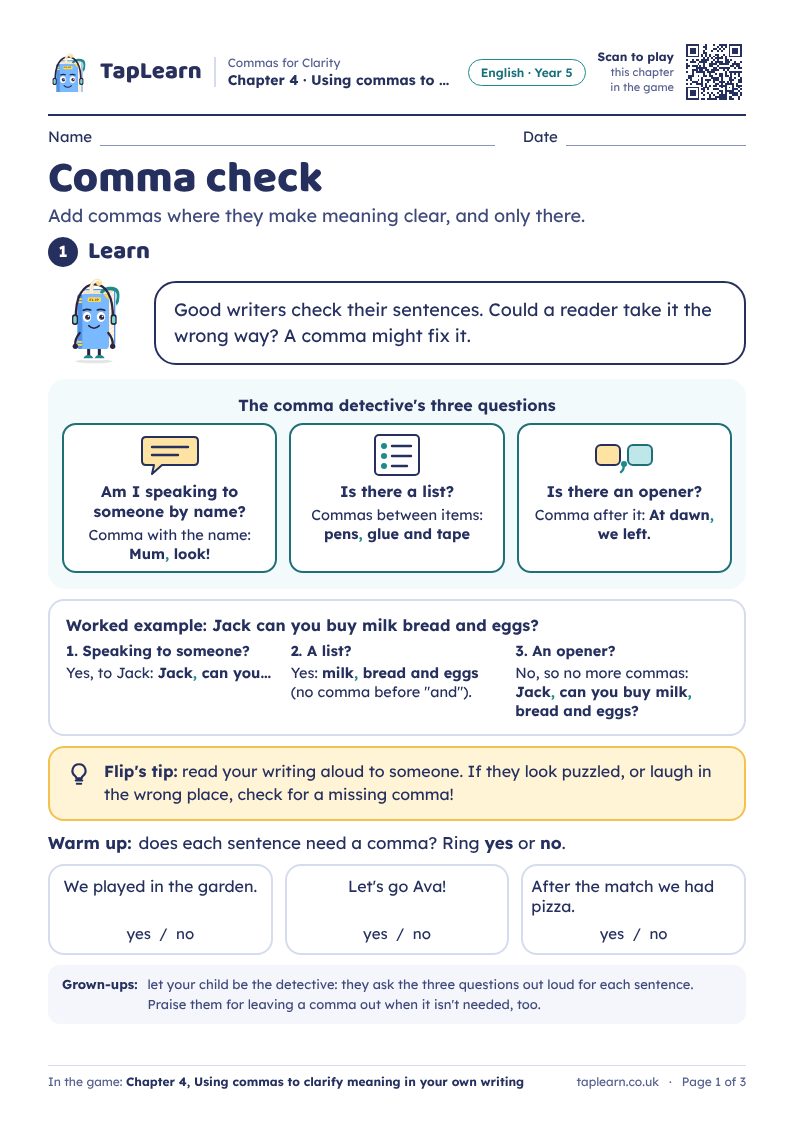
Comma Check is a printable avoiding ambiguity worksheet for Year 5 (ages 9 to 10) that teaches children three detective questions (a name spoken to, a list, an opener) to decide where a comma makes meaning clear, and where it isn't needed. It covers the Year 5 statement on using commas to clarify meaning or avoid ambiguity in writing.
This worksheet is for members
Membership opens every chapter of every game and every worksheet, for all your children.
See the plansAlready a member? Log in to print it.
Start with the free one: One comma, two meanings (chapter 1).
Print it on A4, in colour or black and white. Do it after the chapter, or before it to see what your child already knows.
What's on the worksheet
Your child checks sentences for two meanings, adds commas only where they make the meaning clear, and edits a short diary entry. Includes a secret note activity and an answers sheet.
- Page 1 · Learn
- The comma detective's three questions, a worked example punctuating "Jack can you buy milk bread and eggs?", Flip's read-it-aloud tip, and a yes-or-no warm-up.
- Page 2 · Try it together
- The secret note: the grown-up writes a short note with one comma missing so a sentence means something silly, the child finds it, explains both meanings and fixes it, then swaps.
- Page 3 · Practise
- Decide if sentences could mean two things and fix them, cross out commas that aren't needed, add five commas to Ben's diary, write about a show you love, and a challenge.
- Answers sheet
- Every answer, mix-ups like commas everywhere, and silly-or-sensible and spot-it ideas.
3 A4 pages and an answers sheet · about 25 minutes
Using it at home
- Let your child be the detective, asking the three questions out loud for each sentence. Praise them for leaving a comma out when it isn't needed too.
- In the secret note, if your child can't find it, give a clue: "Look for a name" or "Look for an opener".
- Look for commas on signs and menus when you're out. Is each one needed?
Watch out for
- Not noticing two meanings.
- Read the sentence aloud in two ways, pausing in different places.
- Putting commas everywhere.
- Ask, "Which of the three questions does this comma answer?" If none, take it out.
- Missing a name at the end, like "feed the fish Leo".
- Names spoken to can come at the end too.
Questions from the worksheet
- Could the sentence mean two things? If so, add a comma. If it is already clear, write clear: Let's eat Grandad. Don't forget to feed the fish Leo. We bought apples and pears.
- Too many commas! Cross out every comma that isn't needed: My sister, likes, swimming. After tea, we, played a game.
- Edit Ben's diary. Add the 5 missing commas: "As the curtain rose the audience went quiet. On the stage there was a castle a dragon and a tiny boat…"
- Mia says, "More commas always make writing clearer." She writes: I, love, my, dog. Do you agree with Mia? Why?
The answers are on the answers sheet, for grown-ups.
National curriculum in England
This worksheet practises these statements from the Years 5–6 english programme of study:
- Indicate grammatical and other features by: using commas to clarify meaning or avoid ambiguity in writing
- Punctuation: use of commas to clarify meaning or avoid ambiguity (Year 5 english)
In the classroom
- Use Ben's diary as a whole-class editing task.
- Have pairs write secret notes for each other to fix.
Questions and answers
What does ambiguity mean?
Ambiguity is when a sentence could mean two things. A comma in the right place can make the meaning clear.
How do children decide where to put commas for clarity?
Ask three questions: Am I speaking to someone by name? Is there a list? Is there an opener? If none apply, no comma is needed.
Do more commas make writing clearer?
No. Extra commas chop sentences up. Commas help only where they show which words belong together.
 TapLearn