Commas after openers worksheet for Year 5
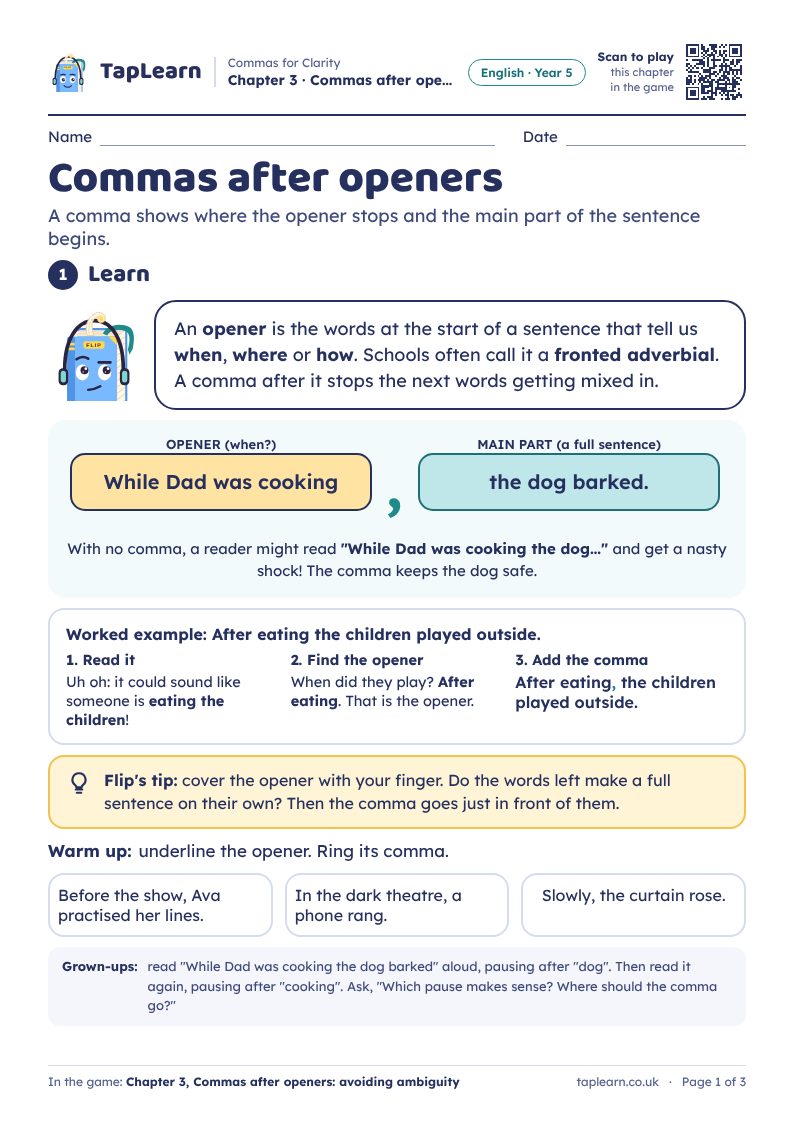
Commas After Openers is a printable commas after openers worksheet for Year 5 (ages 9 to 10) that teaches children to put a comma where the opener stops, so "While Dad was cooking, the dog barked" can't be read the silly way. It covers the Year 5 statement on using commas to clarify meaning or avoid ambiguity in writing.
This worksheet is for members
Membership opens every chapter of every game and every worksheet, for all your children.
See the plansAlready a member? Log in to print it.
Start with the free one: One comma, two meanings (chapter 1).
Print it on A4, in colour or black and white. Do it after the chapter, or before it to see what your child already knows.
What's on the worksheet
Your child puts a comma after an opening phrase or clause, such as a fronted adverbial, so the words after it don't get mixed in. Includes an opener hunt with a story book and an answers sheet.
- Page 1 · Learn
- What an opener is, "While Dad was cooking, the dog barked" explained, a worked example with "After eating, the children played outside", Flip's finger test, and a warm-up.
- Page 2 · Try it together
- Opener hunt: read "While Mum was painting the cat sat still" two ways and pick the sensible one, then hunt a story book for openers with commas and say whether each tells when, where or how.
- Page 3 · Practise
- Add commas after openers, fix sentences that read the silly way, ring the correctly placed comma, finish sentences after an opener, and a challenge about Grandad.
- Answers sheet
- Every answer, mix-ups like a comma after the subject, and opener-ping-pong and pause-spotter ideas.
3 A4 pages and an answers sheet · about 25 minutes
Using it at home
- Read "While Dad was cooking the dog barked" aloud, pausing after dog, then after cooking. Ask, "Which pause makes sense?"
- In the opener hunt, short openers sometimes have no comma. Ask, "Would a comma make it easier to read?"
- Play opener ping-pong: one says an opener ("Late at night…"), the other finishes the sentence.
Watch out for
- Leaving out the comma after the opener.
- Ask, "When, where or how? Where does that bit stop?"
- Putting the comma inside the opener or after the subject.
- Use the finger test: cover the opener; what's left should be a full sentence.
- Being unsure about very short openers, like "Today we…".
- They sometimes have no comma. It's never wrong to add one.
Questions from the worksheet
- Add the comma after each opener: As the lights went down the audience went quiet. Carefully Sam carried the props onto the stage.
- Each sentence can be read the silly way! Add a comma so it means the sensible thing: While Mia was eating the cat jumped onto the table.
- Ring the sentence in each pair with the comma in the right place: When the bell, rang the class lined up. When the bell rang, the class lined up.
- Finish each sentence after the opener: At the end of the show, … Nervously, …
- Leo writes: Every Saturday morning Grandad, takes the dog for a walk. Is the comma in the right place? Explain, and write it correctly.
The answers are on the answers sheet, for grown-ups.
National curriculum in England
This worksheet practises these statements from the Years 5–6 english programme of study:
- Indicate grammatical and other features by: using commas to clarify meaning or avoid ambiguity in writing
- Punctuation: use of commas to clarify meaning or avoid ambiguity (Year 5 english)
In the classroom
- Read silly-way sentences aloud as a starter and let pupils place the comma.
- Use the opener hunt with class reading books in pairs.
Questions and answers
Why do you put a comma after an opener?
The comma shows where the opener stops and the main part begins, so the next words don't get mixed in: "After eating, the children played."
What is an opener in a sentence?
An opener is the words at the start that tell when, where or how. Schools often call it a fronted adverbial.
How do you know where the comma goes?
Cover the opener with your finger. If the words left make a full sentence, the comma goes just in front of them.
 TapLearn