Commas to clarify meaning worksheet for Year 5: One comma, two meanings
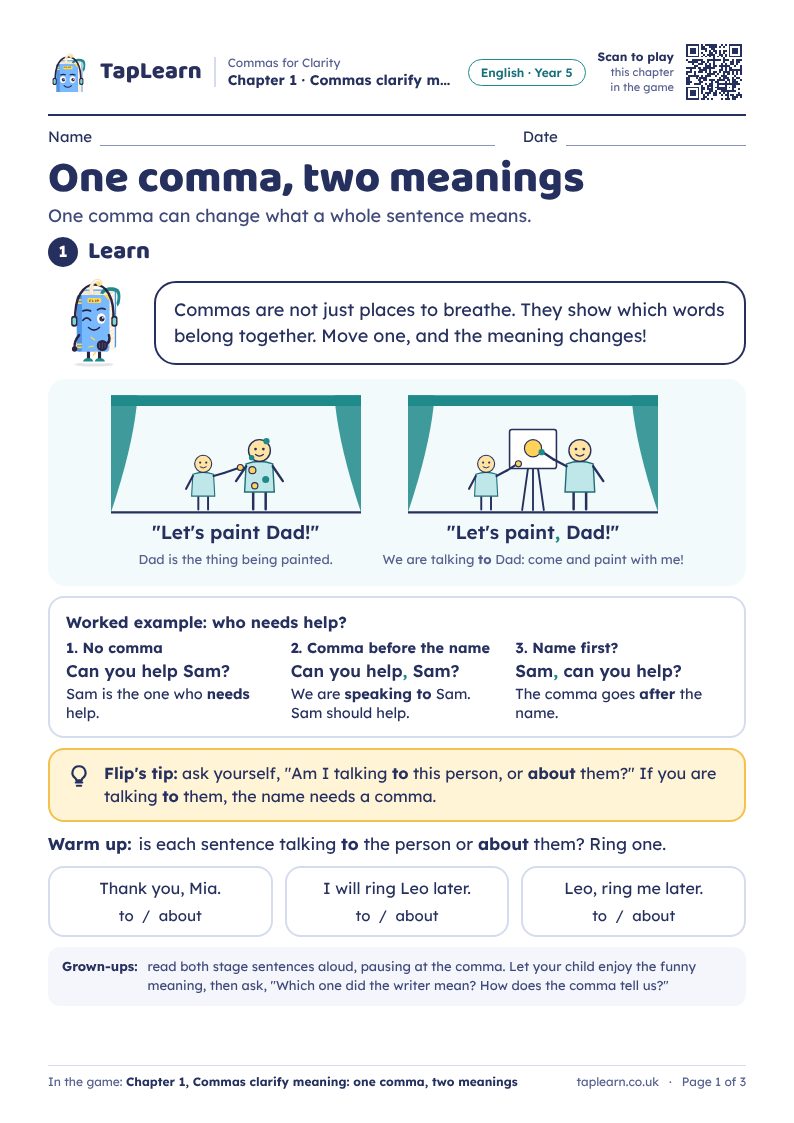
One Comma, Two Meanings is a printable commas to clarify meaning worksheet for Year 5 (ages 9 to 10) that teaches children that a comma shows which words belong together, so "Let's paint Dad!" and "Let's paint, Dad!" mean different things. It covers the Year 5 statement on using commas to clarify meaning or avoid ambiguity in writing.
Free to print, no account needed.
Print it on A4, in colour or black and white. Do it after the chapter, or before it to see what your child already knows.
What's on the worksheet
Your child sees how one comma can change what a sentence means, and uses a comma with the name of the person being spoken to. Includes a comma theatre word-card activity to act out and an answers sheet.
- Page 1 · Learn
- "Let's paint Dad!" and "Let's paint, Dad!" compared, a worked example with "Can you help, Sam?", Flip's talking-to-or-about tip, and a to-or-about warm-up.
- Page 2 · Try it together
- Comma theatre: write each word of "Do you want to draw Leo?" on paper, read and act it out with no comma, then add a pasta comma before the name and act out the new meaning.
- Page 3 · Practise
- Match sentences to meanings, add commas before names spoken to, explain "Stop Jack!" and "Stop, Jack!", write your own pair, and a challenge about breathing commas.
- Answers sheet
- Every answer, mix-ups like commas wherever you pause, and comma-voice and to-or-about ideas.
3 A4 pages and an answers sheet · about 25 minutes
Using it at home
- Read both stage sentences aloud, pausing at the comma. Enjoy the funny meaning, then ask, "Which one did the writer mean? How does the comma tell us?"
- In comma theatre, ask "Who are we talking to?" and "Who is doing the action?" each time, and point to the comma token.
- At tea, notice names: is someone being spoken to, or talked about?
Watch out for
- Leaving out the comma before a name, like "Well done Noah!".
- Ask, "Are we talking to Noah or about him?"
- Putting commas wherever you pause.
- A pause can be a clue, but it isn't the rule: check the meaning.
- Missing the comma when the name comes first.
- The comma comes after it: "Mum, look!"
Questions from the worksheet
- Draw a line from each sentence to what it means: Let's film Tom. Let's film, Tom. Are you ready to eat Max? Are you ready to eat, Max?
- Each sentence speaks to someone. Add the missing comma, or write no comma: Grace please shut the door. Well done Noah! I gave the book to Noah.
- Explain what each sentence means. Who is being told to stop? Stop Jack! Stop, Jack!
- Write your own pair. Use the same words both times, but add a comma before a name in the second one so the meaning changes.
- Leo says, "You put a comma wherever you take a breath." He writes: I want to go, to the park, with Ava. Is Leo right?
The answers are on the answers sheet, for grown-ups.
National curriculum in England
This worksheet practises these statements from the Years 5–6 english programme of study:
- Indicate grammatical and other features by: using commas to clarify meaning or avoid ambiguity in writing
- Punctuation: use of commas to clarify meaning or avoid ambiguity (Year 5 english)
In the classroom
- Act out sentence pairs like "Let's eat Grandma!" as a drama starter.
- Use Practise A as a matching task in pairs.
Questions and answers
How can one comma change the meaning of a sentence?
A comma shows which words belong together. "Let's paint Dad!" means painting Dad; "Let's paint, Dad!" means asking Dad to paint.
When do you put a comma before a name?
When you are speaking to the person: "Can you help, Sam?" If the name comes first, the comma goes after it: "Sam, can you help?"
Should you put a comma wherever you take a breath?
No. Commas go where the meaning needs one. If taking a comma out keeps the meaning clear, it isn't needed.
 TapLearn