Subtracting across zeros worksheet for Year 5: Zeros and checking
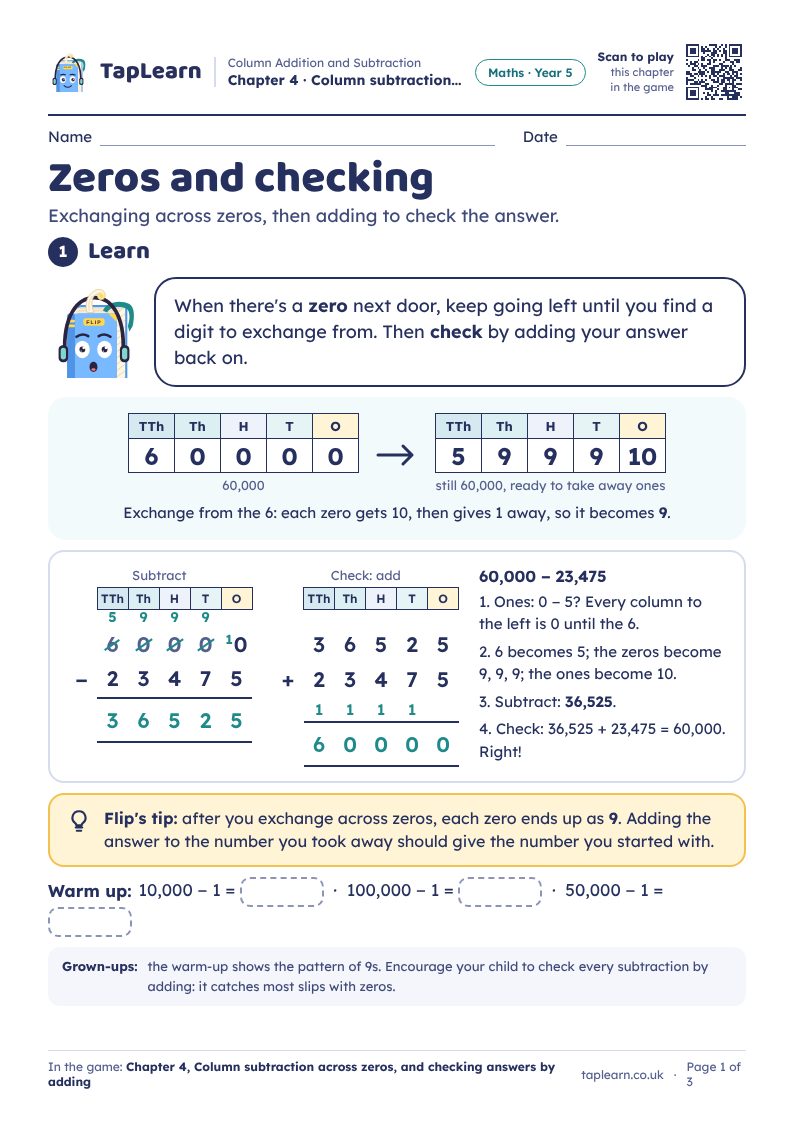
Zeros and Checking is a printable subtracting across zeros worksheet for Year 5 (ages 9 to 10) that teaches children to go left to the first digit that isn't 0, exchange, and see each zero become 9. It covers the Year 5 maths statement to add and subtract whole numbers with more than 4 digits, including using formal written methods (columnar addition and subtraction).
This worksheet is for members
Membership opens every chapter of every game and every worksheet, for all your children.
See the plansAlready a member? Log in to print it.
Start with the free one: Adding big numbers (chapter 1).
Print it on A4, in colour or black and white. Do it after the chapter, or before it to see what your child already knows.
What's on the worksheet
Your child subtracts from numbers like 60,000 by exchanging across zeros, where each zero becomes 9, then checks every answer by adding. Includes a round number challenge and an answers sheet.
- Page 1 · Learn
- 60,000 renamed as 5 ten thousands, 9 thousands, 9 hundreds, 9 tens and 10 ones, a worked example for 60,000 − 23,475 with an adding check, Flip's tip, and a warm-up.
- Page 2 · Try it together
- Round number challenge: the grown-up writes 30,000, 50,000 or 100,000, the child makes a smaller 5-digit number from digit cards, subtracts it across the zeros and checks by adding.
- Page 3 · Practise
- Rename numbers so the ones have 10, subtract across zeros, check answers by adding and correct the wrong one, find a missing number with the inverse, and a challenge.
- Answers sheet
- Every answer, mix-ups like doing 5 − 0 = 5, and one-less and undo-it ideas.
3 A4 pages and an answers sheet · about 25 minutes
Using it at home
- The warm-up shows the pattern of 9s. Encourage your child to check every subtraction by adding: it catches most slips with zeros.
- In the round number challenge, ask "How many zeros did you exchange across, and what did each one become?"
- Say a round number like 300,000 and ask for one less.
Watch out for
- Getting muddled across zeros.
- Go left to the first digit that isn't 0, exchange, then work back: each zero becomes 9.
- Taking the smaller digit from the bigger one, so 0 − 5 becomes 5.
- The top number always comes first.
- Checking with the wrong numbers.
- Add the answer to the number taken away, not to the starting number.
Questions from the worksheet
- Subtract. Exchange across the zeros: 50,000 − 23,475; 100,000 − 45,678; 70,305 − 28,469.
- Check each answer by adding. Tick it if it's right: 90,000 − 45,621 = 45,379; 40,200 − 18,756 = 21,444.
- Use the inverse to find the missing number: ___ − 36,250 = 47,875.
- Ava worked out 60,000 − 23,475 and got 43,475. Check her answer by adding. What went wrong?
The answers are on the answers sheet, for grown-ups.
National curriculum in England
This worksheet practises this statement from the Year 5 maths programme of study:
- Add and subtract whole numbers with more than 4 digits, including using formal written methods (columnar addition and subtraction)
Source: National curriculum in England: mathematics programmes of study (DfE)
In the classroom
- Run the round number challenge in pairs as a fluency starter.
- Use Practise C as a check-by-adding task before marking.
Questions and answers
How do you subtract across zeros?
Go left to the first digit that isn't 0 and exchange from it. Each zero gets 10, then gives 1 away, so it becomes 9.
Why does each zero become 9?
When you exchange across a zero, it receives 10 from the left, then passes 1 on to the right, leaving 9.
What is the inverse of subtraction?
Addition. Adding the answer to the number you took away should give the number you started with.
More worksheets from Column Addition and Subtraction for Year 5: Starship Sums Mission
- Chapter 1: Column addition worksheet: Adding big numbers Free
- Chapter 2: Adding three numbers worksheet: Lining up and adding three Members
- Chapter 3: Column subtraction worksheet: Subtracting big numbers Members
- Chapter 5: Add or subtract worksheet: Head or paper? Members
- Chapter 6: Multi-step word problems worksheet: Multi-step missions Members
 TapLearn