Add or subtract worksheet for Year 5: Head or paper?
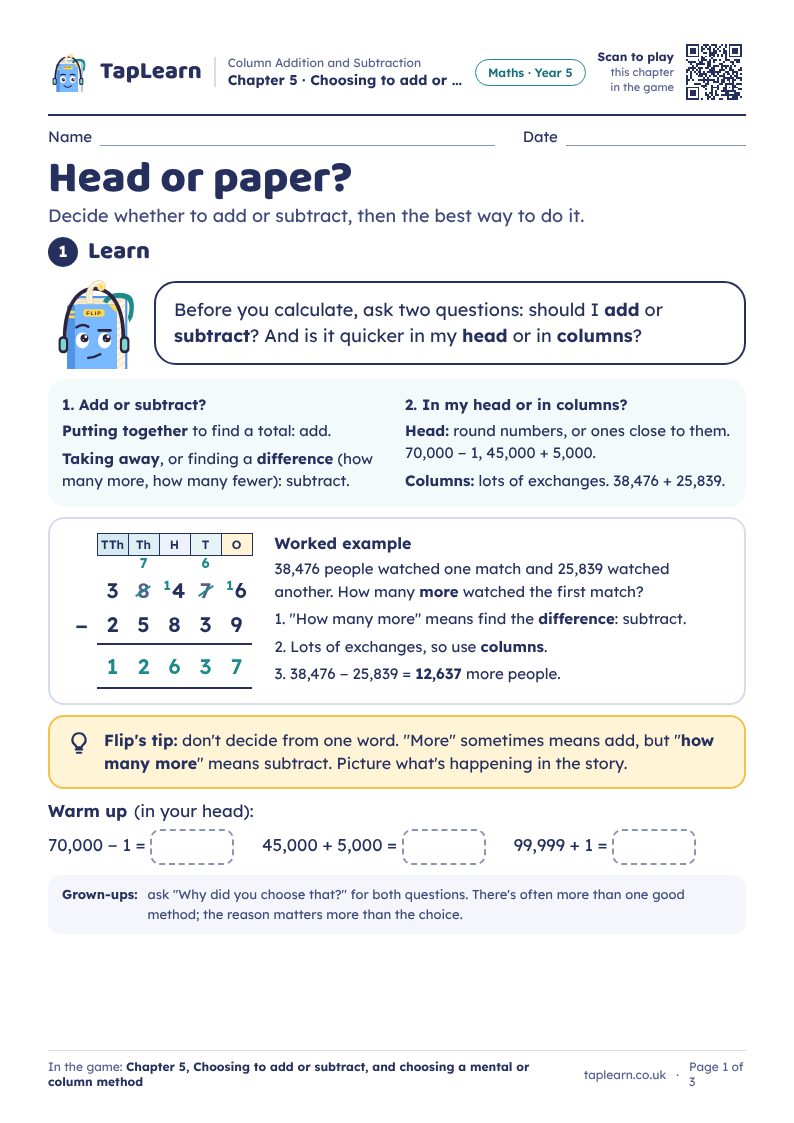
Head or Paper? is a printable add or subtract worksheet for Year 5 (ages 9 to 10) that teaches children to picture the story before choosing an operation, then pick a mental or column method. It covers the Year 5 maths statement to solve addition and subtraction multi-step problems in contexts, deciding which operations and methods to use and why.
This worksheet is for members
Membership opens every chapter of every game and every worksheet, for all your children.
See the plansAlready a member? Log in to print it.
Start with the free one: Adding big numbers (chapter 1).
Print it on A4, in colour or black and white. Do it after the chapter, or before it to see what your child already knows.
What's on the worksheet
Your child decides whether a problem needs adding or subtracting and explains why, avoiding keyword traps, then chooses to work it out mentally or in columns. Includes a head-or-paper sort and an answers sheet.
- Page 1 · Learn
- Two questions to ask before calculating, a worked example finding how many more people watched a match, Flip's tip that "how many more" means subtract, and a mental warm-up.
- Page 2 · Try it together
- Head or paper sort: read calculations like 100,000 − 1 and 64,382 + 27,569, decide head or paper and say why, work each out, then try a paper sum in your head.
- Page 3 · Practise
- Ring + or − for stadium, town, ship and score problems, solve them, ring head or columns for each calculation, and a challenge about the word "more".
- Answers sheet
- Every answer, mix-ups like the keyword trap, and real-life-question and quick-or-careful ideas.
3 A4 pages and an answers sheet · about 25 minutes
Using it at home
- Ask "Why did you choose that?" for both questions. The reason matters more than the choice.
- In the head or paper sort, there's no single right choice. Ask for a reason each time.
- When numbers come up in real life, ask "Are we putting together, taking away or comparing?"
Watch out for
- Falling into the keyword trap, adding because of "more".
- Ask "Whose number is bigger?" Picture the story, not one word.
- Choosing the wrong operation.
- Draw a quick bar: do you need the whole (add) or a part (subtract)?
- Using columns for 60,000 − 1, or 47,386 + 28,957 in your head.
- Choose by how many exchanges there are.
Questions from the worksheet
- Don't work them out yet! Ring + or −: Leo's town has 26,480 people. That is 3,750 more than Mia's town. How many people live in Mia's town?
- Mia's game score was 18,600. That was 2,450 fewer than Sam's. What was Sam's score?
- Ring the best way, head or columns, then work it out: 60,000 − 1; 47,386 + 28,957; 81,204 − 36,587.
- Ava says, "If a problem has the word more in it, I should add." Is she right? Use problem 2 from A to explain.
The answers are on the answers sheet, for grown-ups.
National curriculum in England
This worksheet practises this statement from the Year 5 maths programme of study:
- Solve addition and subtraction multi-step problems in contexts, deciding which operations and methods to use and why
Source: National curriculum in England: mathematics programmes of study (DfE)
In the classroom
- Use Practise A as a no-calculating sorting task, with pairs explaining each choice.
- Run head or paper as a class vote, then compare methods.
Questions and answers
How do you know whether to add or subtract in a word problem?
Picture the story. Putting amounts together to find a total means add. Taking away or finding a difference means subtract.
Does "more" always mean add?
No. "How many more" asks for a difference, so you subtract. If Leo's town has 3,750 more than Mia's, Mia's town is smaller.
When should you use a mental method instead of columns?
Use a mental method for round numbers or ones close to them, like 70,000 − 1. Use columns when there are lots of exchanges.
More worksheets from Column Addition and Subtraction for Year 5: Starship Sums Mission
- Chapter 1: Column addition worksheet: Adding big numbers Free
- Chapter 2: Adding three numbers worksheet: Lining up and adding three Members
- Chapter 3: Column subtraction worksheet: Subtracting big numbers Members
- Chapter 4: Subtracting across zeros worksheet: Zeros and checking Members
- Chapter 6: Multi-step word problems worksheet: Multi-step missions Members
 TapLearn