Column addition worksheet for Year 5: Adding big numbers
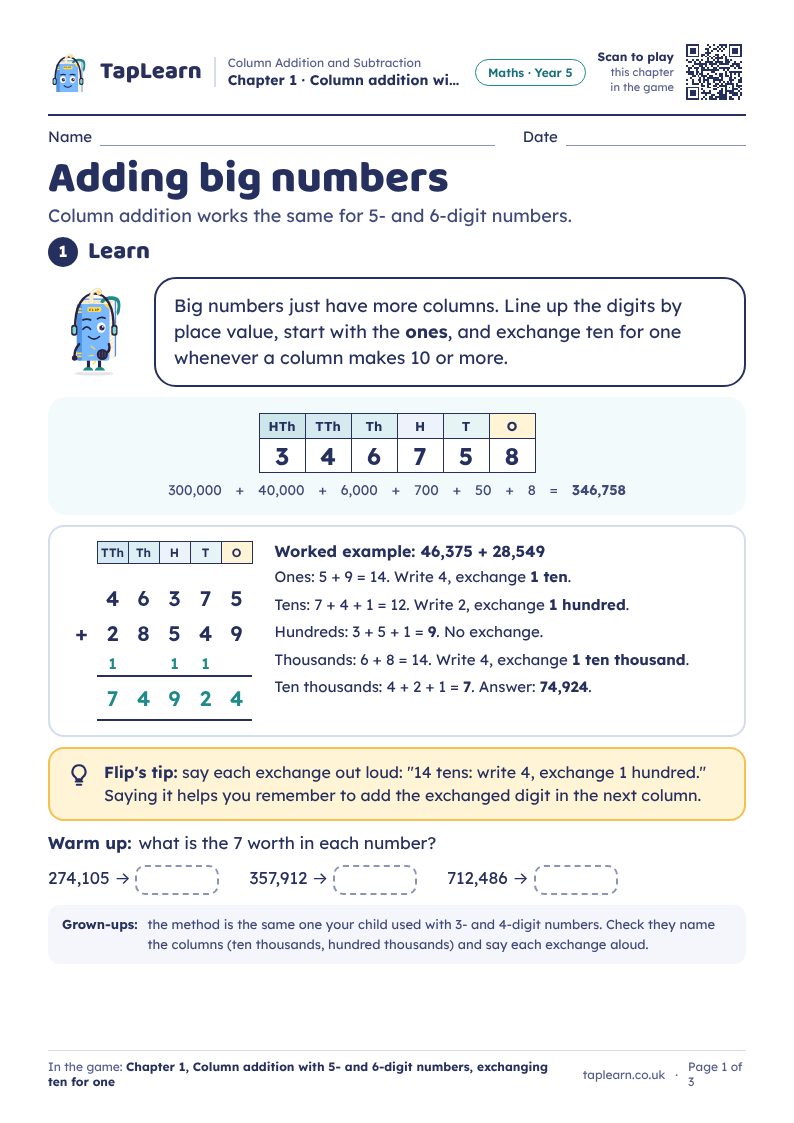
Adding Big Numbers is a printable column addition worksheet for Year 5 (ages 9 to 10) that teaches children to line up digits by place value, start with the ones and exchange ten for one into the next column. It covers the Year 5 maths statement to add and subtract whole numbers with more than 4 digits, including using formal written methods (columnar addition and subtraction).
Free to print, no account needed.
▶ Play chapter 1 in the game · How the column addition works
Print it on A4, in colour or black and white. Do it after the chapter, or before it to see what your child already knows.
What's on the worksheet
Your child adds 5- and 6-digit numbers in columns, lining up by place value and exchanging ten for one into the next column. Includes a digit card sums game and an answers sheet.
- Page 1 · Learn
- 346,758 split by place value, a worked example adding 46,375 + 28,549 column by column, Flip's tip to say each exchange out loud, and a what-is-the-7-worth warm-up.
- Page 2 · Try it together
- Digit card sums: make two 5-digit numbers from digit cards, add them in columns saying each exchange aloud, count the exchanges, then try to make sums with none or with lots.
- Page 3 · Practise
- Add 5-digit and 6-digit numbers in columns, spot what went wrong in Mia's sum, solve a museum visitors problem, and a challenge using an estimate to catch a mistake.
- Answers sheet
- Every answer, mix-ups like writing 15 in one column, and say-the-number and estimate-first ideas.
3 A4 pages and an answers sheet · about 25 minutes
In the classroom
- Play digit card sums in pairs, comparing who made the sum with the most exchanges.
- Use Leo's challenge as an estimation starter before any column calculation.
Questions from the worksheet
- Add in columns: 35,268 + 12,519; 48,736 + 27,185.
- Add these 6-digit numbers: 406,718 + 285,594; 157,846 + 268,379.
- A science museum had 48,375 visitors in July and 39,846 in August. How many visitors is that altogether?
- Leo worked out 65,847 + 23,965 and got 88,702. Use an estimate to show he can't be right. What did he forget to do?
The answers are on the answers sheet, for grown-ups.
National curriculum in England
This worksheet practises this statement from the Year 5 maths programme of study:
- Add and subtract whole numbers with more than 4 digits, including using formal written methods (columnar addition and subtraction)
Source: National curriculum in England: mathematics programmes of study (DfE)
Using it at home
- The method is the same one your child used with 3- and 4-digit numbers. Check they name the columns and say each exchange aloud.
- In digit card sums, check each total with a quick estimate: round both numbers to the nearest 10,000 and add.
- Say a 6-digit number and ask your child what each digit is worth.
Watch out for
- Forgetting the exchanged digit.
- Write it small in the next column every time, and tick it once it's added.
- Writing two digits in one column, like 15.
- Only one digit fits; the ten moves next door.
- Misreading big numbers.
- Read 346,758 as "three hundred and forty-six thousand, seven hundred and fifty-eight".
Questions and answers
How do you do column addition with big numbers?
Line up the digits by place value, start with the ones and add each column. If a column makes 10 or more, write the ones digit and exchange 1 into the next column.
What is exchanging in column addition?
Exchanging, sometimes called carrying, means swapping ten of one place for one of the next. 14 tens becomes 4 tens and 1 hundred.
How can my child check a big addition?
Round both numbers to the nearest 10,000 and add. If the answer is far from the estimate, look for a missed exchange.
More worksheets from Column Addition and Subtraction for Year 5: Starship Sums Mission
- Chapter 2: Adding three numbers worksheet: Lining up and adding three Members
- Chapter 3: Column subtraction worksheet: Subtracting big numbers Members
- Chapter 4: Subtracting across zeros worksheet: Zeros and checking Members
- Chapter 5: Add or subtract worksheet: Head or paper? Members
- Chapter 6: Multi-step word problems worksheet: Multi-step missions Members
 TapLearn