Apostrophes worksheet for Year 2: Two jobs for apostrophes
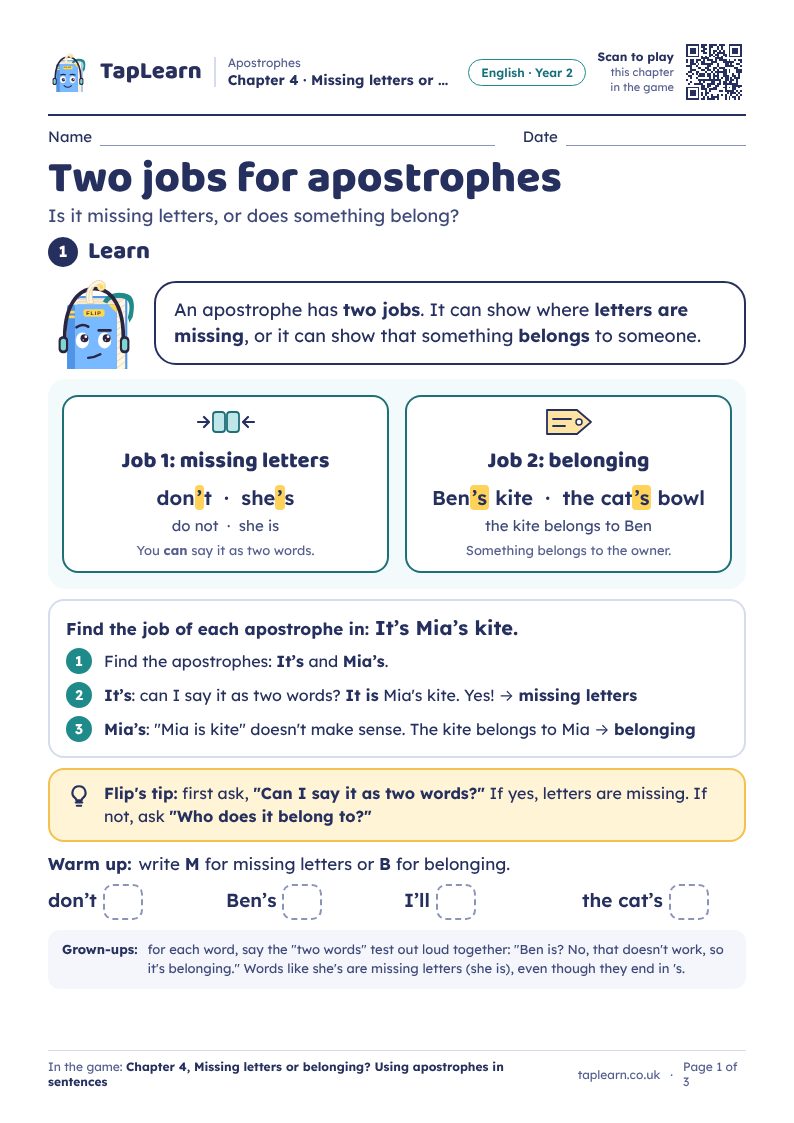
Two Jobs for Apostrophes is a printable apostrophes worksheet for Year 2 (ages 6 to 7) that teaches children to ask "Can I say it as two words?" to tell a missing-letters apostrophe (don't) from a belonging one (Ben's kite). It covers the Year 2 statement on apostrophes to mark where letters are missing and to mark singular possession, and on spelling contracted forms.
This worksheet is for members
Membership opens every chapter of every game and every worksheet, for all your children.
See the plansAlready a member? Log in to print it.
Start with the free one: Squashing words (chapter 1).
Print it on A4, in colour or black and white. Do it after the chapter, or before it to see what your child already knows.
What's on the worksheet
Your child decides whether each apostrophe shows missing letters or belonging using a two-words test, then adds missing apostrophes to sentences. Includes an apostrophe hunt in books and packets and an answers sheet.
- Page 1 · Learn
- The two jobs side by side, a worked example finding the job of each apostrophe in "It's Mia's kite", Flip's two-words test, and an M-or-B warm-up.
- Page 2 · Try it together
- Apostrophe hunt: look through picture books, comics or food packets for words with an apostrophe, write each one, and tick whether it shows missing letters or belonging.
- Page 3 · Practise
- Sort words into missing letters and belonging, ring M or B in sentences, rewrite sentences with two missing apostrophes, write your own sentence with one of each, and a challenge.
- Answers sheet
- Every answer, mix-ups like boy's for boys, and squash-or-thumbs-up and bedtime-hunt ideas.
3 A4 pages and an answers sheet · about 25 minutes
Using it at home
- Say the two-words test aloud together: "Ben is? No, that doesn't work, so it's belonging." Words like she's are missing letters (she is).
- In the hunt, packets often have belonging apostrophes in names, and stories have missing-letter ones in speech.
- At bedtime, stop at each apostrophe in a story and ask, "Which job?"
Watch out for
- Mixing up the jobs, especially she's, he's and it's.
- These are missing letters (she is). Use the two-words test.
- Putting the apostrophe between the words (did'nt) or leaving it out (mums keys).
- It goes where the letters were, or after the owner.
- Using apostrophes for plurals, like boy's or apple's.
- Just more than one, nothing belongs: no apostrophe.
Questions from the worksheet
- Sort the words into missing letters or belonging: can't, Leo's, she's, the dog's, I'll, Mum's, didn't, the bird's.
- What is the apostrophe's job? Ring M (missing letters) or B (belonging): Dad's car is blue. We're going to the park. The fox's tail is bushy.
- Each sentence has two apostrophes missing. Write the sentence again, correctly: Mia cant find her mums keys. Its Sams turn next.
- Write your own sentence with one of each: a missing-letters apostrophe and a belonging apostrophe.
- Sam wrote: "The boy's are playing football." Is the apostrophe right? Try the two-words test, then ask "Does anything belong?"
The answers are on the answers sheet, for grown-ups.
National curriculum in England
This worksheet practises these statements from the Year 2 english programme of study:
- Punctuation: apostrophes to mark where letters are missing in spelling and to mark singular possession in nouns
- Spell by: learning to spell more words with contracted forms
- Spell by: learning the possessive apostrophe (singular)
In the classroom
- Play squash or thumbs up: say can't or Dad's and pupils squash hands for missing letters or give a thumbs-up for belonging.
- Use Practise C as an editing task on the board.
Questions and answers
What are the two jobs of an apostrophe?
An apostrophe can show where letters are missing (don't, she's) or that something belongs to someone (Ben's kite).
How can children tell which job an apostrophe is doing?
Ask, "Can I say it as two words?" If yes, letters are missing. If not, ask, "Who does it belong to?"
Does it's ever show belonging?
No. It's only ever means it is or it has.
 TapLearn