Spelling contractions worksheet for Year 2: Spelling short forms
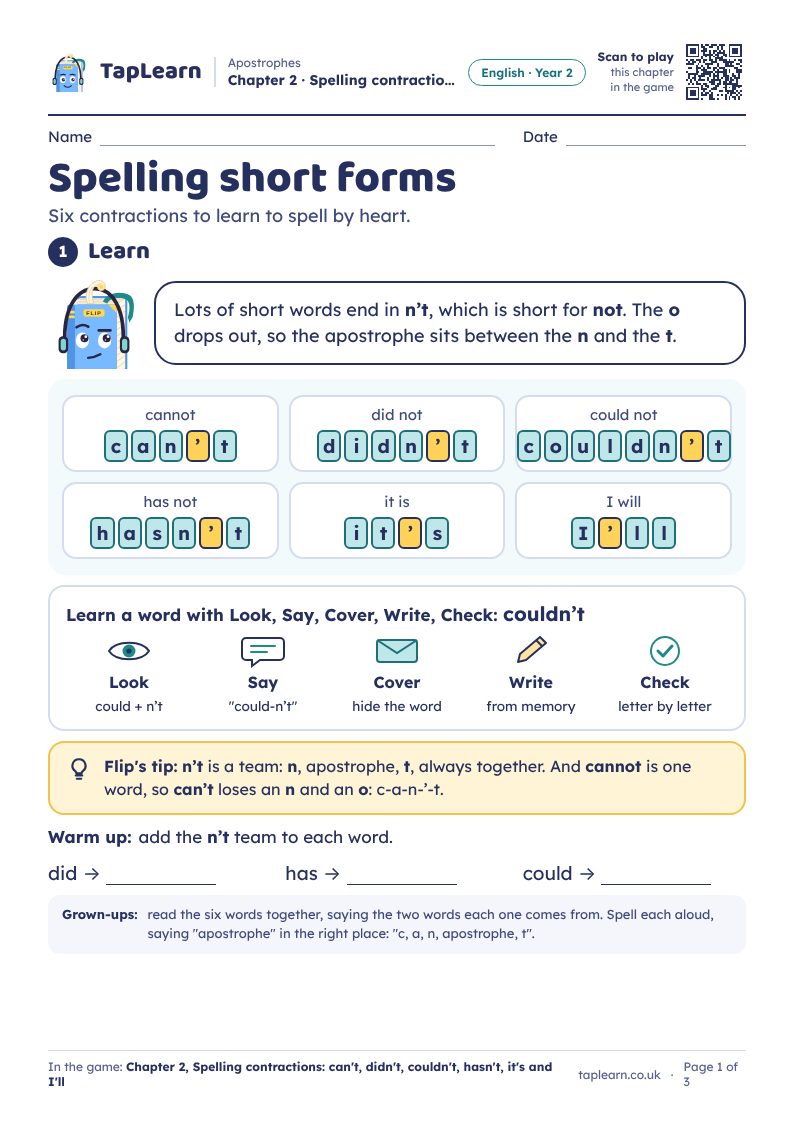
Spelling Short Forms is a printable spelling contractions worksheet for Year 2 (ages 6 to 7) that teaches children to spell can't, didn't, couldn't, hasn't, it's and I'll, keeping n, apostrophe and t together. It covers the Year 2 statements on spelling more words with contracted forms and using apostrophes to mark missing letters.
This worksheet is for members
Membership opens every chapter of every game and every worksheet, for all your children.
See the plansAlready a member? Log in to print it.
Start with the free one: Squashing words (chapter 1).
Print it on A4, in colour or black and white. Do it after the chapter, or before it to see what your child already knows.
What's on the worksheet
Your child learns to spell six contractions by heart: can't, didn't, couldn't, hasn't, it's and I'll, using look, say, cover, write, check. Includes a letter tiles activity and an answers sheet.
- Page 1 · Learn
- The six contractions with the words they come from, look, say, cover, write, check for couldn't, Flip's tip that n't is a team, and an add-n't warm-up.
- Page 2 · Try it together
- Letter tiles: write the letters of could not on paper squares, take out the o, put an apostrophe tile in its place and slide the tiles together, then make the next word.
- Page 3 · Practise
- Look, say, cover, write, check the six words, ring the correct spelling, fill gaps in sentences, write the short form, and a challenge about cann't.
- Answers sheet
- Every answer, mix-ups like could'nt and cant, and air-writing and sentence-swap ideas.
3 A4 pages and an answers sheet · about 20 minutes
Using it at home
- Spell each word aloud together, saying "apostrophe" in the right place: "c, a, n, apostrophe, t".
- With the letter tiles, I will needs two tiles taken out (w and i). Ask your child to spell each word with eyes closed, then check.
- Say "I did not see it" and your child says it the short way: "I didn't see it".
Watch out for
- Putting the apostrophe in the wrong place, like could'nt or has'nt.
- Remind your child that n't stays together: n, apostrophe, t.
- Leaving the apostrophe out, like cant or Ill.
- The apostrophe is part of the spelling, like a letter. Without it, Ill is a different word.
- Keeping extra letters, like cann't.
- Letters that drop out are not written as well as the apostrophe.
Questions from the worksheet
- Draw a ring round the word that is spelled correctly: cann't / can't / cant; could'nt / couldnt / couldn't; hasn't / has'nt / hasnt.
- Fill each gap with a word from the box (can't, didn't, couldn't, hasn't, it's, I'll): Leo ___ got a pet yet. Put your coat on, ___ raining.
- Write the short form: did not, it is, cannot.
- Ava wrote cann't. She says, "It comes from cannot, so I kept the double n." Is she right? How should it be spelled?
The answers are on the answers sheet, for grown-ups.
National curriculum in England
This worksheet practises these statements from the Year 2 english programme of study:
- Punctuation: apostrophes to mark where letters are missing in spelling and to mark singular possession in nouns
- Spell by: learning to spell more words with contracted forms
In the classroom
- Use the letter tiles as a guided spelling group activity.
- Use Practise D as a quick spelling check on mini whiteboards.
Questions and answers
How do you spell can't?
Can't is spelt c-a-n-apostrophe-t. It comes from cannot; the second n and the o drop out.
What does it's mean?
It's means it is (or it has). It never shows that something belongs.
Which contractions do children learn in Year 2?
Year 2 children learn to spell contractions such as can't, didn't, couldn't, hasn't, it's and I'll.
 TapLearn