Contractions worksheet for Year 2: Squashing words
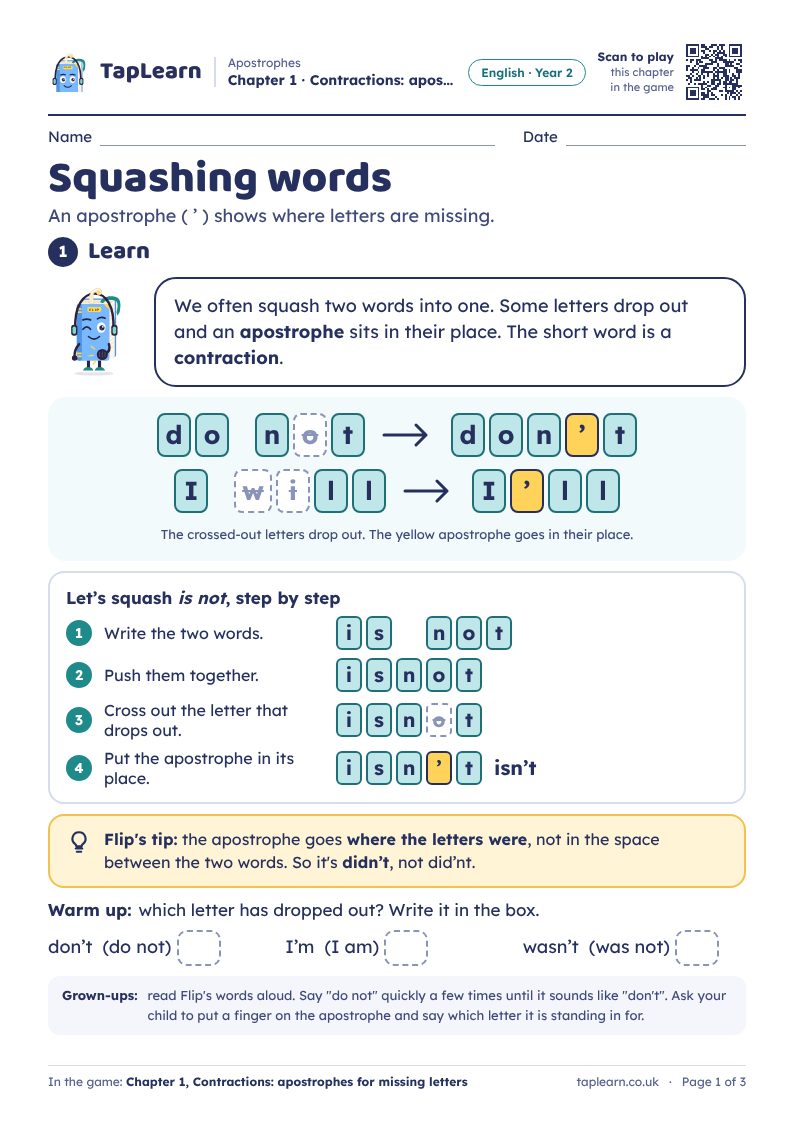
Squashing Words is a printable contractions worksheet for Year 2 (ages 6 to 7) that teaches children to squash two words into one, like is not into isn't, and put the apostrophe where the letters dropped out. It covers the Year 2 statements on spelling more words with contracted forms and using apostrophes to mark where letters are missing.
Free to print, no account needed.
Print it on A4, in colour or black and white. Do it after the chapter, or before it to see what your child already knows.
What's on the worksheet
Your child squashes two words into one (do not becomes don't) and puts the apostrophe exactly where the letters drop out. Includes a fold-a-word paper activity and an answers sheet.
- Page 1 · Learn
- What a contraction is, do not and I will squashed with the dropped letters crossed out, a step-by-step example making isn't, Flip's tip on didn't, and a which-letter warm-up.
- Page 2 · Try it together
- Fold-a-word: write two words like do not on a paper strip, fold the space and the missing letter into the fold, draw an apostrophe on the fold, then try I am, we are and more.
- Page 3 · Practise
- Match two words to their short word, ring the correct spelling, squash words like are not and I have, add missing apostrophes in sentences, and a challenge about did'nt.
- Answers sheet
- Every answer, mix-ups like I'am and dont, and squash-it and unsquash-it ideas.
3 A4 pages and an answers sheet · about 20 minutes
Using it at home
- Say "do not" quickly a few times until it sounds like "don't", then ask your child to put a finger on the apostrophe and say which letter it stands in for.
- In fold-a-word, if your child folds in the wrong place, unfold it and say both words slowly, tapping each letter, to find the one that goes.
- Say a contraction (we'll, isn't) and your child says the two words it came from.
Watch out for
- Putting the apostrophe between the words, like did'nt or was'nt.
- Say the two words slowly and ask, "Which letter goes?" The apostrophe takes that letter's place.
- Leaving the apostrophe out, like dont or Im.
- Without it, some become other words, like were and ill.
- Leaving letters in, like I'am or we'are.
- The apostrophe replaces the letters that drop out.
Questions from the worksheet
- Draw a line to match the two words to their short word: is not, I will, she is, you are, do not.
- Draw a ring round the word that is spelled correctly: did'nt / didn't / didnt; I'm / Im / I'am; was'nt / wasnt / wasn't.
- Squash the two words. Write the short word with its apostrophe: are not, he is, we will, I have, they are, does not.
- Each sentence has a word missing its apostrophe. Write the word again, correctly: I cant reach the top shelf. Mia isnt at school today.
- Leo wrote: "I did'nt see the fox." Is he right? Where should the apostrophe go, and why?
The answers are on the answers sheet, for grown-ups.
National curriculum in England
This worksheet practises these statements from the Year 2 english programme of study:
- Punctuation: apostrophes to mark where letters are missing in spelling and to mark singular possession in nouns
- Spell by: learning to spell more words with contracted forms
In the classroom
- Play squash it as a starter: say two words and pupils write the contraction on mini whiteboards.
- Do fold-a-word in pairs with paper strips.
Questions and answers
What is a contraction?
A contraction is two words squashed into one short word, like do not into don't. An apostrophe shows where letters are missing.
Where does the apostrophe go in a contraction?
It goes exactly where the letters dropped out, not in the gap between the two words: didn't, not did'nt.
Why is it can't and not cann't?
Can't comes from cannot, written as one word. Both the extra n and the o drop out, and one apostrophe takes their place.
 TapLearn