Adverbs of time worksheet for Year 3: Time adverbs
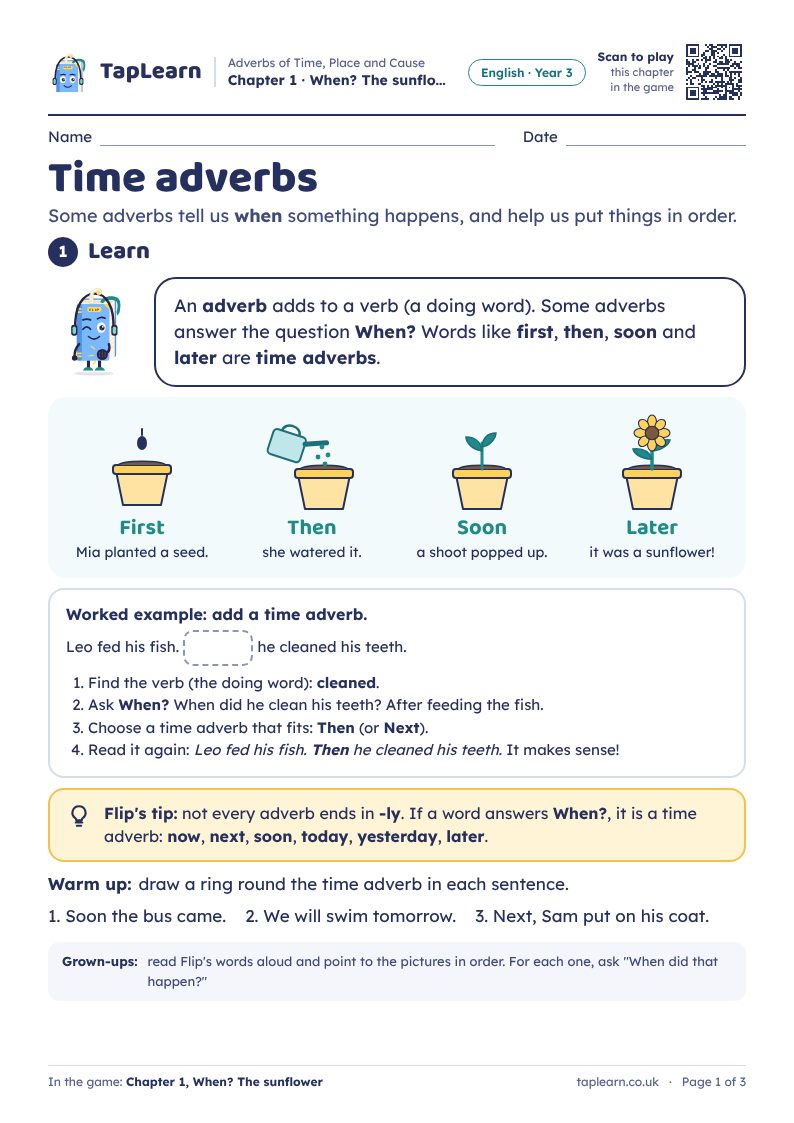
Time Adverbs is a printable adverbs of time worksheet for Year 3 (ages 7 to 8) that teaches children to find and use adverbs such as first, then, soon and later to say when things happen. It covers the Year 3 English statement on expressing time, place and cause using conjunctions, adverbs or prepositions.
Free to print, no account needed.
Print it on A4, in colour or black and white. Do it after the chapter, or before it to see what your child already knows.
What's on the worksheet
Your child finds and uses adverbs of time such as first, then, soon and later to say when things happen and put events in order. Includes a tell-it-in-order activity while doing a small job together, and an answers sheet.
- Page 1 · Learn
- A sunflower story told with First, Then, Soon and Later, a worked example adding a time adverb to a sentence, Flip's tip that not every adverb ends in -ly, and a warm-up.
- Page 2 · Try it together
- Tell it in order: do a small job such as setting the table, and after each step pick up a time word card and say what you did. Then ring the time adverb in sentences with two adverbs.
- Page 3 · Practise
- Fill gaps in the sunflower story, choose tomorrow or yesterday to make sense, write three sentences about your morning, and a challenge about whether soon is an adverb.
- Answers sheet
- Every answer, mix-ups like thinking adverbs always end in -ly, and bedtime recap and kitchen chef ideas.
3 A4 pages and an answers sheet · about 25 minutes
Using it at home
- Point to the sunflower pictures in order and ask "When did that happen?" for each one.
- If your child says "and then, and then" in tell it in order, praise the order and ask them to swap in a different time word.
- At bedtime, ask your child to tell you about their day using "First… then… later…".
Watch out for
- Thinking adverbs always end in -ly.
- Those mostly tell us how. Time adverbs often don't: now, soon, next, later.
- Using "then" every time.
- It's correct, but a mix reads better: first, next, after that, soon, finally.
- Mixing up when and where adverbs.
- If your child rings "outside", ask "Does that tell us when or where?"
Questions from the worksheet
- Each sentence has two adverbs. Draw a ring round the one that tells you when: Ava ran quickly to school yesterday.
- Draw a ring round the time adverb that makes sense: I ate a big bowl of pasta tomorrow / yesterday.
- Write three sentences about your morning. Start them with First, Then and Later.
- Sam says, "Soon can't be an adverb, because it doesn't end in -ly." Is Sam right? How do you know?
The answers are on the answers sheet, for grown-ups.
National curriculum in England
This worksheet practises these statements from the Years 3–4 english programme of study:
- Develop their understanding of the concepts set out in English appendix 2 by: using conjunctions, adverbs and prepositions to express time and cause
- Sentence: expressing time, place and cause using conjunctions, adverbs, or prepositions (Year 3 english)
In the classroom
- Use tell it in order as a shared write: model a classroom routine with time adverb cards, then pairs write their own.
- Display sentences with two adverbs and ask children to show which one answers When? on mini-whiteboards.
Questions and answers
What are adverbs of time?
Adverbs of time tell us when something happens. Examples are first, then, next, soon, later, now, today and yesterday.
Do all adverbs end in -ly?
No. Many adverbs that tell us when or where, such as soon, now, then and outside, don't end in -ly.
How do time adverbs help writing?
They put events in order and show when things happen, which makes stories and instructions easier to follow.
 TapLearn