Adverbs of place worksheet for Year 3: Place adverbs
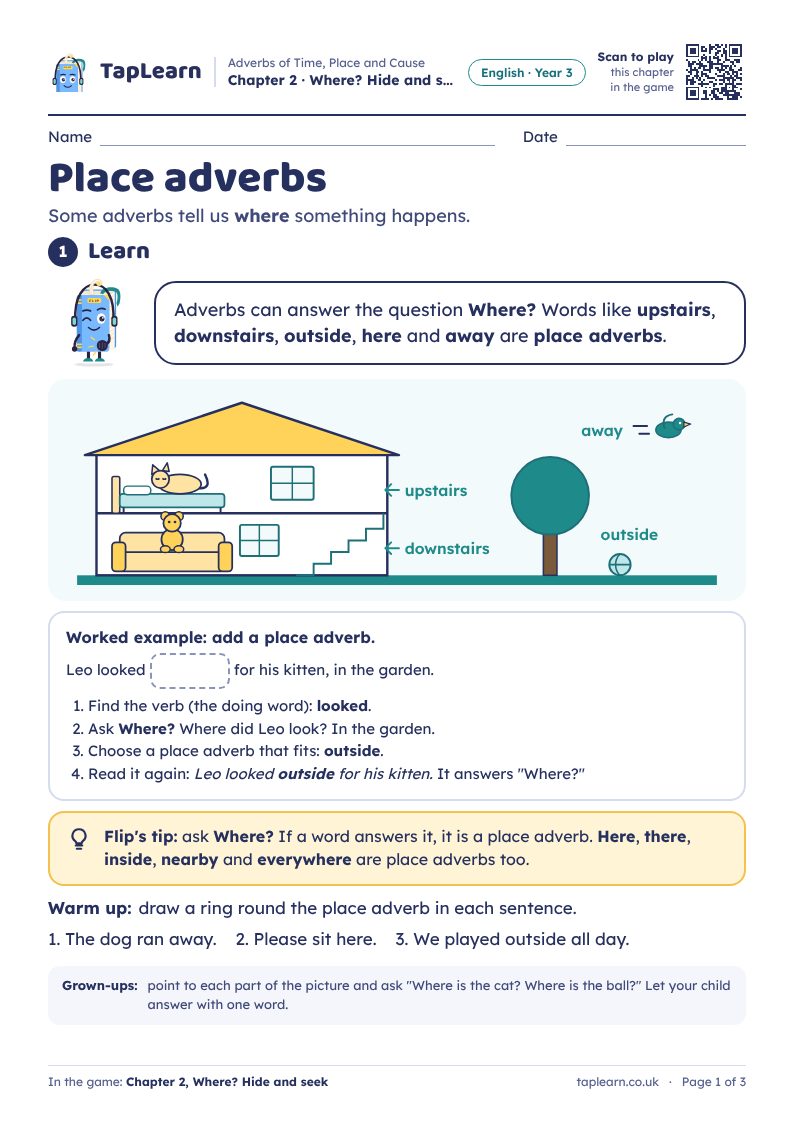
Place Adverbs is a printable adverbs of place worksheet for Year 3 (ages 7 to 8) that teaches children to find and use adverbs such as upstairs, downstairs, outside and away to say where things happen. It covers the Year 3 English statement on expressing time, place and cause using conjunctions, adverbs or prepositions.
Free to print, no account needed.
Print it on A4, in colour or black and white. Do it after the chapter, or before it to see what your child already knows.
What's on the worksheet
Your child finds and uses adverbs of place such as upstairs, downstairs, outside and away to say where things happen. Includes a hide-it-find-it game with a soft toy and an answers sheet.
- Page 1 · Learn
- A house picture shows upstairs, downstairs, outside and away, with a worked example finding Leo's kitten, Flip's tip to ask Where?, and a warm-up.
- Page 2 · Try it together
- Hide it, find it: hide a soft toy and give one-word clues like upstairs, nearby or inside, then swap roles. Then ring the adverb that tells you where in sentences with two adverbs.
- Page 3 · Practise
- Answer questions in whole sentences with place adverbs, fill gaps from a picture, write sentences with nearby and everywhere, and a challenge about then and everywhere.
- Answers sheet
- Every answer, the then-and-there mix-up, when outside is a preposition, and where's-teddy and walk-and-talk ideas.
3 A4 pages and an answers sheet · about 25 minutes
Using it at home
- Point to parts of the page 1 picture and ask "Where is the cat? Where is the ball?" Let your child answer with one word.
- In hide it, find it, nudge clues like "under the bed" towards one-word clues: "nearby", "upstairs", "inside".
- At bedtime, ask your child to say where each toy is: "Teddy is upstairs."
Watch out for
- Mixing up then and there.
- They look alike: then tells us when, and there tells us where.
- Using longer phrases like "under the bed".
- It also tells us where, but it is a phrase, not a one-word adverb.
- Calling outside an adverb in "outside the shop".
- With a noun after it, outside is a preposition. In "We played outside" it is an adverb.
Questions from the worksheet
- Each sentence has two adverbs. Draw a ring round the one that tells you where: Mia played outside yesterday.
- Answer in a whole sentence. Use a place adverb: Where do you like to play?
- Write one sentence with nearby and one sentence with everywhere.
- Ava wrote: "Then I looked everywhere." She says then and everywhere both tell us where. Is she right? How do you know?
The answers are on the answers sheet, for grown-ups.
National curriculum in England
This worksheet practises these statements from the Years 3–4 english programme of study:
- Develop their understanding of the concepts set out in English appendix 2 by: using conjunctions, adverbs and prepositions to express time and cause
- Sentence: expressing time, place and cause using conjunctions, adverbs, or prepositions (Year 3 english)
In the classroom
- Play hide it, find it in the classroom with one child giving one-word place adverb clues to the class.
- Use Practise A as a quick check: children hold up a W card for where and a T card for time.
Questions and answers
What are adverbs of place?
Adverbs of place tell us where something happens. Examples are upstairs, downstairs, outside, inside, here, there, nearby, away and everywhere.
Is outside an adverb or a preposition?
It can be either. In "We played outside" it is an adverb. In "outside the shop" it has a noun after it, so it is a preposition.
How can children tell then and there apart?
Then tells us when and there tells us where. There has the word "here" inside it.
 TapLearn