Adverbs of cause worksheet for Year 3: Using therefore
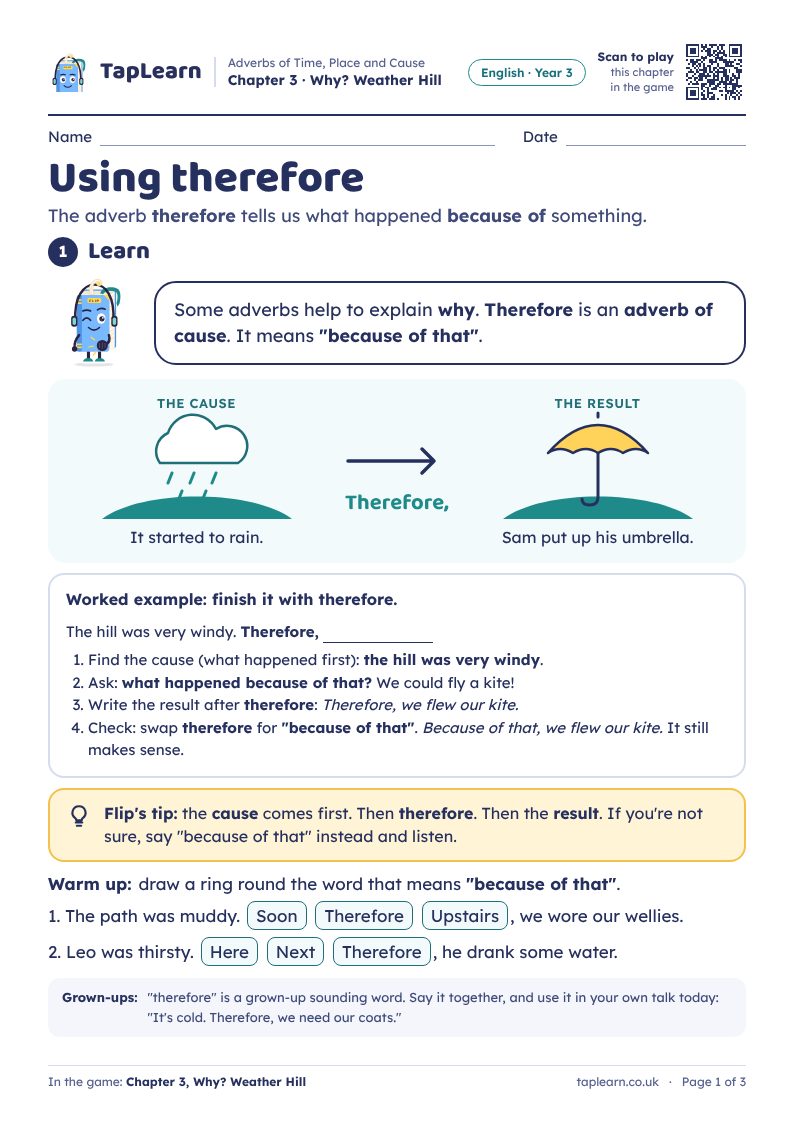
Using Therefore is a printable adverbs of cause worksheet for Year 3 (ages 7 to 8) that teaches children that therefore means "because of that" and goes before the result, after the cause. It covers the Year 3 English statement on expressing time, place and cause using conjunctions, adverbs or prepositions.
Free to print, no account needed.
Print it on A4, in colour or black and white. Do it after the chapter, or before it to see what your child already knows.
What's on the worksheet
Your child uses the adverb therefore to show cause, putting what happened first and the result after therefore. Includes a toy car ramp test to try at home and an answers sheet.
- Page 1 · Learn
- The cause and the result linked by Therefore, with a worked example about a windy hill, Flip's tip to swap in "because of that", and a warm-up choosing therefore.
- Page 2 · Try it together
- Ramp test: roll a toy car down a tray ramp, make the ramp steeper and write what happened using therefore. Then match causes to results.
- Page 3 · Practise
- Tick or cross cause-and-result pairs that are the right way round, finish sentences with a result, write a cause to go first, write about the weather, and a challenge.
- Answers sheet
- Every answer, how because and therefore point in opposite directions, and window weather and chain game ideas.
3 A4 pages and an answers sheet · about 25 minutes
Using it at home
- Say therefore together and use it in your own talk today: "It's cold. Therefore, we need our coats."
- The ramp test is about the words more than the science: any sensible result is fine. Say each sentence aloud before your child writes it.
- Look out of the window and take turns making a therefore sentence about the weather.
Watch out for
- Writing it the wrong way round, with the result first.
- Ask "Which happened first? Which happened because of it?"
- Mixing up because and therefore.
- They point in opposite directions: We stayed in because it rained. / It rained. Therefore, we stayed in.
- Using then or next to explain why.
- Then and next tell us when, not why.
Questions from the worksheet
- Is the cause first and the result after therefore? Tick or cross: We built a snowman. Therefore, it snowed.
- Finish each one with a result: The wind blew hard. Therefore,
- Now write the cause to go first: ___. Therefore, we put on our sunhats.
- Sam says these two mean the same: "We stayed in because it rained." and "We stayed in. Therefore, it rained." Is he right? Write the second one the right way round.
The answers are on the answers sheet, for grown-ups.
National curriculum in England
This worksheet practises these statements from the Years 3–4 english programme of study:
- Develop their understanding of the concepts set out in English appendix 2 by: using conjunctions, adverbs and prepositions to express time and cause
- Sentence: expressing time, place and cause using conjunctions, adverbs, or prepositions (Year 3 english)
In the classroom
- Play the chain game round the class: each child adds a result starting with therefore.
- Use Practise B as a thumbs up or down check on whether each pair is the right way round.
Questions and answers
What does therefore mean?
Therefore means "because of that". It comes before the result of something that has just happened.
What is an adverb of cause?
An adverb of cause explains why something happens. In Year 3, therefore is the main adverb of cause children learn.
What is the difference between because and therefore?
Because comes before the cause and therefore comes before the result. It rained, therefore we stayed in; we stayed in because it rained.
 TapLearn