Fractions that make one whole worksheet for Year 3: Making one whole
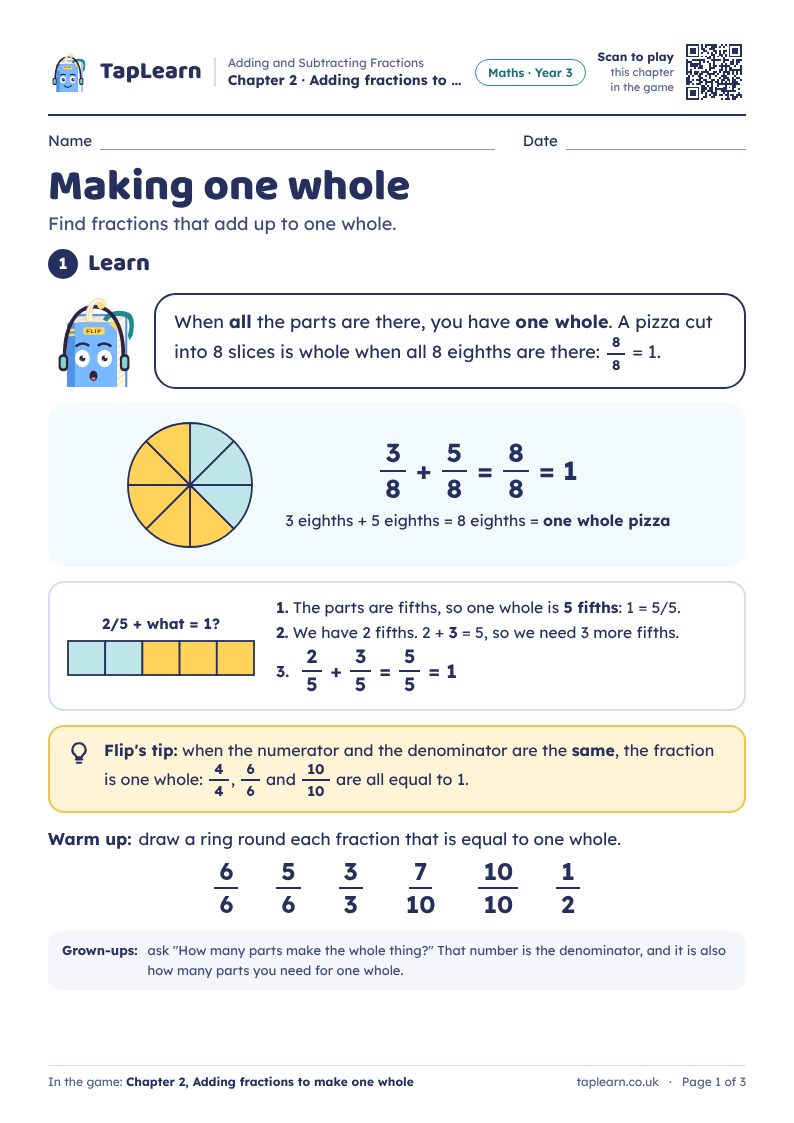
Making One Whole is a printable worksheet on fractions that make one whole for Year 3 (ages 7 to 8) that teaches children to find pairs of fractions that add up to 1 and to see that fractions like 6/6 and 8/8 are one whole. It covers the Year 3 maths statement to add and subtract fractions with the same denominator within one whole.
This worksheet is for members
Membership opens every chapter of every game and every worksheet, for all your children.
See the plansAlready a member? Log in to print it.
Start with the free one: Adding equal parts (chapter 1).
Print it on A4, in colour or black and white. Do it after the chapter, or before it to see what your child already knows.
What's on the worksheet
Your child finds fractions that add up to one whole, like 3/8 + 5/8 = 1, and sees that fractions such as 6/6 or 8/8 equal one whole. Includes a fill-the-egg-box activity and an answers sheet.
- Page 1 · Learn
- A pizza shows 3 eighths + 5 eighths = 8 eighths = one whole, a worked example finding what goes with 2/5 to make 1, Flip's tip, and a ring-the-wholes warm-up.
- Page 2 · Try it together
- Fill the box: the grown-up fills some spaces of a 6-space egg box, and the child works out how many more sixths fill it, then fills them to check. Then find what more pizza makes one whole.
- Page 3 · Practise
- Write missing numerators to make one whole, join pairs that make one whole, write 1 as a fraction with different denominators, and a challenge about 3/8 + 5/8 = 8/16.
- Answers sheet
- Every answer, mix-ups like not seeing 8/8 as one whole, and make-1 and full-or-not games.
3 A4 pages and an answers sheet · about 25 minutes
In the classroom
- Play make 1 as a starter: say a fraction such as 3/10 and children write the fraction that makes one whole.
- Give groups egg boxes or ice cube trays and ask them to record every pair of fractions that fills the box.
Questions from the worksheet
- The yellow slices are left. How much more pizza would make one whole?
- Write the missing numerator to make one whole.
- Write 1 as a fraction.
- Mia says 3/8 + 5/8 = 8/16. "That's a half." Is she right? What is the correct answer?
The answers are on the answers sheet, for grown-ups.
National curriculum in England
This worksheet practises this statement from the Year 3 maths programme of study:
- Add and subtract fractions with the same denominator within one whole
Source: National curriculum in England: mathematics programmes of study (DfE)
Using it at home
- Ask "How many parts make the whole thing?" That number is the denominator and how many parts you need for one whole.
- If your egg box has 10 or 12 spaces, use tenths or twelfths instead. An ice cube tray works too.
- At mealtimes ask "What fraction of the plate is full? What makes it one whole?"
Watch out for
- Not seeing 6/6 or 8/8 as one whole.
- Ask "How many slices is the pizza cut into? How many are there? So is it all there?"
- Adding the denominators, as in 3/8 + 5/8 = 8/16.
- Say it in words: "3 eighths + 5 eighths = 8 eighths". The parts don't change size.
- Counting the wrong slices.
- Count the slices that are missing to fill the whole.
Questions and answers
What fraction is equal to one whole?
Any fraction where the numerator and denominator are the same, such as 5/5, 6/6 or 8/8, is equal to one whole.
How do you find what makes one whole?
Work out how many more parts are needed to reach the denominator. With 2/5, you need 3 more fifths, because 2 + 3 = 5.
Is 3/8 + 5/8 equal to a half?
No. 3 eighths + 5 eighths = 8 eighths, which is one whole.
 TapLearn