Fraction word problems worksheet for Year 3: Fraction puzzles
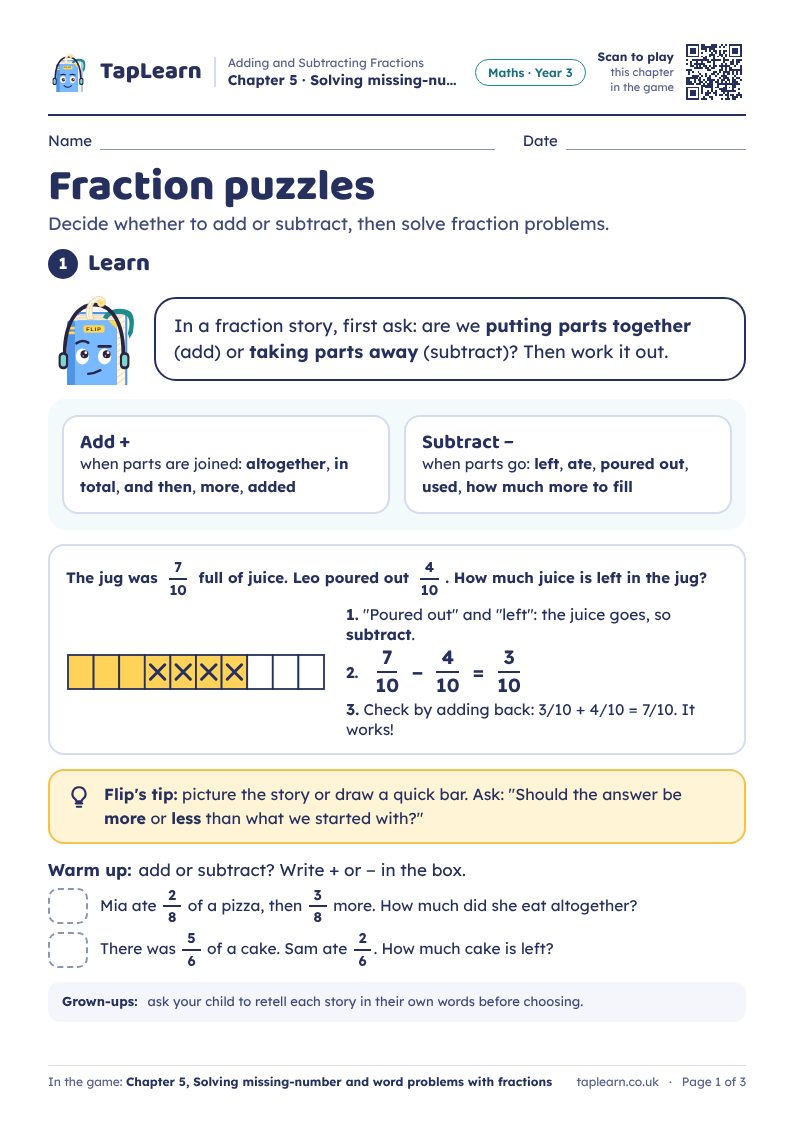
Fraction Puzzles is a printable fraction word problems worksheet for Year 3 (ages 7 to 8) that teaches children to decide whether a fraction story needs adding or subtracting and to find missing numbers. It covers the Year 3 maths statement to add and subtract fractions with the same denominator within one whole.
This worksheet is for members
Membership opens every chapter of every game and every worksheet, for all your children.
See the plansAlready a member? Log in to print it.
Start with the free one: Adding equal parts (chapter 1).
Print it on A4, in colour or black and white. Do it after the chapter, or before it to see what your child already knows.
What's on the worksheet
Your child solves missing-number puzzles and word problems by deciding whether to add or subtract fractions with the same denominator. Includes a kitchen stories activity with pasta and an answers sheet.
- Page 1 · Learn
- Clue words for adding and subtracting, a worked example about juice poured out of a jug with a check by adding, Flip's more-or-less tip, and an add-or-subtract warm-up.
- Page 2 · Try it together
- Kitchen stories: use 10 pasta shapes as tenths, act out a short fraction story the grown-up tells, decide add or subtract and check by counting. Then swap storytellers.
- Page 3 · Practise
- Write + or − to make calculations true, find missing numbers, solve pizza, brownie and book problems, and a challenge about a jug of water.
- Answers sheet
- Every answer, mix-ups like choosing the wrong operation or forgetting the whole, and story swap and two-step ideas.
3 A4 pages and an answers sheet · about 25 minutes
In the classroom
- Use story swap: give pairs a calculation and ask them to write a matching fraction story.
- Use the warm-up as a whole-class add-or-subtract vote before solving.
Questions from the worksheet
- Write + or − in each box to make it true.
- A tray of brownies was ___ full. Leo ate ___ of the tray. How much is left?
- Mia has read ___ of her book. What fraction does she still have to read? (Hint: the whole book is 1.)
- Ava solved this: "The jug had 7/10 of water. We poured out 4/10." She wrote 7/10 + 4/10 = 11/10. Is she right?
The answers are on the answers sheet, for grown-ups.
National curriculum in England
This worksheet practises this statement from the Year 3 maths programme of study:
- Add and subtract fractions with the same denominator within one whole
Source: National curriculum in England: mathematics programmes of study (DfE)
Using it at home
- Ask your child to retell each story in their own words before choosing whether to add or subtract.
- Use real moments: "The bottle was 7/10 full and we poured out 4/10. How much is left?"
- Say a calculation, such as 5/8 − 2/8, and ask your child to make up a story to match.
Watch out for
- Choosing the wrong operation.
- Ask "Should the answer be more or less than we started with?" Acting it out with pasta helps.
- Adding or taking away the denominators.
- The parts don't change size, so the denominator stays the same.
- Forgetting the whole in what-is-still-to-do questions.
- The starting amount is 1 whole, such as 7/7.
Questions and answers
How do children know whether to add or subtract in a fraction problem?
Picture the story: if parts are joined, add; if parts go away, are eaten or poured out, subtract.
What if a question asks what is still left to do?
Start from 1 whole written as a fraction, such as 7/7, and subtract the part already done.
How can you check a fraction word problem?
Do the opposite calculation. If 7/10 − 4/10 = 3/10, then 3/10 + 4/10 should make 7/10.
 TapLearn