Adding fractions worksheet for Year 3: Adding equal parts
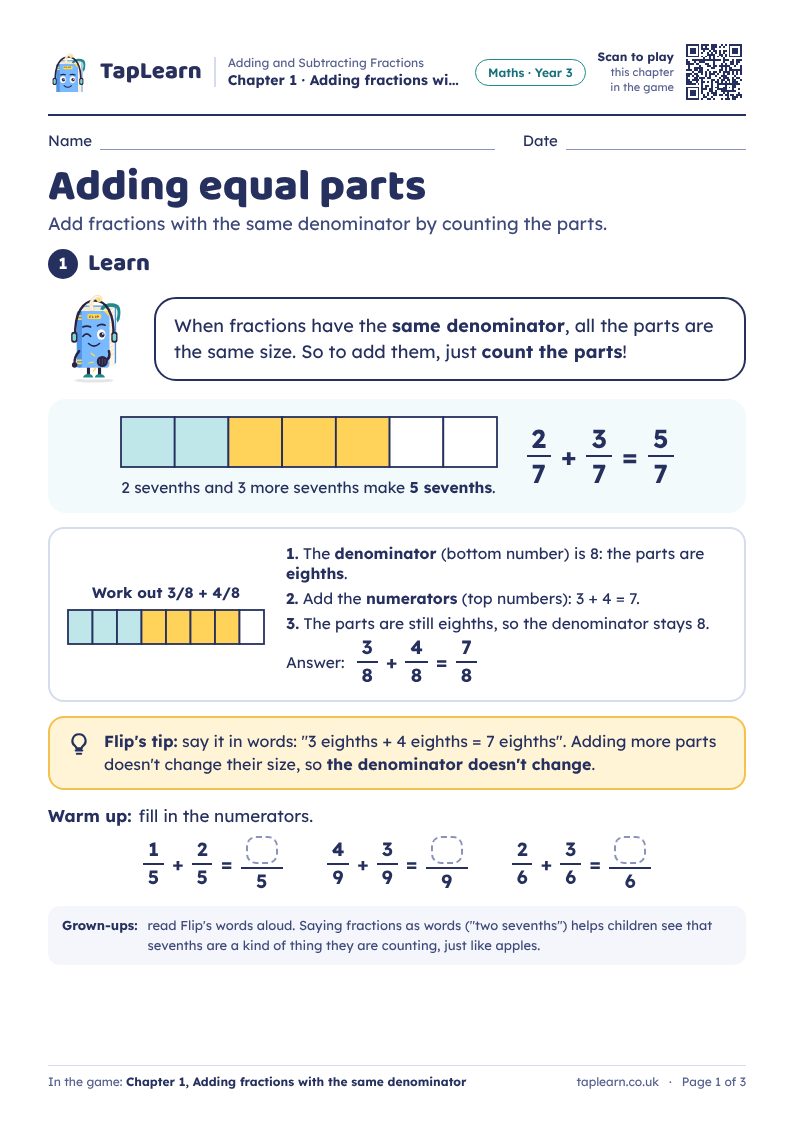
Adding Equal Parts is a printable adding fractions worksheet for Year 3 (ages 7 to 8) that teaches children to add fractions with the same denominator by adding the numerators and keeping the denominator. It covers the Year 3 maths statement to add and subtract fractions with the same denominator within one whole.
Free to print, no account needed.
Print it on A4, in colour or black and white. Do it after the chapter, or before it to see what your child already knows.
What's on the worksheet
Your child adds fractions with the same denominator, like 2/7 + 3/7 = 5/7, by adding the numerators and keeping the denominator. Includes a fold-and-colour paper strip activity and an answers sheet.
- Page 1 · Learn
- Fraction bars show 2 sevenths and 3 more sevenths make 5 sevenths, a worked example adding 3/8 + 4/8, Flip's say-it-in-words tip, and a warm-up.
- Page 2 · Try it together
- Fold and colour: fold a paper strip into 8 equal parts, colour some eighths in one colour and some in another, then count them and write the addition.
- Page 3 · Practise
- Write additions from fraction bars, add fractions, colour bars to show additions, add fractions in words like two ninths + four ninths, and a challenge about 5/14.
- Answers sheet
- Every answer, mix-ups like adding the denominators, and snack fractions and say-it-add-it games.
3 A4 pages and an answers sheet · about 25 minutes
In the classroom
- Play say it, add it as a starter: "2 fifths and 2 fifths" and the class answers "4 fifths".
- Run fold and colour in pairs with strips of different lengths and compare the additions.
Questions from the worksheet
- Add the fractions with the same denominator.
- Words and fractions: 3 fifths + 1 fifth = ___ fifths
- Two ninths + four ninths = ___
- Sam says 2/7 + 3/7 = 5/14 "because 2 + 3 = 5 and 7 + 7 = 14." Is he right? Explain how you know.
The answers are on the answers sheet, for grown-ups.
National curriculum in England
This worksheet practises this statement from the Year 3 maths programme of study:
- Add and subtract fractions with the same denominator within one whole
Source: National curriculum in England: mathematics programmes of study (DfE)
Using it at home
- Say fractions as words ("two sevenths") so your child sees sevenths are a kind of thing they are counting, like apples.
- In fold and colour, ask "Why is the answer still in eighths?" after each round.
- Cut toast into 4 equal pieces: "I eat 1 quarter, you eat 2 quarters. How much did we eat altogether?"
Watch out for
- Adding the denominators too, as in 2/7 + 3/7 = 5/14.
- Say it in words: "2 sevenths + 3 sevenths = 5 sevenths". We are counting sevenths, so they stay sevenths.
- Changing the denominator, as in 3/8 + 4/8 = 7/12.
- Ask "What size are the parts? Did the parts change size?"
- Reading the bar wrongly.
- Count all the parts for the denominator, not just the coloured ones.
Questions and answers
How do you add fractions with the same denominator?
Add the numerators (top numbers) and keep the denominator (bottom number) the same. 3/8 + 4/8 = 7/8.
Why doesn't the denominator change when adding fractions?
The denominator tells you the size of the parts. Adding more parts doesn't change their size, so eighths stay eighths.
Is 2/7 + 3/7 equal to 5/14?
No. 2 sevenths + 3 sevenths = 5 sevenths, or 5/7. Adding the denominators is a common mistake.
 TapLearn