Subtracting fractions worksheet for Year 3: Taking away parts
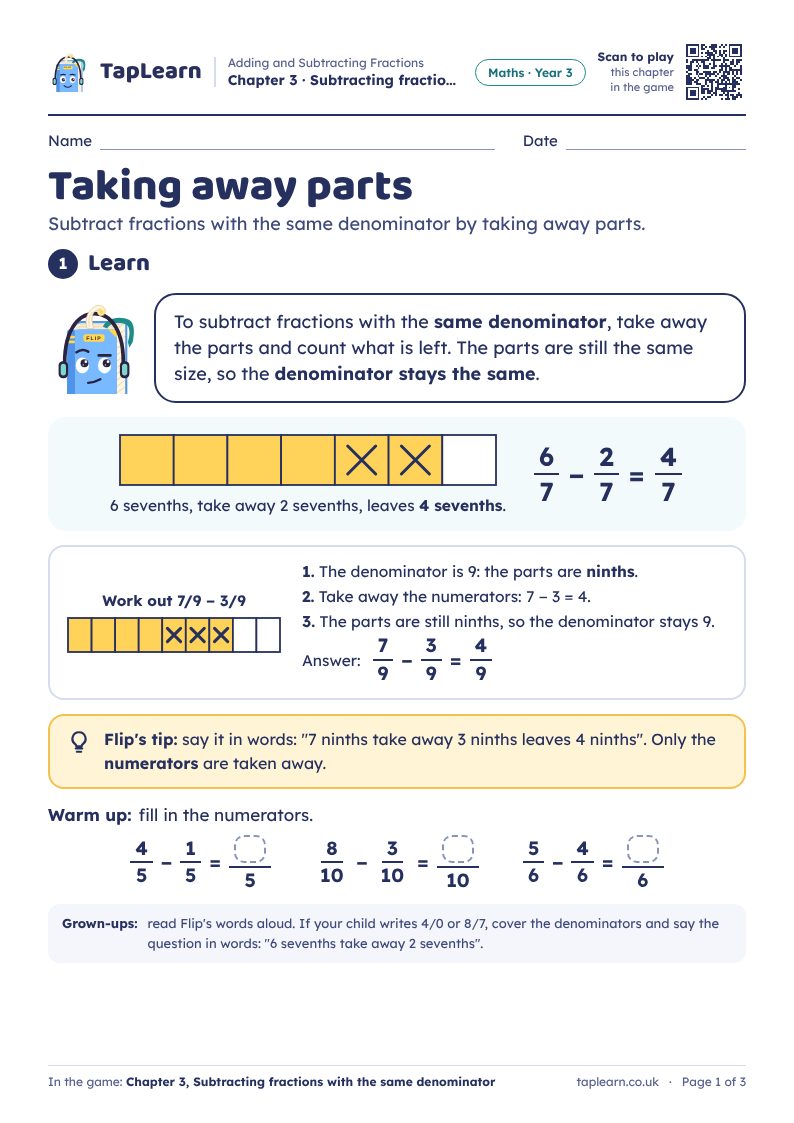
Taking Away Parts is a printable subtracting fractions worksheet for Year 3 (ages 7 to 8) that teaches children to subtract fractions with the same denominator by taking away the numerators and keeping the denominator. It covers the Year 3 maths statement to add and subtract fractions with the same denominator within one whole.
This worksheet is for members
Membership opens every chapter of every game and every worksheet, for all your children.
See the plansAlready a member? Log in to print it.
Start with the free one: Adding equal parts (chapter 1).
Print it on A4, in colour or black and white. Do it after the chapter, or before it to see what your child already knows.
What's on the worksheet
Your child subtracts fractions with the same denominator, like 6/7 − 2/7 = 4/7, by taking away parts and keeping the denominator. Includes a pasta-on-a-bar activity and an answers sheet.
- Page 1 · Learn
- A bar shows 6 sevenths take away 2 sevenths leaves 4 sevenths, a worked example of 7/9 − 3/9, Flip's say-it-in-words tip, and a warm-up.
- Page 2 · Try it together
- Pasta on a bar: put pasta on some tenths of a 10-part bar, take some away and write the subtraction. Then write subtractions from bars with crossed-out parts.
- Page 3 · Practise
- Subtract fractions, cross out parts to show subtractions, write missing numbers, and a challenge about 6/7 − 2/7 = 4/0.
- Answers sheet
- Every answer, mix-ups like adding instead of taking away, and snack subtraction and check-with-adding ideas.
3 A4 pages and an answers sheet · about 25 minutes
In the classroom
- Use pasta on a bar with counters on a printed bar in pairs, recording each subtraction.
- Show bars with crossed-out parts and ask children to write the subtraction on mini-whiteboards.
Questions from the worksheet
- Some yellow parts are crossed out. Write the subtraction for each bar.
- Subtract the fractions with the same denominator.
- Cross out parts to show the subtraction. Then write the answer.
- Leo writes 6/7 − 2/7 = 4/0. Is he right? What should the answer be, and why?
The answers are on the answers sheet, for grown-ups.
National curriculum in England
This worksheet practises this statement from the Year 3 maths programme of study:
- Add and subtract fractions with the same denominator within one whole
Source: National curriculum in England: mathematics programmes of study (DfE)
Using it at home
- If your child writes 4/0 or 8/7, cover the denominators and say the question in words: "6 sevenths take away 2 sevenths".
- In pasta on a bar, ask "Why is the answer still in tenths?" after each round.
- After a subtraction, check by adding back: 4/9 + 3/9 should take you back to 7/9.
Watch out for
- Taking away the denominators, as in 6/7 − 2/7 = 4/0.
- Say it in words: "6 sevenths take away 2 sevenths". The answer is still in sevenths.
- Adding instead of taking away, as in 8/7.
- Ask "Should there be more or less than we started with?"
- Counting the crossed-out parts as the answer.
- The answer is the parts that are left.
Questions and answers
How do you subtract fractions with the same denominator?
Take away the numerators and keep the denominator the same. 7/9 − 3/9 = 4/9.
Why is 6/7 − 2/7 not 4/0?
The parts are sevenths before and after, so the answer is 4/7. A denominator of 0 would mean the whole was cut into no parts.
How can you check a fraction subtraction?
Add the answer to the fraction you took away. 4/9 + 3/9 = 7/9 takes you back to the start.
 TapLearn