Wheels and Axles: Build a Buggy with Hubbs the Badger
Years 1 and 2: learn what wheels, axles and axle holders do, fix wobbly wheels and test a buggy against design criteria with Hubbs.
Online game, chapter 1 free · Years 1 and 2 (KS1) · ages 5–7 · national curriculum in England · no adverts · plays on a phone, tablet or computer · no sign-up to start.
An online technology game for Years 1 and 2 (KS1). It covers the national curriculum in England, Years 1–2 design and technology: “Explore and use mechanisms in their products”, and 1 more statement listed under the chapters.
5 short chapters, about 30 minutes in all. Children can stop after any chapter.
Start playing for free. Plays in the browser on phones, tablets and computers: no app, no adverts.
Free for teachers: every chapter on the whiteboard with a free teacher account.
Last updated · Checked against the national curriculum in England by the TapLearn team
What you'll learn
Say what wheels and axles are and spot them in everyday things
Name a vehicle's chassis, axles, axle holders and wheels
Tell a fixed axle from a free axle and say which part turns
Spot why a vehicle won't roll well and say how to fix it
Test a vehicle fairly and check it against design criteria
Learn that a wheel rotates on an axle through its centre and that wheels roll instead of sliding, then spot wheels and axles on bikes, trolleys and suitcases, not just cars.
Spin the wheels of two buggies with red-striped axles to see that a free axle turns with its wheels while a fixed axle stays still, then sort four designs.
Learn what parallel means, then test four faulty buggies and fix them: move holes to the centre, straighten an axle, leave a gap so wheels don't rub, and add a stopper.
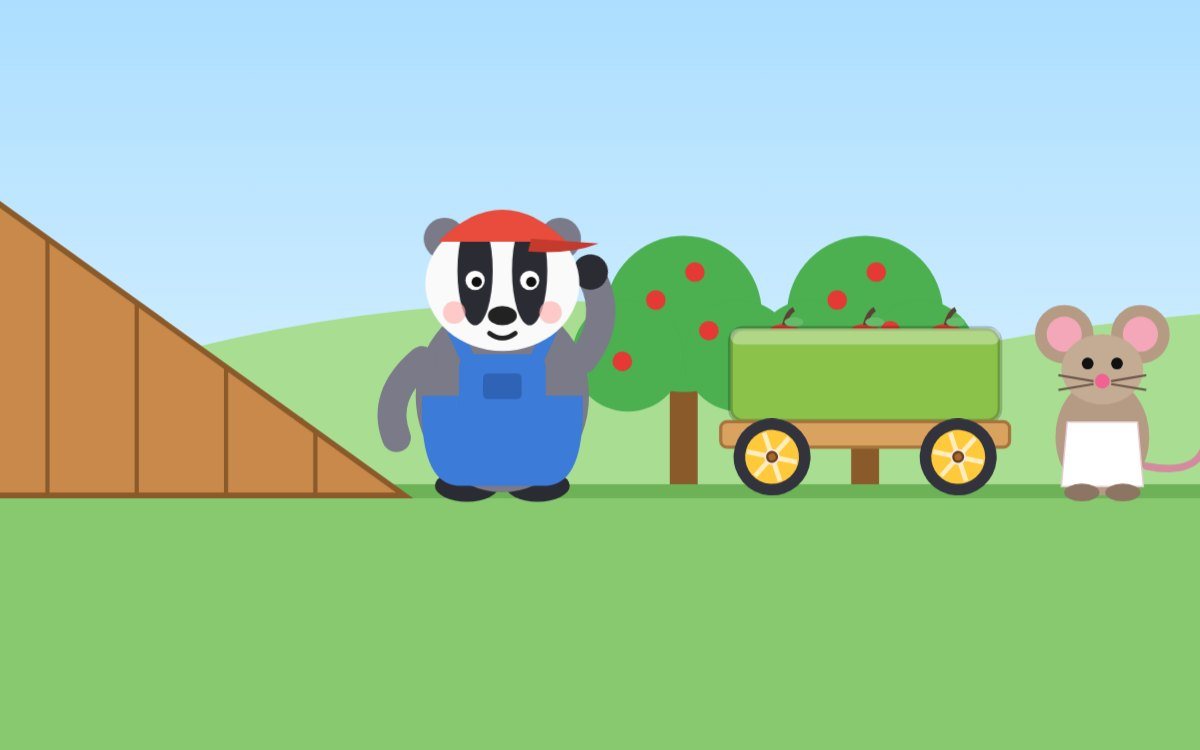
Roll Tansy the mouse's apple cart down a ramp, tick or cross each design criterion, choose improvements, keep the retest fair and judge the cart again.
Years 1–2 design and technology · statement 2Years 1–2 design and technology · statement 1
What the chapters cover in the national curriculum in England:
Years 1–2 design and technology: Explore and use mechanisms in their products
Years 1–2 design and technology: Evaluate their ideas and products against design criteria
How to play
Press Start, then pick any of the five jobs in Hubbs's workshop, or start with job one.
Each job opens with a short animated introduction that can be skipped, then Hubbs reads every instruction aloud and shows it as a caption.
Your child taps glowing parts in the scene to build, spin or fix things, and answers questions with large buttons at the bottom.
A wrong answer is shown in red and Hubbs says to look again; the child keeps trying until they find the right one.
The final challenge asks eight questions from all five jobs and lights a lamp for each one answered first time.
A worked example
A buggy keeps turning off the track. What is wrong?
Watch the test: the buggy starts straight, then curves away to one side.
Look at it from above and compare the two axles.
One axle is crooked, so the axles are not the same distance apart all the way along.
That means they are not parallel, so the wheels point in different directions.
Answer: the axles are not parallel. Straighten the crooked axle and the buggy rolls in a straight line.
Common mistakes and how to fix them
Thinks only cars have wheels and axlesGo on a wheel hunt together and name each find: a pram, a bin, a toy truck, a chair with castors.
Mixes up the axle and the axle holderSay 'the axle goes through the holder': the rod is the axle, and the straw it slides through is the axle holder.
Glues the wheels to the axle and tapes the axle down, so nothing turnsAsk 'which part is able to turn?' Either the wheels or the axle must be loose.
Fixes axles at an angle, so the model veers offLine the straws up with a ruler so they are parallel, like train tracks, before taping them down.
Judges the model by how it looksRead the design criteria aloud and test each one, then ask 'did it do this job?' before talking about colours.
Try it at home
Go on a wheel hunt at home or on a walk and count how many things with wheels and axles you can find.
Turn a toy car over together, point to its chassis, axles and wheels, then spin a wheel to see whether the axle turns too.
Make a ramp from a tray and a pile of books, then let two toy cars go from the same spot with no push to see which rolls furthest.
In the classroom
Play job two on the whiteboard and let pupils come up to tap each part as the class names it.
Use job four as a starter before making models, asking pairs to predict the fault before each test.
After job five, give pairs a mini-whiteboard to write their own three design criteria for a class vehicle.
Use the final challenge as a plenary, with pupils showing answers on fingers before a child taps.
About this adventure
Wheels and Axles is an interactive online game for Years 1 and 2 (ages 5 to 7) that teaches how wheels, axles and axle holders make a vehicle roll, and how to test one. It follows the key stage 1 design and technology curriculum in England: explore and use mechanisms such as wheels and axles, and evaluate ideas and products against design criteria.
There are five short chapters and an eight-question final challenge, set in Hubbs the badger's Roll-Along Workshop. Every idea is shown and read aloud first, then the child tries it with Hubbs's help, then answers on their own. Children tap parts to build a buggy, spin wheels to see which part turns, test faulty buggies on a track and judge a cart's ramp test.
A wheel is a round part that rotates, and an axle is the rod through its centre. An axle holder, often a straw, keeps the axle in place but lets it turn, and the chassis is the base. On a fixed axle only the wheels turn; on a free axle the wheels and axle turn together. Axles should be parallel, holes go in the centre, and a fair test changes only one thing.
Questions and answers
What is an axle, in simple words?
An axle is a rod that goes through the centre of a wheel, and the wheel turns on it. In a classroom model it is often a wooden dowel, held under the vehicle by straws called axle holders.
What is the difference between a fixed axle and a moving axle?
On a fixed axle, the axle is stuck to the chassis and only the wheels turn, because their holes are loose. On a moving axle, the wheels are stuck tight to the axle, so the wheels and axle turn together inside a loose axle holder.
Why won't my child's model car roll in a straight line?
The most likely reason is that the axles are not parallel, so the car steers itself to one side. Also check that each hole is in the centre of its wheel and that the wheels are not rubbing against the chassis.
What do Year 2 children learn about wheels and axles?
In key stage 1 design and technology, children explore and use mechanisms such as wheels and axles in their products. They learn the parts of a wheeled vehicle, make one that rolls, and evaluate it against design criteria.
Is there an interactive wheels and axles game for a Year 1 or Year 2 class?
Yes. Wheels and Axles plays in a web browser on a classroom whiteboard, tablets or computers. A class can build the buggy together, vote on which part turns, and diagnose each faulty buggy before making their own models.
What does the Wheels and Axles game include?
It has five chapters and an eight-question final challenge, taking about 30 minutes in all. Every line is read aloud by Hubbs the badger, so children who are still learning to read can play on their own.
We count visits to make TapLearn better.We use one cookie, only on this site, to see how families find and use it. No adverts, and nothing is shared.One cookie, only on this site. No adverts.How we measure
 TapLearn