Strong Structures: Build and Test with Plank the Beaver
Years 1 and 2: learn to make structures stronger, stiffer and more stable by testing towers, paper bridges, frames and brick walls with Plank.
Online game, chapter 1 free · Years 1 and 2 (KS1) · ages 5–7 · national curriculum in England · no adverts · plays on a phone, tablet or computer · no sign-up to start.
An online technology game for Years 1 and 2 (KS1). It covers the national curriculum in England, Years 1–2 design and technology: “Build structures, exploring how they can be made stronger, stiffer and more stable”.
4 short chapters, about 25 minutes in all. Children can stop after any chapter.
Start playing for free. Plays in the browser on phones, tablets and computers: no app, no adverts.
Free for teachers: every chapter on the whiteboard with a free teacher account.
Last updated · Checked against the national curriculum in England by the TapLearn team
What you'll learn
Explain what strong, stiff and stable mean for a structure
Make a structure more stable with a wider base
Put heavy parts at the bottom and anchor structures down
Stiffen paper and card by folding, rolling or layering
Use triangles and braces to stop frames squashing
Explain why overlapping bricks make a stronger wall
Learn what a structure is and what strong, stiff and stable mean, by tapping structures in Plank's town, dropping a melon on stools, pressing shelves and shaking towers (freestanding structures).
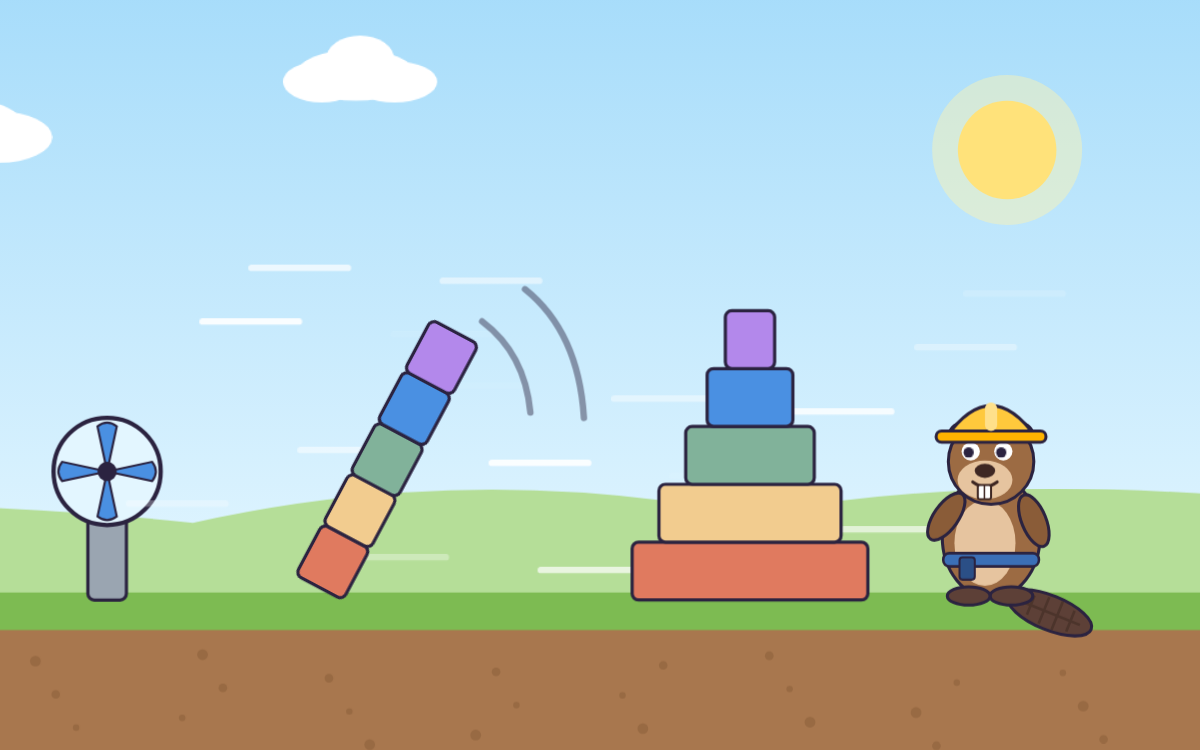
Find out how a wide base, heavy parts at the bottom and pegs that anchor it down make a structure more stable, by testing towers and a tent in front of a windy fan.
Make paper stiffer and stronger by folding, rolling and layering it, then test each paper bridge with pennies and stand sheets up to hold a book (concertina folding).
Discover why triangles keep frames stiff by bracing a wobbly square, spot the triangles in a bridge, and build a wall with overlapping bricks that doesn't split (brick bond).
What the chapters cover in the national curriculum in England:
Years 1–2 design and technology: Build structures, exploring how they can be made stronger, stiffer and more stable
How to play
Press Start, then pick a chapter from the building yard map, or play them in order.
Each chapter opens with Plank showing what you'll learn, then your child taps buttons or parts of the scene to run tests: drop, press, shake, blow or roll.
Before some tests your child predicts what will happen, then watches the result and hears why.
After a wrong answer, Plank explains the right one, the correct button turns green, and your child carries on.
The Big Build Challenge asks eight questions and awards a gold, silver or bronze builder's badge.
A worked example
Question: which paper bridge will hold more pennies, a flat sheet or a zigzag folded sheet?
Step 1: lay each sheet across the gap between two piles of books.
Step 2: add pennies to the middle, one at a time.
Step 3: in the game, the flat sheet sags and collapses after just 1 penny.
Step 4: the zigzag fold stays stiff and holds 15 pennies before it gives way.
Answer: the zigzag folded sheet, because folds make paper stiffer.
Common mistakes and how to fix them
Mixes up stiff and stableAsk 'Is it bending or falling over?' Bending means it needs to be stiffer; falling over means it needs to be more stable.
Thinks a strong structure can't fall overStack strong tins into a tall, narrow tower and tap the table: strong stops it breaking, but only a wide base stops it toppling.
Thinks a narrow base is steadier than a wide oneBuild the same blocks on a narrow base and on a wide base, then gently blow or tap and compare.
Puts the heaviest parts at the top of a towerBalance a heavy book on top of light boxes and watch it wobble, then swap so the book is at the bottom.
Thinks a square frame is as stiff as one with trianglesTape four strips of card into a square, push a corner to squash it, then tape a strip from corner to corner and push again.
Try it at home
Build a tower from cereal boxes together and talk about whether it is strong, stiff and stable.
Build two towers from tins or blocks, one with a wide base and one narrow, then gently blow or tap the table to test them.
Make a paper bridge between two piles of books and test a flat sheet, a zigzag fold and rolled tubes with coins.
On a walk, spot triangles on bridges, cranes and pylons, and look for overlapping bricks in walls.
In the classroom
Play the paper bridge chapter on the whiteboard and have pupils predict each result on mini-whiteboards before the test runs.
Use the first chapter as a starter to introduce the words strong, stiff and stable before a making lesson.
In pairs on tablets, children play one chapter, then repeat the same test with real paper, card or construction blocks.
Use the Big Build Challenge as a plenary after children have evaluated their own freestanding structures.
About this adventure
Strong Structures is an interactive online game for Years 1 and 2 (ages 5 to 7) that teaches children how to make structures stronger, stiffer and more stable. It follows the Key Stage 1 design and technology national curriculum in England: build structures, exploring how they can be made stronger, stiffer and more stable.
There are four chapters and a final quiz, set in the riverside building yard of Plank the beaver. Every idea is shown and read aloud first, then the child tries it with Plank's help, then answers on their own. Children tap to drop a melon on stools, switch on a fan to blow towers over, hammer in tent pegs, test paper bridges with pennies, brace a wobbly frame and slide rows of bricks to build a wall.
The key words: strong means a structure holds a load without breaking, stiff means it keeps its shape, and stable means it doesn't fall over. A wide base, heavy parts at the bottom and anchoring make structures stable. Folding, rolling and layering stiffen paper and card. Triangles stop frames squashing, and overlapping bricks (a brick bond) make walls strong.
Questions and answers
How do I explain strong, stiff and stable to my Year 2 child?
Strong means a structure can hold a heavy load without breaking, stiff means it keeps its shape and doesn't bend, and stable means it stays standing. A bendy shelf needs to be stiffer; a tower that keeps falling over needs to be more stable.
How can you make a structure more stable?
Give it a wider base, put the heaviest parts at the bottom and anchor it to the ground, for example with pegs and ropes like a tent. Narrow, top-heavy towers tip over much more easily.
How do you make paper stronger for a KS1 structures project?
Fold it, roll it or layer it. A zigzag (concertina) fold, rolled paper tubes or several sheets stuck together are all much stiffer than one flat sheet, so a paper bridge or tower can hold far more.
What do Year 1 and Year 2 children learn about structures in design and technology?
The national curriculum in England says KS1 children should build structures, exploring how they can be made stronger, stiffer and more stable. They usually make freestanding structures such as towers, bridges and playground equipment, then test and improve them.
Is there an interactive structures game for a KS1 class?
Yes, Strong Structures plays in a web browser on a classroom whiteboard, tablets or computers. The class can predict which tower, bridge or wall will hold, watch Plank's tests and talk about why before building their own models.
What does the Strong Structures game include?
It has four short chapters and an eight-question final quiz, and takes about 25 minutes to play through. Every line is read aloud, so children who are still learning to read can play on their own.
We count visits to make TapLearn better.We use one cookie, only on this site, to see how families find and use it. No adverts, and nothing is shared.One cookie, only on this site. No adverts.How we measure
 TapLearn