Unit fractions worksheet for Year 3: Equal parts
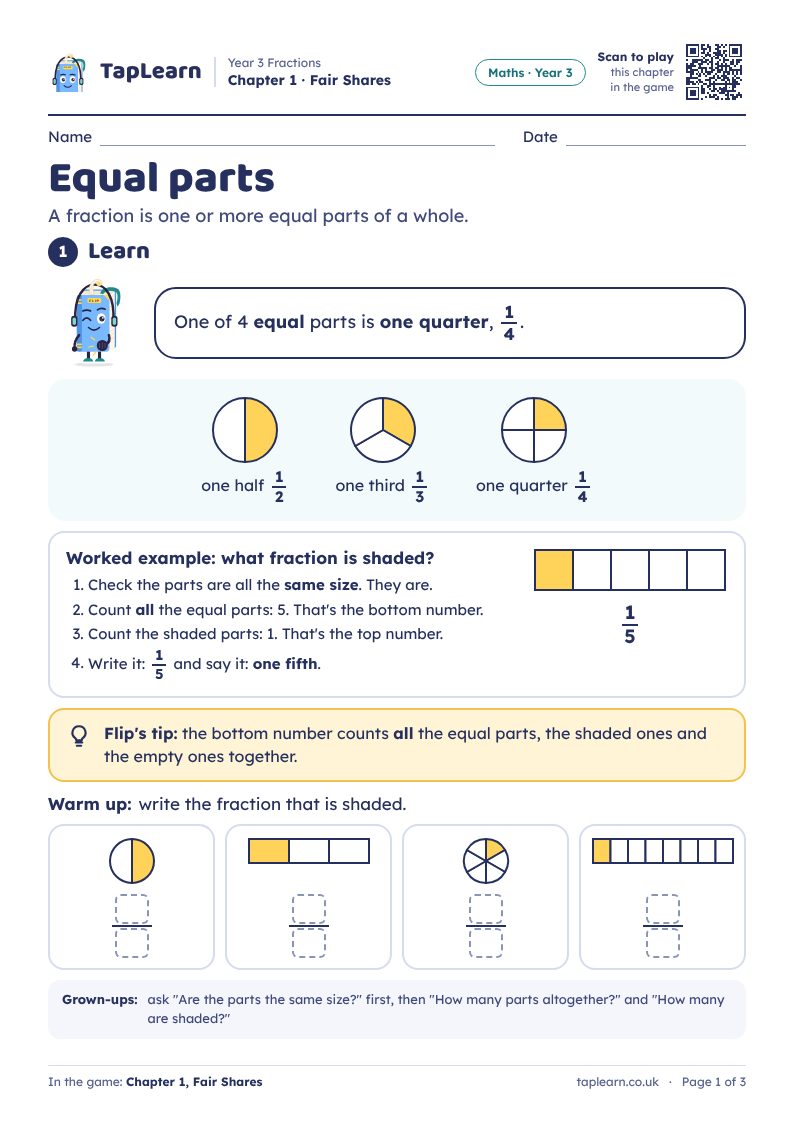
Equal Parts is a printable unit fractions worksheet for Year 3 (ages 7 to 8) that teaches children to check a whole is split into equal parts and name one part, such as one half, one third or one quarter. It covers the Year 3 maths statement to recognise and use unit fractions with small denominators.
Free to print, no account needed.
Print it on A4, in colour or black and white. Do it after the chapter, or before it to see what your child already knows.
What's on the worksheet
Your child checks that shapes are split into equal parts and names one part as a unit fraction, like one half, one third or one quarter. Includes a fold-it-fair paper activity and an answers sheet.
- Page 1 · Learn
- Shapes split into halves, thirds and quarters, a worked example naming one fifth, Flip's tip that the bottom number counts all the equal parts, and a warm-up.
- Page 2 · Try it together
- Fold it fair: fold scrap paper into halves, quarters and thirds, check the parts match, colour one part and name it. Then tick shapes cut into equal parts.
- Page 3 · Practise
- Colour one part and write the fraction, write the shaded fraction, match words like one third to fractions, and a challenge about Sam's pie.
- Answers sheet
- Every answer, mix-ups like using unshaded parts as the bottom number, and snack-time and is-it-fair ideas.
3 A4 pages and an answers sheet · about 20 minutes
Using it at home
- Ask "Are the parts the same size?" first, then "How many parts altogether?" and "How many are shaded?"
- If a fold comes out uneven, say "those parts aren't equal, so it isn't a half" and fold again together.
- At snack time, cut a sandwich into halves or quarters and name one part.
Watch out for
- Counting parts that aren't equal as a fraction.
- A half must be two parts the same size.
- Using the unshaded parts as the bottom number.
- Count all the parts: "1 out of 4 altogether" is one quarter.
Questions from the worksheet
- Tick the shapes cut into equal parts. Cross the others.
- Draw a line to match the words to the fraction: one half, one third, one quarter, one fifth.
- A pie is cut into 4 equal parts. Sam colours 1 part. He says it's one third, because 3 parts are not coloured. Is he right? What fraction did he colour?
The answers are on the answers sheet, for grown-ups.
National curriculum in England
This worksheet practises these statements from the Year 3 maths programme of study:
- Count up and down in tenths; recognise that tenths arise from dividing an object into 10 equal parts and in dividing one-digit numbers or quantities by 10
- Recognise, find and write fractions of a discrete set of objects: unit fractions and non-unit fractions with small denominators
- Recognise and use fractions as numbers: unit fractions and non-unit fractions with small denominators
- Recognise and show, using diagrams, equivalent fractions with small denominators
- Add and subtract fractions with the same denominator within one whole
- Compare and order unit fractions, and fractions with the same denominators
Source: National curriculum in England: mathematics programmes of study (DfE)
In the classroom
- Run fold it fair with paper squares, then display the folds and discuss which are equal.
- Use is-it-fair as a starter: show a shape cut unequally and ask whether one part is a half.
Questions and answers
What is a unit fraction?
A unit fraction is one equal part of a whole, with 1 as the top number, such as one half, one third or one quarter.
Why do fractions need equal parts?
A fraction only works if every part is the same size. Two unequal parts aren't halves.
What does the bottom number of a fraction tell you?
It tells you how many equal parts the whole is split into, counting the shaded and empty parts together.
 TapLearn