Counting in tenths worksheet for Year 3
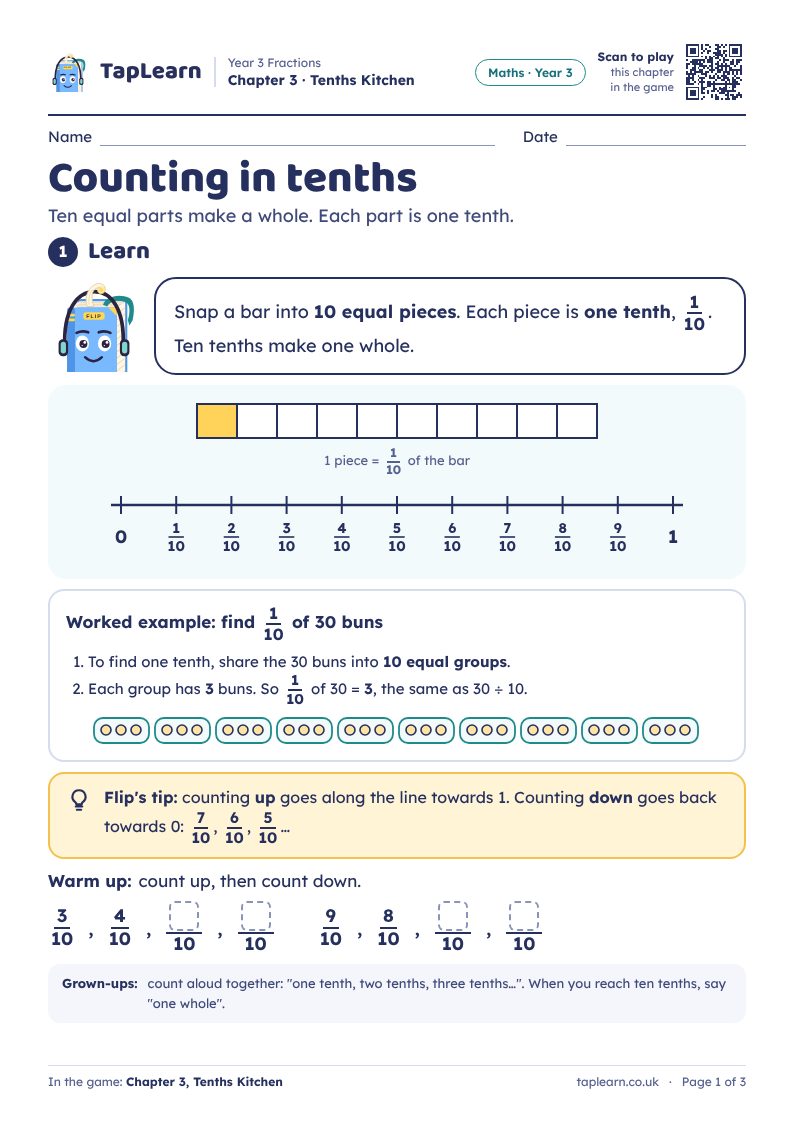
Counting in Tenths is a printable counting in tenths worksheet for Year 3 (ages 7 to 8) that teaches children to count up and down in tenths and find one tenth of a number by sharing it into 10. It covers the Year 3 maths statement to count up and down in tenths and recognise that tenths come from dividing by 10.
Free to print, no account needed.
Print it on A4, in colour or black and white. Do it after the chapter, or before it to see what your child already knows.
What's on the worksheet
Your child counts up and down in tenths on a number line, sees that ten tenths make a whole, and finds one tenth by sharing into 10. Includes a ten piles sharing activity and an answers sheet.
- Page 1 · Learn
- A bar snapped into 10 pieces and a number line in tenths, a worked example finding one tenth of 30 buns, Flip's tip on counting up and down, and a warm-up.
- Page 2 · Try it together
- Ten piles: count 10 things as tenths up to one whole, take them away counting down, then share 20, 30 and 40 things into 10 piles to find one tenth of each.
- Page 3 · Practise
- Fill in missing tenths on a number line, count up and down, find one tenth of 20, 50, 70 and 100, name shaded tenths, and a challenge about counting down.
- Answers sheet
- Every answer, mix-ups like counting the wrong way, and tenths chant and ten piles ideas.
3 A4 pages and an answers sheet · about 20 minutes
Using it at home
- Count aloud together: "one tenth, two tenths, three tenths…", and when you reach ten tenths say "one whole".
- In ten piles, ask "What do you notice about one tenth of 20, 30 and 40?"
- Ask "What is one tenth of 60?" and let your child picture sharing into 10 piles.
Watch out for
- Counting up instead of down.
- Point along the number line: down means towards 0.
- Not knowing what comes after nine tenths.
- Ten tenths is one whole.
Questions from the worksheet
- Fill in the missing tenths on the number line.
- Find one tenth. Share into 10 equal groups: one tenth of 50, one tenth of 70.
- What fraction of each bar is shaded?
The answers are on the answers sheet, for grown-ups.
National curriculum in England
This worksheet practises these statements from the Year 3 maths programme of study:
- Count up and down in tenths; recognise that tenths arise from dividing an object into 10 equal parts and in dividing one-digit numbers or quantities by 10
- Recognise, find and write fractions of a discrete set of objects: unit fractions and non-unit fractions with small denominators
- Recognise and use fractions as numbers: unit fractions and non-unit fractions with small denominators
- Recognise and show, using diagrams, equivalent fractions with small denominators
- Add and subtract fractions with the same denominator within one whole
- Compare and order unit fractions, and fractions with the same denominators
Source: National curriculum in England: mathematics programmes of study (DfE)
In the classroom
- Chant the tenths up to 1 and back to 0 as a class warm-up.
- Use counters and 10 paper plates in groups to find one tenth of different amounts.
Questions and answers
What is a tenth?
A tenth is one of 10 equal parts of a whole. Ten tenths make one whole.
How do you find one tenth of a number?
Share it into 10 equal groups, which is the same as dividing by 10. One tenth of 30 is 3.
How do you count down in tenths?
Count back towards 0 one tenth at a time: nine tenths, eight tenths, seven tenths.
 TapLearn