Adding fractions with the same denominator worksheet for Year 3: Adding fractions
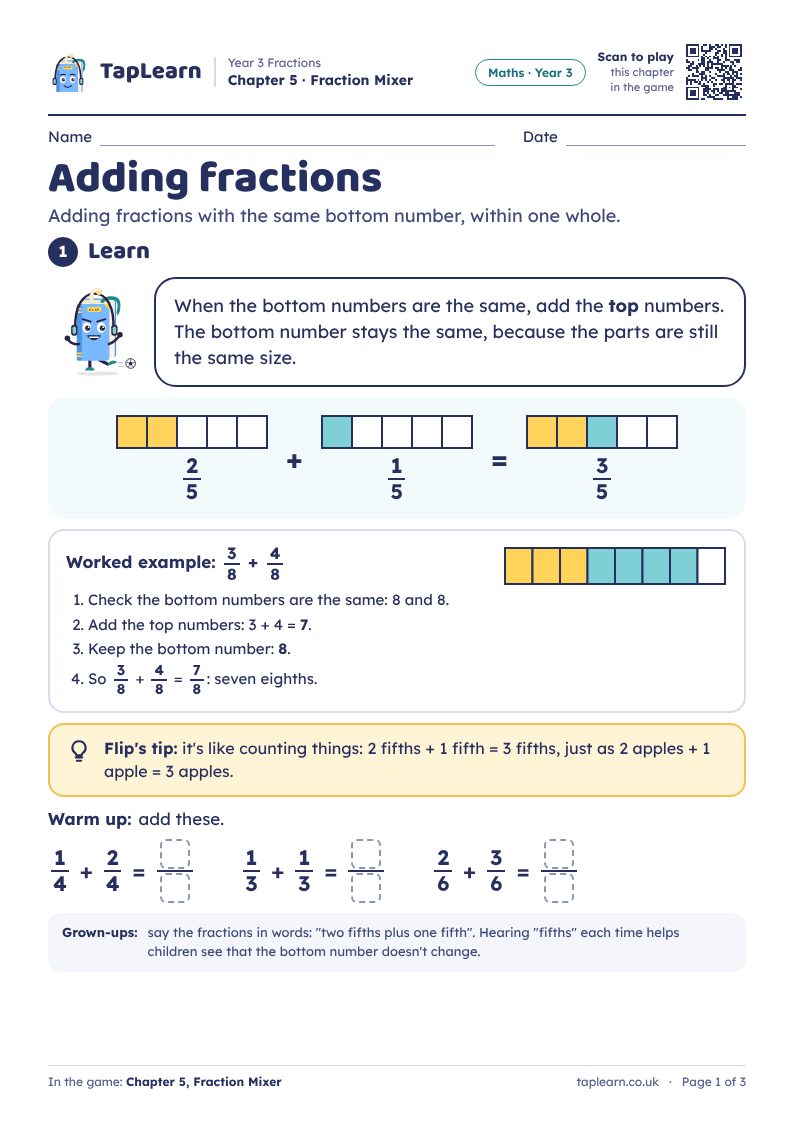
Adding Fractions is a printable worksheet on adding fractions with the same denominator for Year 3 (ages 7 to 8) that teaches children to add the top numbers and keep the bottom number the same. It covers the Year 3 maths statement to add and subtract fractions with the same denominator within one whole.
Free to print, no account needed.
Print it on A4, in colour or black and white. Do it after the chapter, or before it to see what your child already knows.
What's on the worksheet
Your child adds fractions with the same bottom number within one whole, such as 2/5 + 1/5 = 3/5, using bar pictures. Includes a fill-the-egg-box activity and an answers sheet.
- Page 1 · Learn
- A bar shows 2 fifths + 1 fifth = 3 fifths, a worked example adding eighths, Flip's tip comparing fractions to counting apples, and an adding warm-up.
- Page 2 · Try it together
- Fill the box: fill some egg box cups with pasta and more with buttons, then say and write the adding sentence for the cups filled altogether.
- Page 3 · Practise
- Write adding sentences for bars, add fractions, fill missing numbers including one whole, solve pizza and cake problems, and a challenge about adding the bottom numbers.
- Answers sheet
- Every answer, mix-ups like adding the denominators, and snack maths and egg box ideas.
3 A4 pages and an answers sheet · about 20 minutes
Using it at home
- Say the fractions in words: "two fifths plus one fifth". Hearing "fifths" each time shows the bottom number doesn't change.
- Keep the egg box total within the box, 6 cups or fewer. A 12-cup box lets you try twelfths.
- At snack time, ask how much of an apple you ate altogether between you.
Watch out for
- Adding the bottom numbers too, so 1/5 + 2/5 becomes 3/10.
- Say it in words: "one fifth plus two fifths" is three fifths.
- Going past one whole.
- At this stage, answers stay at or below one whole.
Questions from the worksheet
- Write the adding sentence for each bar.
- Fill in the missing number to make one whole.
- A cake is cut into 6 equal slices. Sam has 1 slice and Ava has 2 slices. What fraction of the cake did they have?
The answers are on the answers sheet, for grown-ups.
National curriculum in England
This worksheet practises these statements from the Year 3 maths programme of study:
- Count up and down in tenths; recognise that tenths arise from dividing an object into 10 equal parts and in dividing one-digit numbers or quantities by 10
- Recognise, find and write fractions of a discrete set of objects: unit fractions and non-unit fractions with small denominators
- Recognise and use fractions as numbers: unit fractions and non-unit fractions with small denominators
- Recognise and show, using diagrams, equivalent fractions with small denominators
- Add and subtract fractions with the same denominator within one whole
- Compare and order unit fractions, and fractions with the same denominators
Source: National curriculum in England: mathematics programmes of study (DfE)
In the classroom
- Use egg boxes in pairs to model additions, then write the matching number sentences.
- Show Leo's 3/10 mistake and ask groups to draw a bar to prove the right answer.
Questions and answers
How do you add fractions with the same denominator?
Add the top numbers and keep the bottom number the same: 3/8 + 4/8 = 7/8.
Why doesn't the bottom number change when adding?
The pieces stay the same size, so fifths added to fifths are still fifths.
Can Year 3 answers go over one whole?
In Year 3, children add fractions within one whole, so answers stay at or below 1.
 TapLearn