Statutory spelling words worksheet for Years 3–4: Tricky word tricks
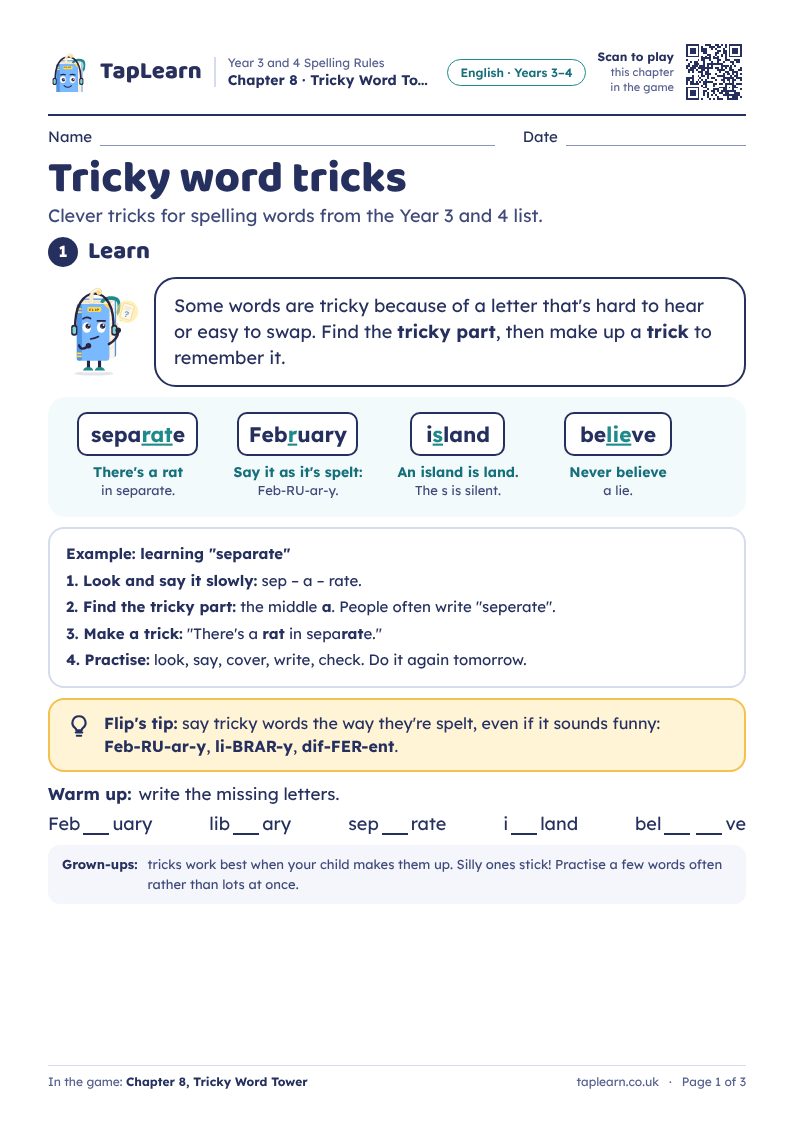
Tricky Word Tricks is a printable statutory spelling words worksheet for Years 3 and 4 (ages 7 to 9) that teaches children to find the tricky part of a word and make up a trick to remember it, like "there's a rat in separate". It covers the Years 3 to 4 statement on spelling words that are often misspelt.
This worksheet is for members
Membership opens every chapter of every game and every worksheet, for all your children.
See the plansAlready a member? Log in to print it.
Start with the free one: Prefix power (chapter 1).
Print it on A4, in colour or black and white. Do it after the chapter, or before it to see what your child already knows.
What's on the worksheet
Your child learns tricky words from the Year 3 and 4 list, like February, separate, island and believe, using memory tricks. Includes a trick makers activity with look, say, cover, write, check, and an answers sheet.
- Page 1 · Learn
- Four tricky words with memory tricks, a worked example learning separate, Flip's tip to say words the way they're spelt, and a missing-letters warm-up.
- Page 2 · Try it together
- Trick makers: say each word slowly, colour its tricky part, make up a trick together, then cover the word, write it from memory and check.
- Page 3 · Practise
- Ring correct spellings, find smaller words hiding inside, fill gaps with words from a box, write a sentence with two tricky words, and a challenge about Febuary.
- Answers sheet
- Every answer, mix-ups like swapping i and e, and spell-it-backwards and trick-swap ideas.
3 A4 pages and an answers sheet · about 25 minutes
Using it at home
- Tricks work when your child makes them up. Silly ones stick! Practise a few words often rather than lots at once.
- Stuck for a trick? Try "bus in business", "know + ledge in knowledge" or "fav-our-ite: it's our favourite".
- Spell a tricky word aloud forwards, then backwards: it makes you picture every letter.
Watch out for
- Leaving out letters you don't hear, like "Febuary" or "libary".
- Say the word slowly the way it's spelt.
- Swapping i and e, like "beleive".
- Use "never believe a lie". Tricks for single words work better than the i-before-e rhyme.
- Missing silent letters, like the s in island.
- Point them out and say them in a funny voice.
Questions from the worksheet
- Ring the correct spelling in each box: Febuary / February, separate / seperate, libary / library, beleive / believe, diffrent / different.
- Find a smaller word hiding inside each word: business, heart, island, height, knowledge, favourite.
- Fill each gap with a word from the box: Please ___ the red socks from the blue ones.
- Ava writes Febuary. She says, "That's how everyone says it, so that's how it's spelt." Is she right? What trick could help her?
The answers are on the answers sheet, for grown-ups.
National curriculum in England
This worksheet practises these statements from the Years 3–4 english programme of study:
- Use further prefixes and suffixes and understand how to add them (English appendix 1)
- Spell words that are often misspelt (English appendix 1)
In the classroom
- Play trick swap in pairs: each makes up a trick for one word and the other guesses it.
- Practise a few list words daily with look, say, cover, write, check.
Questions and answers
What are statutory spelling words?
They are words from the Year 3 and 4 word list in the national curriculum that children are expected to spell, like February, separate and island.
How can children remember tricky spellings?
Find the tricky part and make up a trick, like "there's a rat in separate", then practise with look, say, cover, write, check.
How do you spell February?
February has an r after the b. Saying it the way it's spelt, Feb-RU-ar-y, helps.
More worksheets from Year 3 and 4 Spelling Rules: Sail the Spell Isles with Pip
- Chapter 1: Prefixes worksheet: Prefix power Free
- Chapter 2: Doubling consonants worksheet: Double or not? Members
- Chapter 3: Adding suffixes worksheet: Suffix tricks Members
- Chapter 4: Tion, sion, ssion and cian worksheet: Shun endings Members
- Chapter 5: Unusual spellings worksheet: Surprise spellings Members
- Chapter 6: Homophones worksheet: Sound-alike words Members
- Chapter 7: Apostrophes for plural possession worksheet: Plural owners Members
 TapLearn