Homophones worksheet for Years 3–4: Sound-alike words
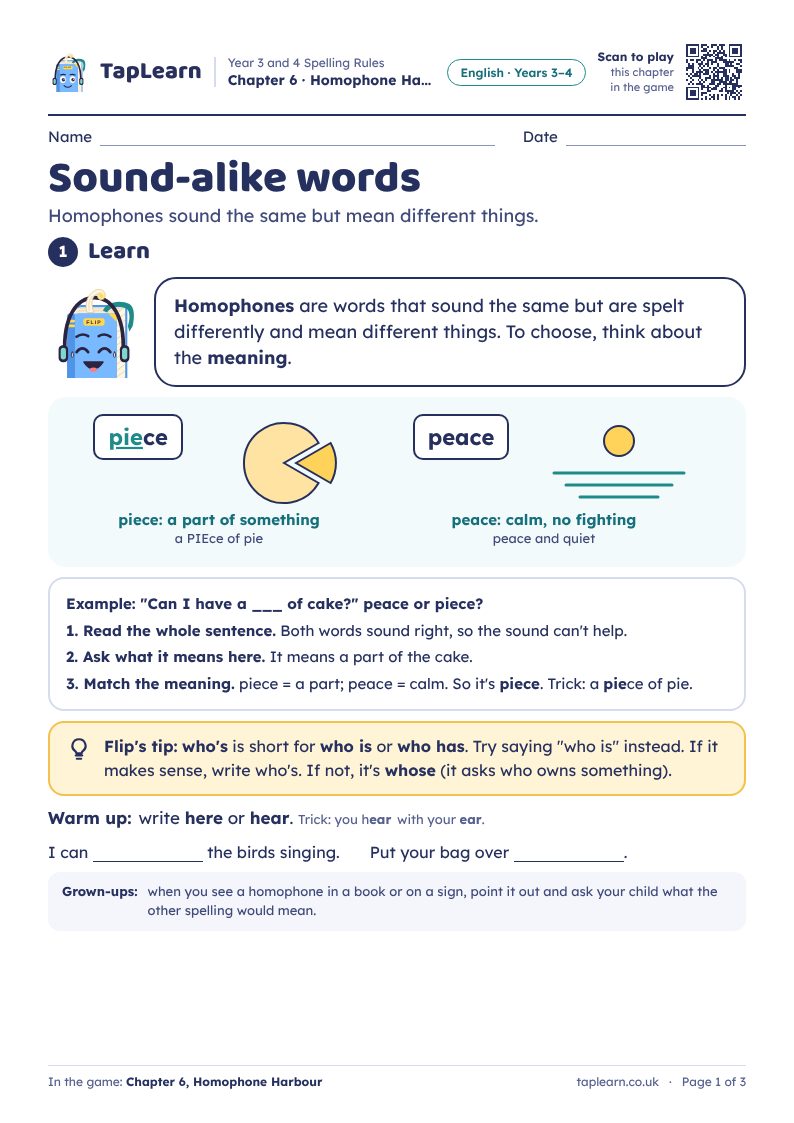
Sound-Alike Words is a printable homophones worksheet for Years 3 and 4 (ages 7 to 9) that teaches children to choose between words that sound the same by thinking about the meaning, with tricks like a piece of pie and hear with your ear. Children ring the right word in sentences, use the "who is" test for whose and who's, and write sentences with peace and piece.
This worksheet is for members
Membership opens every chapter of every game and every worksheet, for all your children.
See the plansAlready a member? Log in to print it.
Start with the free one: Prefix power (chapter 1).
Print it on A4, in colour or black and white. Do it after the chapter, or before it to see what your child already knows.
What's on the worksheet
Your child chooses the right homophone by its meaning, such as peace or piece, here or hear, and whose or who's, with memory tricks. Includes a draw-the-difference activity and an answers sheet.
- Page 1 · Learn
- Piece and peace with their meanings and a memory trick, a worked example choosing piece of cake, Flip's "who is" test, and a here-or-hear warm-up.
- Page 2 · Try it together
- Draw the difference: the grown-up reads homophone pairs like meet and meat, the child draws a quick picture for each, then spells the words by looking at the pictures.
- Page 3 · Practise
- Ring the right word in sentences, write whose or who's, choose words like berry or bury, write sentences with peace and piece, and a challenge about "Who's coat".
- Answers sheet
- Every answer, mix-ups like who's and whose, and homophone-riddle and make-up-tricks ideas.
3 A4 pages and an answers sheet · about 25 minutes
Using it at home
- When you see a homophone in a book or on a sign, point it out and ask what the other spelling would mean.
- Some words are hard to draw, like "not" or "plain": your child can draw an idea instead, such as a cross for not.
- Make up homophone riddles: "I sound like meet, but you can eat me. How am I spelt?"
Watch out for
- Picking by sound, like "a peace of cake".
- Both words sound right, so always ask what the word means in the sentence.
- Mixing up who's and whose.
- Use the "who is / who has" test every time. The apostrophe in who's shows letters are missing.
- Looking for one rule.
- Learn homophones in pairs, with a trick for each, like a piece of pie or hear with your ear.
Questions from the worksheet
- Ring the right word: Can I have a (peace / piece) of cake? Squeeze the (brake / break) to stop. The horse shook its (main / mane).
- Write whose or who's: ___ coming to the party? ___ shoes are these?
- Choose the right word: What a ___ idea! (grate / great) The ___ is sunny today. (weather / whether)
- Write two sentences: one using peace and one using piece.
- Leo writes, "Who's coat is this?" Is he right? Try the "who is" test to check.
The answers are on the answers sheet, for grown-ups.
National curriculum in England
This worksheet practises these statements from the Years 3–4 english programme of study:
- Use further prefixes and suffixes and understand how to add them (English appendix 1)
- Spell words that are often misspelt (English appendix 1)
In the classroom
- Collect homophone pairs on a class display with a memory trick for each.
- Use Practise B as a whose-or-who's show-me check.
Questions and answers
What are homophones?
Homophones are words that sound the same but are spelt differently and mean different things, like peace and piece.
How do you know whether to write whose or who's?
Try saying "who is" or "who has". If it makes sense, write who's. If not, it's whose.
How can children remember peace and piece?
Use a trick: a piece of pie. Piece means a part of something; peace means calm.
More worksheets from Year 3 and 4 Spelling Rules: Sail the Spell Isles with Pip
- Chapter 1: Prefixes worksheet: Prefix power Free
- Chapter 2: Doubling consonants worksheet: Double or not? Members
- Chapter 3: Adding suffixes worksheet: Suffix tricks Members
- Chapter 4: Tion, sion, ssion and cian worksheet: Shun endings Members
- Chapter 5: Unusual spellings worksheet: Surprise spellings Members
- Chapter 7: Apostrophes for plural possession worksheet: Plural owners Members
- Chapter 8: Statutory spelling words worksheet: Tricky word tricks Members
 TapLearn