Doubling consonants worksheet for Years 3–4: Double or not?
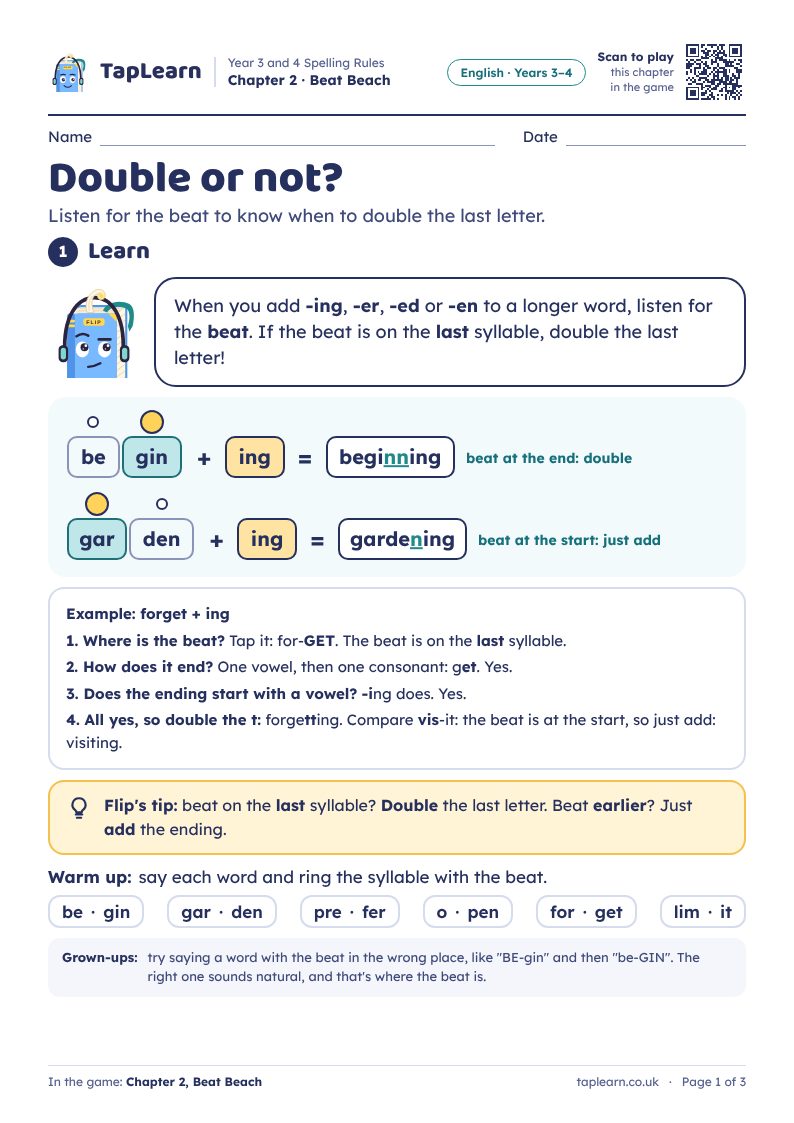
Double or Not? is a printable doubling consonants worksheet for Years 3 and 4 (ages 7 to 9) that teaches children to tap the beat in a word: if it's on the last syllable, double the last letter, as in beginning, but not in gardening. It covers the Years 3 to 4 statement on using further prefixes and suffixes and understanding how to add them.
This worksheet is for members
Membership opens every chapter of every game and every worksheet, for all your children.
See the plansAlready a member? Log in to print it.
Start with the free one: Prefix power (chapter 1).
Print it on A4, in colour or black and white. Do it after the chapter, or before it to see what your child already knows.
What's on the worksheet
Your child hears the beat in words like begin and garden to know when to double the last letter before -ing, -er or -ed, as in beginning and gardener. Includes a pot drums activity and an answers sheet.
- Page 1 · Learn
- Begin and garden compared by where the beat falls, a worked example adding -ing to forget, Flip's beat tip, and a ring-the-beat warm-up.
- Page 2 · Try it together
- Pot drums: turn a saucepan upside down, tap once for each syllable of a word and hit hardest on the beat, then use the rule to add -ing.
- Page 3 · Practise
- Ring correct spellings, add endings to words like occur and enter, fill gaps in sentences, explain beginner and gardener, and a challenge about gardenning.
- Answers sheet
- Every answer, mix-ups like doubling when the beat isn't at the end, and beat-clap and double-or-add ideas.
3 A4 pages and an answers sheet · about 25 minutes
Using it at home
- Try saying a word with the beat in the wrong place, like "BE-gin", then "be-GIN". The right one sounds natural.
- If hearing the beat is hard, try humming the word, or say it while stamping: the beat is where the stamp feels strongest.
- Clap family names and places together and find the beat in each one.
Watch out for
- Forgetting to double, like "begining".
- Drum the word: be-GIN has the beat at the end, so double.
- Doubling when the beat isn't at the end, like "gardenning" or "visitted".
- Check the beat before doubling.
- Being surprised by words ending in l, like travelling.
- In UK spelling these double the l even though the beat is at the start: that's a separate rule.
Questions from the worksheet
- Ring the correct spelling in each box: beginning / begining, gardenning / gardening, prefered / preferred, visitted / visited.
- Add the ending. Say the word first to find the beat: occur + ed, enter + ed, regret + ing, offer + ing.
- Fill the gap. Add the ending to the word in brackets: Mia kept ___ her coat. (forget + ing)
- Why does beginner have a double n, but gardener has one n?
- Sam writes gardenning. He says, "Garden ends with one vowel and one consonant, so I double the n." Is he right? What has he forgotten to check?
The answers are on the answers sheet, for grown-ups.
National curriculum in England
This worksheet practises these statements from the Years 3–4 english programme of study:
- Use further prefixes and suffixes and understand how to add them (English appendix 1)
- Spell words that are often misspelt (English appendix 1)
In the classroom
- Drum syllables as a class, with pupils stamping on the beat.
- Play double or add?: say a word and pupils show "double" or "add" cards for -ing.
Questions and answers
When do you double the last letter before -ing?
Double it when the beat is on the last syllable and the word ends with one vowel then one consonant, as in begin and beginning.
Why is gardening spelt with one n?
The beat in garden is on the first syllable (GAR-den), so you just add -ing.
How can children hear the beat in a word?
Tap or clap each syllable and hit hardest on the beat, or say the word with the beat in different places to hear which sounds right.
More worksheets from Year 3 and 4 Spelling Rules: Sail the Spell Isles with Pip
- Chapter 1: Prefixes worksheet: Prefix power Free
- Chapter 3: Adding suffixes worksheet: Suffix tricks Members
- Chapter 4: Tion, sion, ssion and cian worksheet: Shun endings Members
- Chapter 5: Unusual spellings worksheet: Surprise spellings Members
- Chapter 6: Homophones worksheet: Sound-alike words Members
- Chapter 7: Apostrophes for plural possession worksheet: Plural owners Members
- Chapter 8: Statutory spelling words worksheet: Tricky word tricks Members
 TapLearn