Silent letters worksheet for Year 2: Shh! Silent letters
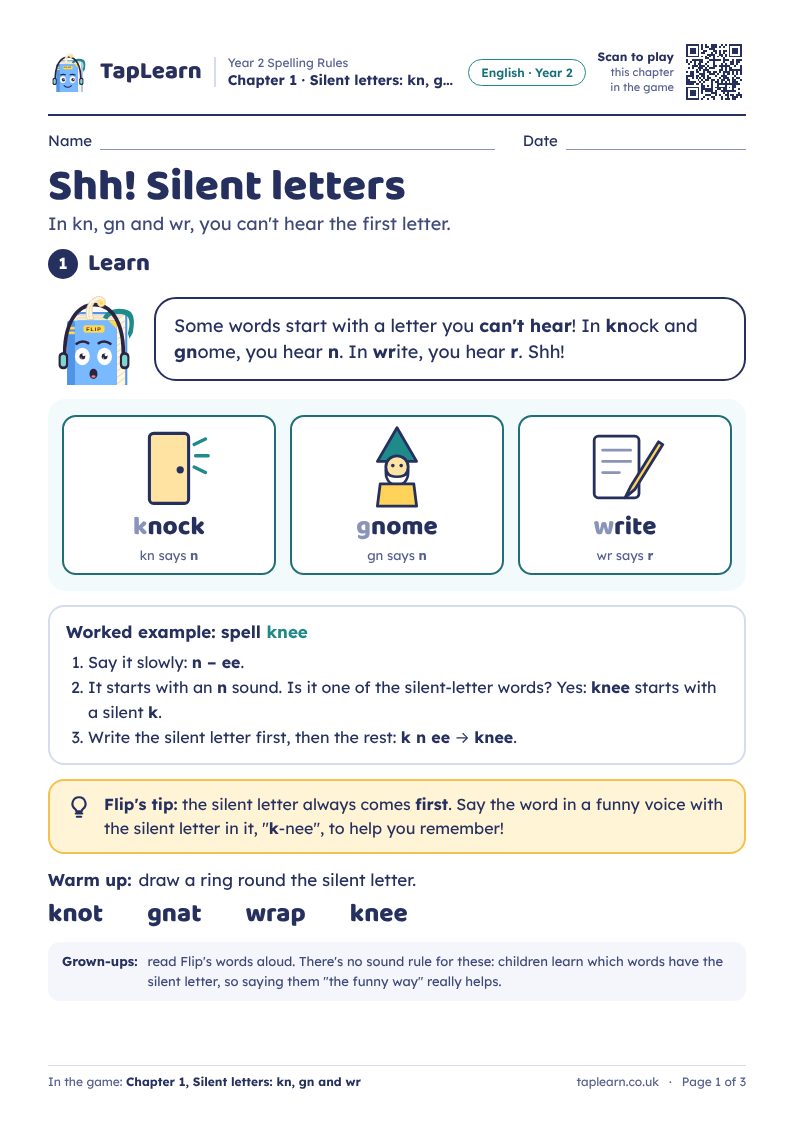
Shh! Silent Letters is a printable silent letters worksheet for Year 2 (ages 6 to 7) that teaches children to spell words starting with kn, gn and wr, like knock, gnome and write, by remembering the letter they can't hear. It covers the Year 2 statements on learning new ways of spelling phonemes for which one or more spellings are already known and applying the spelling rules and guidance in English appendix 1.
Free to print, no account needed.
Print it on A4, in colour or black and white. Do it after the chapter, or before it to see what your child already knows.
What's on the worksheet
Your child spells words that start with kn, gn and wr, like knock, gnome and write, where the first letter is silent. Includes a silent-letter hunt in a storybook and an answers sheet.
- Page 1 · Learn
- Knock, gnome and write with the sound each team makes, a worked example spelling knee, Flip's tip to say the word "the funny way", and a ring-the-silent-letter warm-up.
- Page 2 · Try it together
- Silent-letter hunt: look through a storybook for words starting with kn, gn or wr, whisper "shh!" at the silent letter, and write each word in the right column.
- Page 3 · Practise
- Write kn, gn or wr, ring the right spelling, correct a mistake in each sentence, sort words like knit, wrist and gnaw, and a challenge about gnock.
- Answers sheet
- Every answer, mix-ups like nee for knee, and funny-voices and air-writing ideas.
3 A4 pages and an answers sheet · about 20 minutes
Using it at home
- There's no sound rule for these words, so saying them "the funny way" (k-nee, w-rite) really helps them stick.
- In the hunt, don't worry if the gn column stays empty: gn words are rare. Most books have lots of know, knew, write and wrote.
- Say a kn, gn or wr word and your child writes it in the air, making the silent letter extra big.
Watch out for
- Leaving out the silent letter, like nee for knee or rite for write.
- Say the word "the funny way" with the silent letter sounded out.
- Using the wrong silent letter, like gnock for knock.
- kn is the most common; gn is only in a few words, like gnome, gnat and gnaw.
- Mixing up write and right.
- They sound the same but mean different things. Write is what you do with a pencil.
Questions from the worksheet
- Draw a ring round the right spelling: nee / knee, wrong / rong, nat / gnat, rite / write, know / gnow, nock / knock.
- Each sentence has a spelling mistake. Write the word correctly: I hurt my nee. Mia can rite her name.
- Sort the words. Write each one in the right box, kn, gn or wr: knit, wrist, gnaw, knob, wren, gnome.
- Ava wrote gnock for knock. "The g is silent, so it sounds right!" she says. Is she right?
The answers are on the answers sheet, for grown-ups.
National curriculum in England
This worksheet practises these statements from the Year 2 english programme of study:
- Spell by: learning new ways of spelling phonemes for which 1 or more spellings are already known, and learn some words with each spelling, including a few common homophones
- Apply spelling rules and guidance, as listed in English appendix 1
In the classroom
- Use the sorting task (Practise D) as a starter with words on cards.
- Run the silent-letter hunt in pairs with class reading books.
Questions and answers
What are silent letters?
Silent letters are letters you write but don't hear, like the k in knee, the g in gnat and the w in write.
Which silent letters do children learn in Year 2?
In Year 2, children learn words starting with kn, gn and wr, like knock, gnome and write.
How can children remember silent letter words?
Say the word "the funny way" with the silent letter sounded, like k-nock, then write it.
More worksheets from Year 2 Spelling Rules: Explore Spelling Village with Quill
- Chapter 2: Le and el endings worksheet: -le or -el? Members
- Chapter 3: Al and il endings worksheet: -al, -il and friends Members
- Chapter 4: Tion words worksheet: The -tion ending Members
- Chapter 5: Soft g and soft c worksheet Members
- Chapter 6: Alternative spellings worksheet: New ways to spell Members
- Chapter 7: Homophones worksheet: Sound-alike words Members
 TapLearn