Soft g and soft c worksheet for Year 2
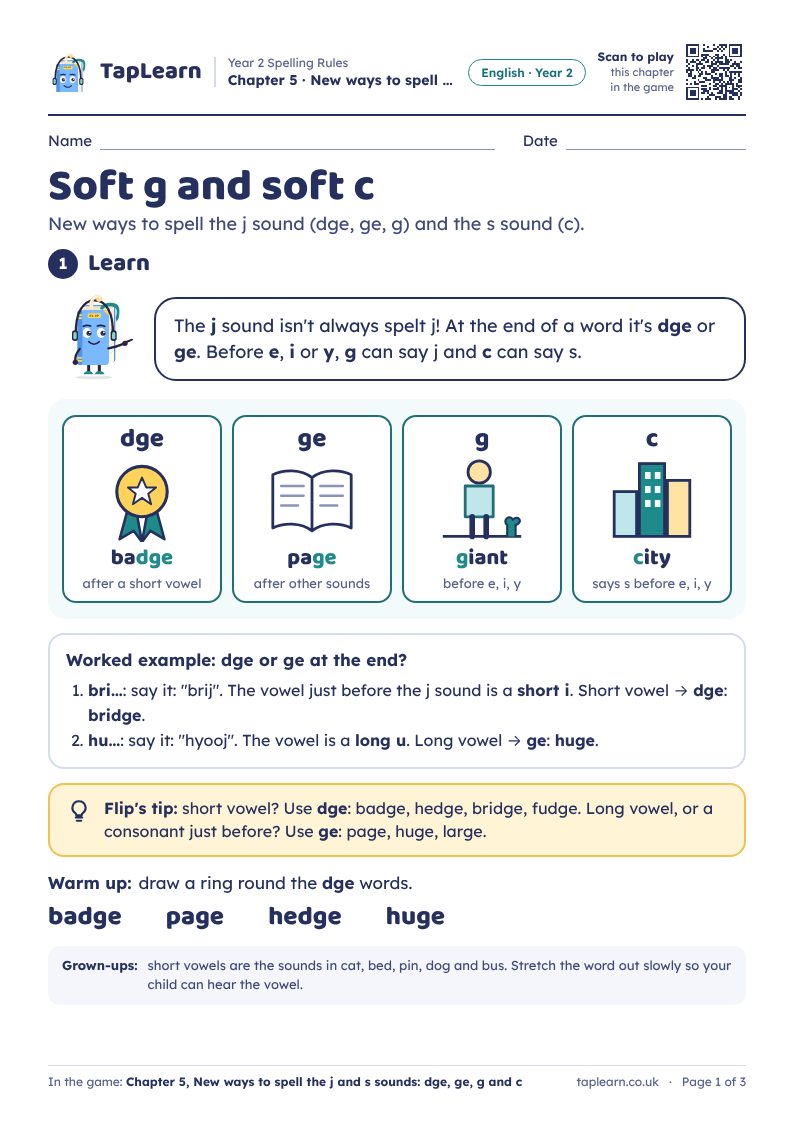
Soft g and Soft c is a printable soft g and soft c worksheet for Year 2 (ages 6 to 7) that teaches children to use dge after a short vowel and ge after a long one, and that g says j and c says s before e, i or y. It covers the Year 2 statements on learning new ways of spelling phonemes for which one or more spellings are already known and applying the spelling rules and guidance in English appendix 1.
This worksheet is for members
Membership opens every chapter of every game and every worksheet, for all your children.
See the plansAlready a member? Log in to print it.
Start with the free one: Shh! Silent letters (chapter 1).
Print it on A4, in colour or black and white. Do it after the chapter, or before it to see what your child already knows.
What's on the worksheet
Your child uses dge after a short vowel and ge after a long vowel, and learns that g says j and c says s before e, i or y, as in badge, page, giant and city. Includes a dge and ge word collecting walk and an answers sheet.
- Page 1 · Learn
- Badge, page, giant and city with when each spelling is used, a worked example choosing dge or ge for bridge and huge, Flip's tip on short vowels, and a warm-up.
- Page 2 · Try it together
- dge and ge collectors: walk round your home for things ending in a j sound, like a fridge or a page, say each slowly and sort it by its vowel.
- Page 3 · Practise
- Write dge or ge, g or j, and c or s, ring the words where g says j, write a sentence with a dge and a ge word, and a challenge about bage.
- Answers sheet
- Every answer, mix-ups like jiraffe and sity, and rhyme-time and hard-or-soft ideas.
3 A4 pages and an answers sheet · about 25 minutes
Using it at home
- Short vowels are the sounds in cat, bed, pin, dog and bus. Stretch the word out slowly so your child can hear the vowel.
- In the collecting walk, orange and large have a consonant just before the j sound, so they use ge.
- Find words that rhyme with hedge (edge, ledge) and with page (cage, stage). Which ending does each group use?
Watch out for
- Mixing up dge and ge, like bage for badge.
- Stretch the word: is the vowel short (cat) or long (cake)?
- Writing j instead of g, like jiraffe.
- Before e, i or y, the j sound is usually g. Before a, o or u it's j: jam, jog, jug.
- Writing s instead of c, like sity.
- c says s before e, i or y: city, ice, fancy.
Questions from the worksheet
- Write dge or ge: ba__, pa__, he__, bri__.
- Write g or j. Remember: g says j before e, i or y: __iraffe, __iant, __ump, __ym, __ug.
- Write c or s. Remember: c says s before e, i or y: __ity, __un, __ircle, __ock.
- Draw a ring round the words where g says j: giant, goat, gym, gap, magic, garden.
- Mia wrote bage for badge. Is she right? How can she tell?
The answers are on the answers sheet, for grown-ups.
National curriculum in England
This worksheet practises these statements from the Year 2 english programme of study:
- Spell by: learning new ways of spelling phonemes for which 1 or more spellings are already known, and learn some words with each spelling, including a few common homophones
- Apply spelling rules and guidance, as listed in English appendix 1
In the classroom
- Play hard or soft: say cat, city, goat, giant and pupils show hard or soft with a sign.
- Use Practise A to C as a mini-whiteboard check.
Questions and answers
When do you use dge or ge?
Use dge straight after a short vowel, as in badge and bridge. Use ge after a long vowel or a consonant, as in page, huge and large.
What is soft g?
Soft g is when g says j, which usually happens before e, i or y, as in giant, gym and magic.
What is soft c?
Soft c is when c says s, which happens before e, i or y, as in city, ice and fancy.
More worksheets from Year 2 Spelling Rules: Explore Spelling Village with Quill
- Chapter 1: Silent letters worksheet: Shh! Silent letters Free
- Chapter 2: Le and el endings worksheet: -le or -el? Members
- Chapter 3: Al and il endings worksheet: -al, -il and friends Members
- Chapter 4: Tion words worksheet: The -tion ending Members
- Chapter 6: Alternative spellings worksheet: New ways to spell Members
- Chapter 7: Homophones worksheet: Sound-alike words Members
 TapLearn