Homophones worksheet for Year 2: Sound-alike words
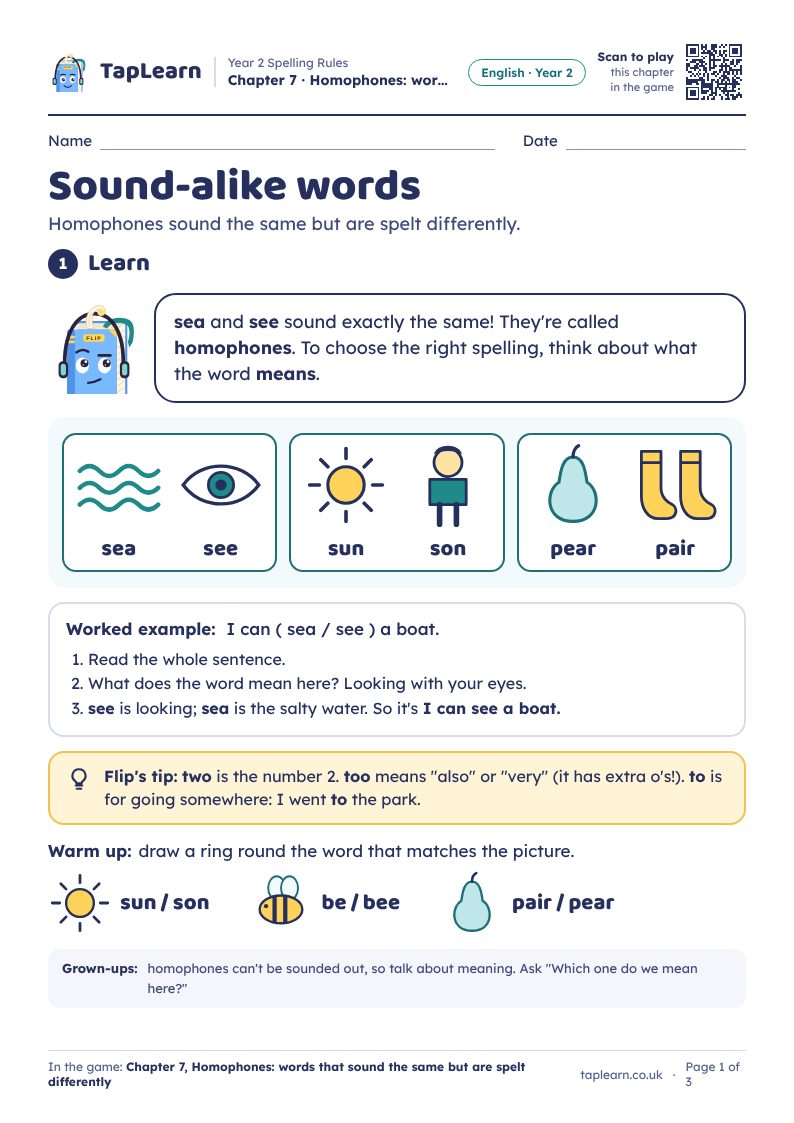
Sound-alike Words is a printable homophones worksheet for Year 2 (ages 6 to 7) that teaches children to choose between words like see and sea, here and hear, and to, too and two by thinking about what they mean. It covers the Year 2 statement on learning new ways of spelling phonemes, including a few common homophones.
This worksheet is for members
Membership opens every chapter of every game and every worksheet, for all your children.
See the plansAlready a member? Log in to print it.
Start with the free one: Shh! Silent letters (chapter 1).
Print it on A4, in colour or black and white. Do it after the chapter, or before it to see what your child already knows.
What's on the worksheet
Your child chooses the right spelling of words that sound the same, like see and sea, sun and son, and to, too and two, by thinking about the meaning. Includes a draw-the-pair activity and an answers sheet.
- Page 1 · Learn
- Sea and see, sun and son, pear and pair, a worked example choosing see in "I can see a boat", Flip's tip on to, too and two, and a picture warm-up.
- Page 2 · Try it together
- Draw the pair: choose two homophone pairs like sun/son or night/knight, draw a picture for each word, write the spelling under it and say a sentence.
- Page 3 · Practise
- Ring the right word in sentences, write to, too or two, fill gaps with here, hear, night or knight, write sentences with see and sea, and a challenge.
- Answers sheet
- Every answer, mix-ups like "I can sea", and which-one and homophone-hunt ideas.
3 A4 pages and an answers sheet · about 25 minutes
Using it at home
- Homophones can't be sounded out, so talk about meaning. Ask, "Which one do we mean here?"
- For words that are hard to draw, like be or blew, help your child draw a scene: someone blowing out candles for blew.
- Say a sentence ("I like the blue car") and ask which spelling you mean: blue or blew?
Watch out for
- Choosing by sound, like "I can sea".
- Ask, "What does it mean here?" Looking is see; water is sea.
- Mixing up to, too and two.
- Two is a number. Too has extra o's for "extra" (also, very). To is for going somewhere.
- Mixing up here and hear.
- You hear with your ear: the word ear is inside hear!
Questions from the worksheet
- Draw a ring round the right word: The ( sun / son ) is very hot today. The wind ( blue / blew ) my hat off.
- Write to, too or two: I have __ cats. We went __ the shop. This soup is __ hot!
- Write the right word in each gap: Come over __. (here / hear) The moon shines at __. (night / knight)
- Write one sentence with see and one with sea.
- Mia wrote: "I can sea the sea." Is she right? What would you change?
The answers are on the answers sheet, for grown-ups.
National curriculum in England
This worksheet practises these statements from the Year 2 english programme of study:
- Spell by: learning new ways of spelling phonemes for which 1 or more spellings are already known, and learn some words with each spelling, including a few common homophones
- Apply spelling rules and guidance, as listed in English appendix 1
In the classroom
- Use Practise B as a to, too, two mini-whiteboard check.
- Have pairs think of more homophone pairs (one/won, flower/flour) and draw them.
Questions and answers
What is a homophone?
A homophone is a word that sounds the same as another word but has a different spelling and meaning, like see and sea.
How do you know whether to use to, too or two?
Two is the number 2. Too means also or very. To is for going somewhere, as in "I went to the park".
What homophones do children learn in Year 2?
Year 2 children learn common pairs such as see and sea, sun and son, here and hear, night and knight, and to, too and two.
More worksheets from Year 2 Spelling Rules: Explore Spelling Village with Quill
- Chapter 1: Silent letters worksheet: Shh! Silent letters Free
- Chapter 2: Le and el endings worksheet: -le or -el? Members
- Chapter 3: Al and il endings worksheet: -al, -il and friends Members
- Chapter 4: Tion words worksheet: The -tion ending Members
- Chapter 5: Soft g and soft c worksheet Members
- Chapter 6: Alternative spellings worksheet: New ways to spell Members
 TapLearn