Comparing lengths of time worksheet for Year 2: How long?
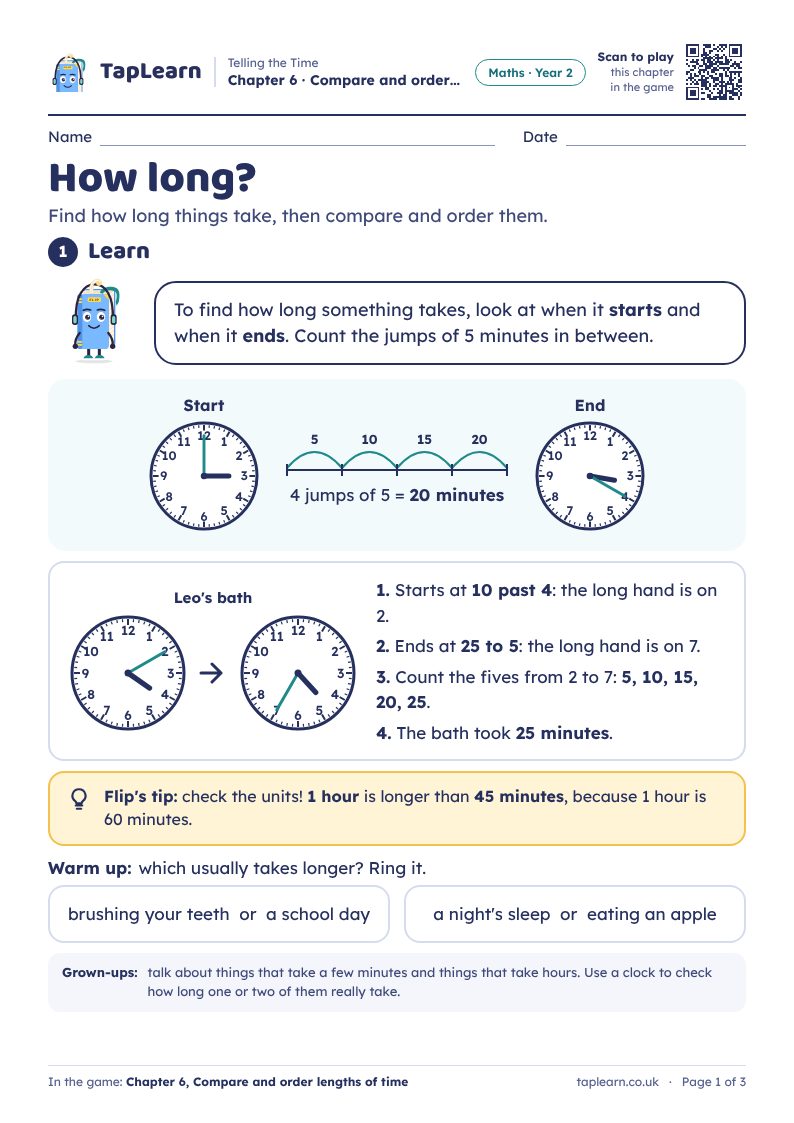
How Long? is a printable comparing lengths of time worksheet for Year 2 (ages 6 to 7) that teaches children to count the jumps of 5 minutes from start to end to find how long something takes, then compare minutes and hours. It covers the Year 2 maths statements on comparing and sequencing intervals of time and knowing the number of minutes in an hour.
This worksheet is for members
Membership opens every chapter of every game and every worksheet, for all your children.
See the plansAlready a member? Log in to print it.
Start with the free one: Quarter times (chapter 1).
Print it on A4, in colour or black and white. Do it after the chapter, or before it to see what your child already knows.
What's on the worksheet
Your child finds how long things take by counting on in fives from start to end, then compares and orders times in minutes and hours. Includes a time-the-jobs activity and an answers sheet.
- Page 1 · Learn
- Two clocks showing a start and end time, a worked example finding that Leo's bath took 25 minutes, Flip's tip to check the units, and a which-takes-longer warm-up.
- Page 2 · Try it together
- Time the jobs: choose 3 everyday jobs like putting on shoes, write the start and end times from a clock, work out how long each took, and put them in order.
- Page 3 · Practise
- Find how long from clock pairs, ring the longer time, order four times, a reading word problem, find how long from start and end times, and a challenge about finishing later.
- Answers sheet
- Every answer, mix-ups like thinking 45 minutes is longer than 1 hour, and longer-or-shorter and guess-then-check ideas.
3 A4 pages and an answers sheet · about 25 minutes
Using it at home
- In time the jobs, say it's not a race: just do each job as normal. Quick jobs might take only a minute or two.
- If a digital clock is easier, a grown-up can read the minutes while your child works out how long.
- When comparing, ask "How many minutes is 1 hour?" before your child decides which is longer.
Watch out for
- Thinking whatever finishes later took longer.
- Always look at the start as well as the end.
- Comparing the numbers, not the units, like thinking 45 minutes is longer than 1 hour.
- Change the hour to 60 minutes first.
- Miscounting the jumps of 5.
- Point to each number as you count on, starting with the first jump.
Questions from the worksheet
- Ring the longer time: 20 minutes or 1 hour? 45 minutes or 1 hour? 30 minutes or 25 minutes?
- Put these in order, from the shortest time to the longest: 1 hour, 10 minutes, 30 minutes, 5 minutes.
- Mia read for 20 minutes. Sam read for 35 minutes. Who read for longer? How much longer?
- Start: quarter past 8. End: half past 8. How long did that take?
- Mia's walk: 3 o'clock to 25 past 3. Leo's walk: 10 past 3 to half past 3. Leo says, "My walk was longer, because I finished later." Is he right?
The answers are on the answers sheet, for grown-ups.
National curriculum in England
This worksheet practises these statements from the Year 2 maths programme of study:
- Know the number of minutes in an hour and the number of hours in a day
- Compare and sequence intervals of time
Source: National curriculum in England: mathematics programmes of study (DfE)
In the classroom
- Use the warm-up as a talk partner starter on things that take minutes or hours.
- Time a few class routines, like tidying up, and order them on the board.
Questions and answers
How do you work out how long something takes?
Look at the start and end times, then count on in jumps of 5 minutes from the start to the end. From 10 past 4 to 25 to 5 is 25 minutes.
Is 45 minutes longer than 1 hour?
No. 1 hour is 60 minutes, so 1 hour is longer than 45 minutes.
Does finishing later mean something took longer?
No. You need the start time too: something that starts later can finish later and still be shorter.
More worksheets from Telling the Time for Year 2: Fix the Clocks of Time Town
- Chapter 1: Quarter past and quarter to worksheet: Quarter times Free
- Chapter 2: Minutes past the hour worksheet: Count in fives Members
- Chapter 3: Minutes to the hour worksheet: Minutes to Members
- Chapter 4: Drawing clock hands worksheet: Draw the hands Members
- Chapter 5: Minutes in an hour worksheet: Hours and days Members
 TapLearn