Drawing clock hands worksheet for Year 2: Draw the hands
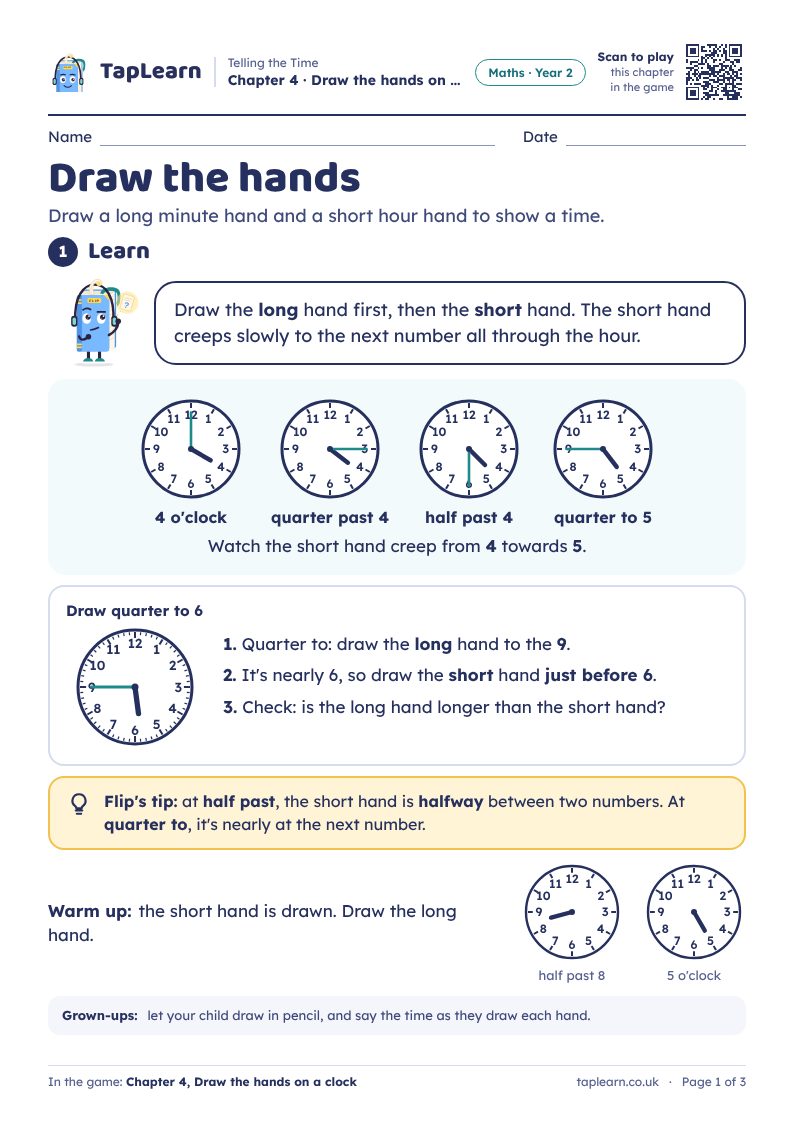
Draw the Hands is a printable drawing clock hands worksheet for Year 2 (ages 6 to 7) that teaches children to draw the long hand first and place the short hand between the right numbers, as the hour hand creeps on through the hour. It covers the Year 2 maths statement on drawing the hands on a clock face to show times to five minutes.
This worksheet is for members
Membership opens every chapter of every game and every worksheet, for all your children.
See the plansAlready a member? Log in to print it.
Start with the free one: Quarter times (chapter 1).
Print it on A4, in colour or black and white. Do it after the chapter, or before it to see what your child already knows.
What's on the worksheet
Your child draws the long minute hand and the short hour hand to show times to five minutes, putting the hour hand between the right numbers. Includes a paper plate clock activity and an answers sheet.
- Page 1 · Learn
- Four clocks showing the short hand creeping from 4 towards 5, a worked example drawing quarter to 6, Flip's tip on where the short hand goes, and a draw-the-long-hand warm-up.
- Page 2 · Try it together
- Paper plate clock: number a paper plate, use a long and a short strip as hands, and take turns saying times like quarter to 4 or 20 past 7 for the other person to set.
- Page 3 · Practise
- Draw both hands for quarter past 2, half past 7 and quarter to 11, then for 10 past 4, 25 past 9, 20 to 6 and 5 to 12, tick the right half past 6, and a challenge.
- Answers sheet
- Every answer, mix-ups like leaving the short hand on the number, and arm-clock and spot-the-short-hand ideas.
3 A4 pages and an answers sheet · about 25 minutes
In the classroom
- Use Practise C as a discussion starter: why are the other two clocks wrong?
- Give pairs mini clocks and call out times for them to set and check each other's short hand.
Questions from the worksheet
- Draw both hands: quarter past 2, half past 7, quarter to 11.
- Draw both hands: 10 past 4, 25 past 9, 20 to 6, 5 to 12.
- Which clock shows half past 6 the right way? Tick it.
- Ava drew quarter to 4 like this. Is she right? What would you change?
The answers are on the answers sheet, for grown-ups.
National curriculum in England
This worksheet practises this statement from the Year 2 maths programme of study:
- Tell and write the time to five minutes, including quarter past/to the hour and draw the hands on a clock face to show these times
Source: National curriculum in England: mathematics programmes of study (DfE)
Using it at home
- Let your child draw in pencil, and say the time aloud as they draw each hand.
- On the paper plate clock, look closely at the short hand: for 20 past 7 it should be a little past the 7, not right on it.
- Ask your child to draw the long hand first, then check: is the long hand longer than the short hand?
Watch out for
- Leaving the short hand on the number, like right on 4 for quarter to 4.
- The short hand moves all through the hour: at quarter to 4 it's just before the 4.
- Swapping the hands.
- Draw the long hand first and say "long for minutes".
- Putting the short hand near the wrong number for to times.
- It's heading towards the hour you say: quarter to 4 is nearly 4.
Questions and answers
How do you draw the hands on a clock?
Draw the long minute hand first, pointing to the minutes. Then draw the short hour hand near the hour, moving it on towards the next number as the hour goes by.
Where does the hour hand go at half past?
At half past, the short hour hand is halfway between two numbers, such as halfway between 7 and 8 at half past 7.
Why isn't the hour hand on the number at quarter to?
The hour hand moves slowly all through the hour, so at quarter to 4 it is nearly at 4 but not quite there.
More worksheets from Telling the Time for Year 2: Fix the Clocks of Time Town
- Chapter 1: Quarter past and quarter to worksheet: Quarter times Free
- Chapter 2: Minutes past the hour worksheet: Count in fives Members
- Chapter 3: Minutes to the hour worksheet: Minutes to Members
- Chapter 5: Minutes in an hour worksheet: Hours and days Members
- Chapter 6: Comparing lengths of time worksheet: How long? Members
 TapLearn