Pictograms worksheet for Year 2
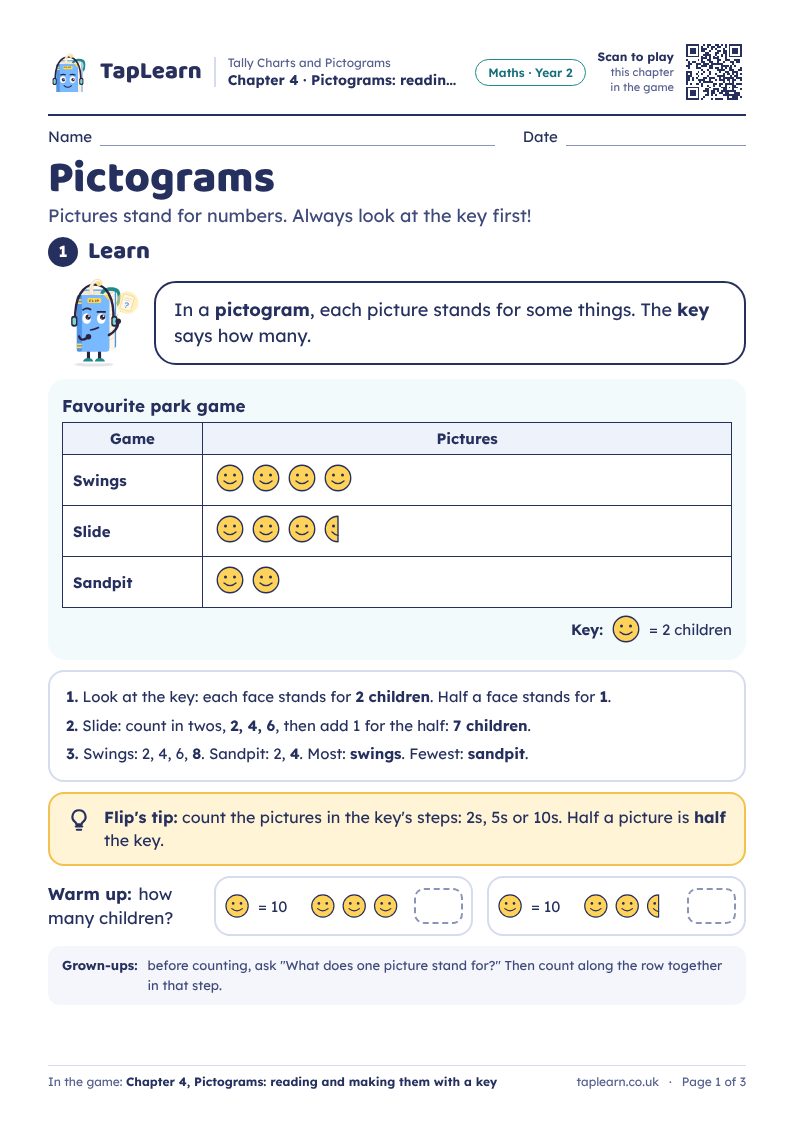
Pictograms is a printable pictograms worksheet for Year 2 (ages 6 to 7) that teaches children to read a pictogram using its key, including half pictures, and make one of their own. It covers the Year 2 maths statements to interpret and construct simple pictograms, tally charts, block diagrams and tables, and to sort categories by quantity.
This worksheet is for members
Membership opens every chapter of every game and every worksheet, for all your children.
See the plansAlready a member? Log in to print it.
Start with the free one: Tally marks (chapter 1).
Print it on A4, in colour or black and white. Do it after the chapter, or before it to see what your child already knows.
What's on the worksheet
Your child reads pictograms using the key, including half pictures, where each picture stands for 2 or 10, and makes a pictogram of their own. Includes a sock pictogram activity and an answers sheet.
- Page 1 · Learn
- A favourite park game pictogram with a key of 2, a worked example counting 7 for the slide including a half face, Flip's tip on counting in the key's steps, and a warm-up.
- Page 2 · Try it together
- Sock pictogram: sort socks into colours, count each colour, then draw one face for every pair and half a face for any odd sock.
- Page 3 · Practise
- Read a park visitors pictogram, read a books pictogram with a key of 10, make a pond pictogram with a key of 2, compare rows, and a challenge about Class 3.
- Answers sheet
- Every answer, mix-ups like ignoring the key or half pictures, and pizza toppings and hands-of-5 ideas.
3 A4 pages and an answers sheet · about 20 minutes
Using it at home
- Before counting, ask "What does one picture stand for?" Then count along the row in that step.
- Pairs make the key easy to see in the sock pictogram: one face for each pair, half a face for a sock on its own.
- Hold up a hand for every 5 toys and ask how many hands you'd need for 15.
Watch out for
- Ignoring the key.
- Point to the key first every time: "What is one picture worth?"
- Skipping a half picture or counting it as whole.
- Half a picture is half the key: 1 when the key is 2, and 5 when it is 10.
- Thinking the longest row is the most.
- Pictures can be different sizes. Count them, don't measure the row.
Questions from the worksheet
- Children at the park. Write how many came each day. Which day had the most children?
- Books read by each class. Look at the key! Write how many.
- Make a pictogram of the pond. Each face stands for 2 animals: fish 6, frogs 4, ducks 9.
- Leo looks at the books pictogram and says, "Class 3 read 4 books." Is he right? What did he forget?
The answers are on the answers sheet, for grown-ups.
National curriculum in England
This worksheet practises these statements from the Year 2 maths programme of study:
- Interpret and construct simple pictograms, tally charts, block diagrams and tables
- Ask and answer simple questions by counting the number of objects in each category and sorting the categories by quantity
Source: National curriculum in England: mathematics programmes of study (DfE)
In the classroom
- Make a class pictogram of favourite colours with a key of 2, discussing how to show an odd number.
- Use Practise D as a discussion about why the longer row isn't always more.
Questions and answers
What is a pictogram in Year 2?
A pictogram uses pictures to show data. A key tells you what each picture stands for, such as 1, 2, 5 or 10.
What does half a picture mean in a pictogram?
Half a picture is worth half the key. If one face stands for 2 children, half a face stands for 1.
Why check the key before counting?
If each picture stands for 10, counting the pictures as 1 each gives the wrong answer.
 TapLearn