Comparing data worksheet for Year 2: Add or compare?
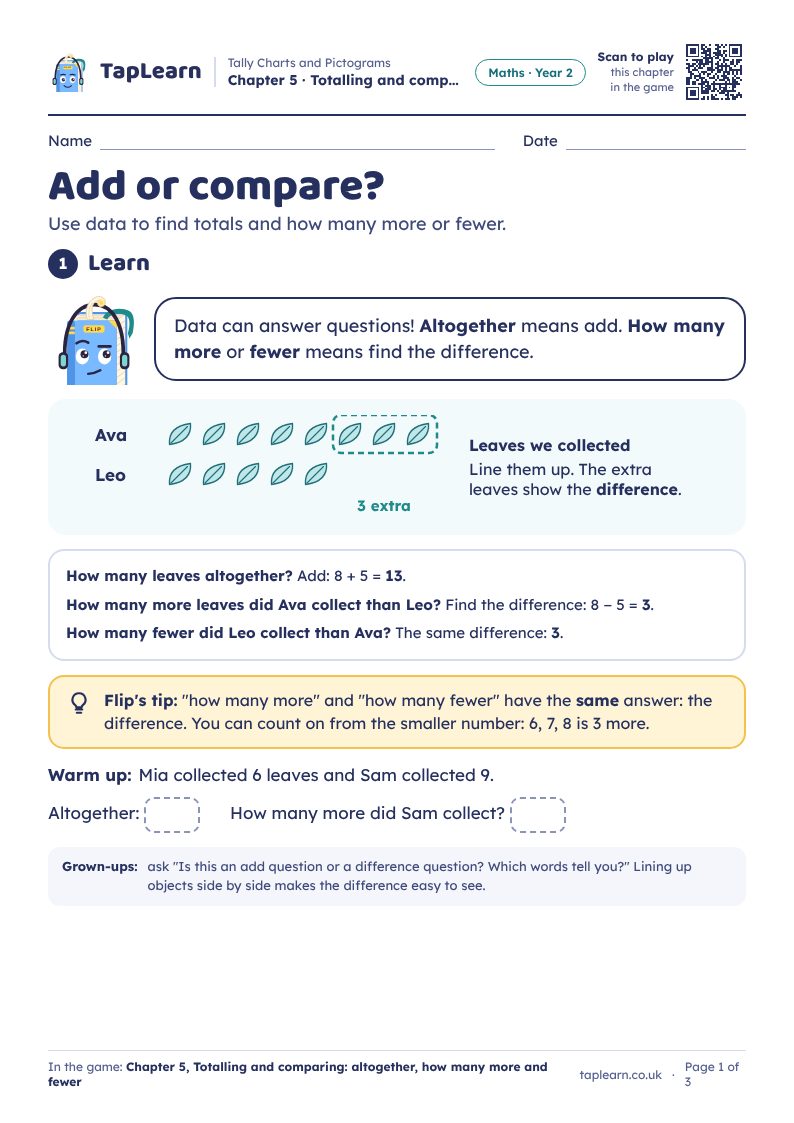
Add or Compare? is a printable comparing data worksheet for Year 2 (ages 6 to 7) that teaches children to add for altogether questions and find the difference for how many more or fewer. It covers the Year 2 maths statement to ask and answer questions about totalling and comparing categorical data.
This worksheet is for members
Membership opens every chapter of every game and every worksheet, for all your children.
See the plansAlready a member? Log in to print it.
Start with the free one: Tally marks (chapter 1).
Print it on A4, in colour or black and white. Do it after the chapter, or before it to see what your child already knows.
What's on the worksheet
Your child uses tables, block diagrams and pictograms to answer altogether questions by adding and how-many-more-or-fewer questions by finding the difference. Includes a toy count activity and an answers sheet.
- Page 1 · Learn
- Leaves collected by Ava and Leo lined up to show the difference, worked altogether and how-many-more questions, Flip's tip that more and fewer have the same answer, and a warm-up.
- Page 2 · Try it together
- Toy count: sort toys into three groups, count each, add two groups, then line two groups up side by side and count the extras with no partner.
- Page 3 · Practise
- Answer questions from a park animals table, a ride votes block diagram and an apple pictogram, write your own question, and a challenge about pigeons and dogs.
- Answers sheet
- Every answer, mix-ups like adding for how many more, and spoons and forks and question maker ideas.
3 A4 pages and an answers sheet · about 20 minutes
Using it at home
- Ask "Is this an add question or a difference question? Which words tell you?"
- Let your child check a how-many-more answer by lining up toys and counting the ones with no partner.
- Ask your child to make up an altogether or how-many-more question for you.
Watch out for
- Adding for "how many more".
- Line the two amounts up side by side and count the extra ones with no partner.
- Taking away for "altogether".
- Altogether means put the groups together: add.
Questions from the worksheet
- Animals in the park: squirrels and dogs altogether?
- How many more pigeons than ducks?
- Votes for the park ride: how many fewer for the swings than the slide?
- "How many more pigeons than dogs?" Sam writes 15 + 6 = 21. Is he right? What is the answer?
The answers are on the answers sheet, for grown-ups.
National curriculum in England
This worksheet practises these statements from the Year 2 maths programme of study:
- Ask and answer simple questions by counting the number of objects in each category and sorting the categories by quantity
- Ask-and-answer questions about totalling and comparing categorical data
Source: National curriculum in England: mathematics programmes of study (DfE)
In the classroom
- Use the warm-up as a mini-whiteboard starter on altogether and how many more.
- Give pairs a data table and ask each to write one altogether and one how-many-more question for their partner.
Questions and answers
How do you answer 'how many more' questions in Year 2?
Find the difference: take the smaller number from the bigger one, or count on from the smaller number.
Do 'how many more' and 'how many fewer' have the same answer?
Yes. Both ask for the difference. If Ava has 8 and Leo has 5, Ava has 3 more and Leo has 3 fewer.
What does 'altogether' mean?
Altogether means add the groups: 8 leaves and 5 leaves make 13 altogether.
 TapLearn