Listening comprehension worksheet for Year 1: Listen and remember
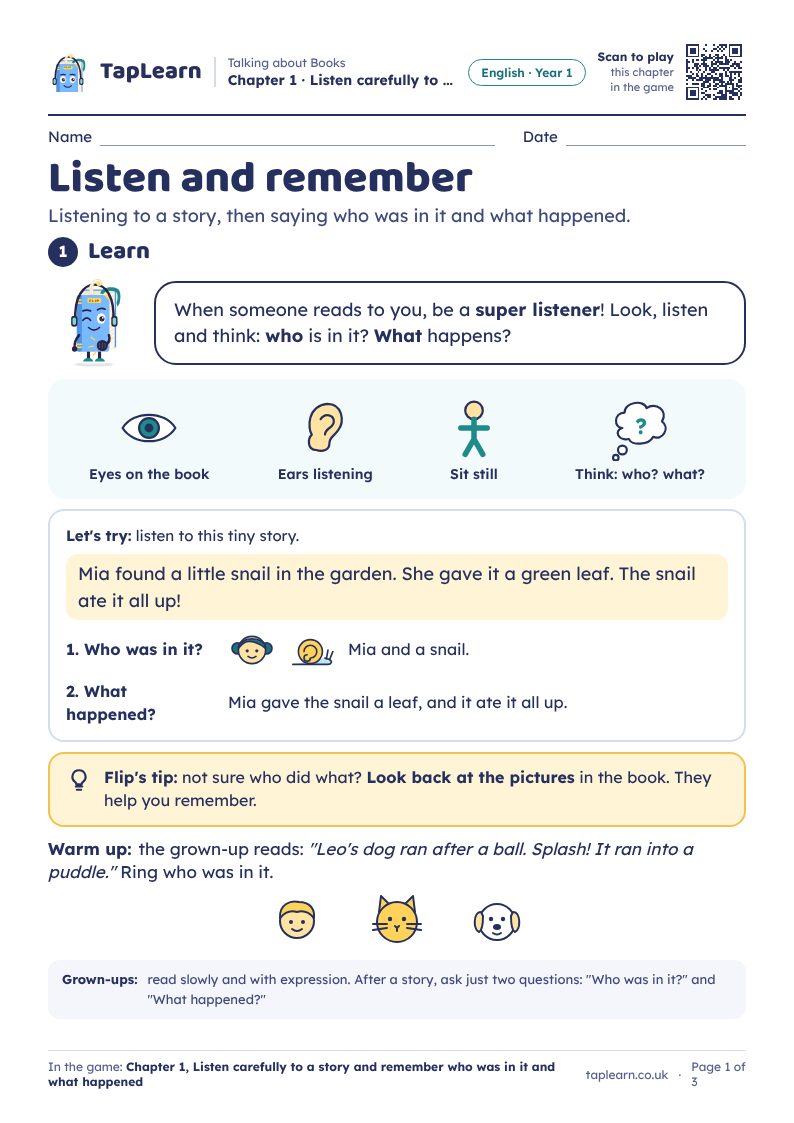
Listen and Remember is a printable listening comprehension worksheet for Year 1 (ages 5 to 6) that teaches children to be super listeners and then say who was in a story and what happened, using a read-aloud story called Hen's Windy Day. It covers the Year 1 statement on listening to and discussing a wide range of poems, stories and non-fiction at a level beyond that at which they can read independently.
What it practises: Learn what good listening looks like, then listen to a story read aloud, make a picture in your head and remember who was in it and what happened.
Free to print, no account needed.
Print it on A4, in colour or black and white. Do it after the chapter, or before it to see what your child already knows.
What's on the worksheet
Your child listens to a short story read aloud, then says who was in it, who did what and what happened first. Includes a story check activity with a favourite book and an answers sheet.
- Page 1 · Learn
- What a super listener does, a tiny story about Mia and a snail with who and what answers, Flip's tip to look back at the pictures, and a ring-who-was-in-it warm-up.
- Page 2 · Try it together
- Story check: read a favourite picture book together, close it, draw who was in it, say what happened while the grown-up writes it, then open the book to check.
- Page 3 · Practise
- Listen to Hen's Windy Day, ring who was in it, match who did what, tick whether things were in the story, order what happened, and a challenge about who shook the tree.
- Answers sheet
- Every answer, mix-ups like adding things that weren't in the book, and two-questions and spot-the-mistake ideas.
3 A4 pages and an answers sheet · about 20 minutes
Using it at home
- Read slowly and with expression. After a story, ask just two questions: "Who was in it?" and "What happened?"
- In the story check, if your child adds something that wasn't in the book, say "Let's look and check."
- Retell a favourite story with one thing wrong and see if your child can catch it.
Watch out for
- Mixing up who did what.
- Ask, "Who was it that…?" and look back at the words or pictures together.
- Remembering things that weren't in the book.
- Gently say, "Was that in the story? Let's check."
- Losing focus.
- Short stories read with lively voices help. Pause to ask "Who's this?" as you go.
Questions from the worksheet
- Who was in Hen's Windy Day? Draw a ring round them: Hen, Cat, Frog, Goat, Fish.
- Who did what? Draw a line to match: Hen, Frog, Goat with shook the tree, called for help, was too small to reach.
- Was it in the story? Tick yes or no: The wind blew Hen's hat into a tree. Hen climbed up the tree. The hat fell into the pond.
- Sam says, "Frog shook the tree!" Is he right? How could you check?
The answers are on the answers sheet, for grown-ups.
National curriculum in England
This worksheet practises this statement from the Year 1 english programme of study:
- Develop pleasure in reading, motivation to read, vocabulary and understanding by: listening to and discussing a wide range of poems, stories and non-fiction at a level beyond that at which they can read independently
In the classroom
- After a class story, ask who was in it and what happened, then check with the pictures.
- Read Hen's Windy Day aloud and use Practise C as a yes-or-no thumbs vote.
Questions and answers
How can I help my child remember a story?
After reading, ask "Who was in it?" and "What happened?", then look back at the pictures together to check.
What does good listening look like at story time?
Eyes on the book, ears listening, sitting still, and thinking about who is in the story and what happens.
Why read books aloud that are harder than my child can read?
Listening to stories beyond their reading level builds vocabulary and understanding, ready for when they read alone.
 TapLearn