Retelling a story worksheet for Year 1: Tell it back
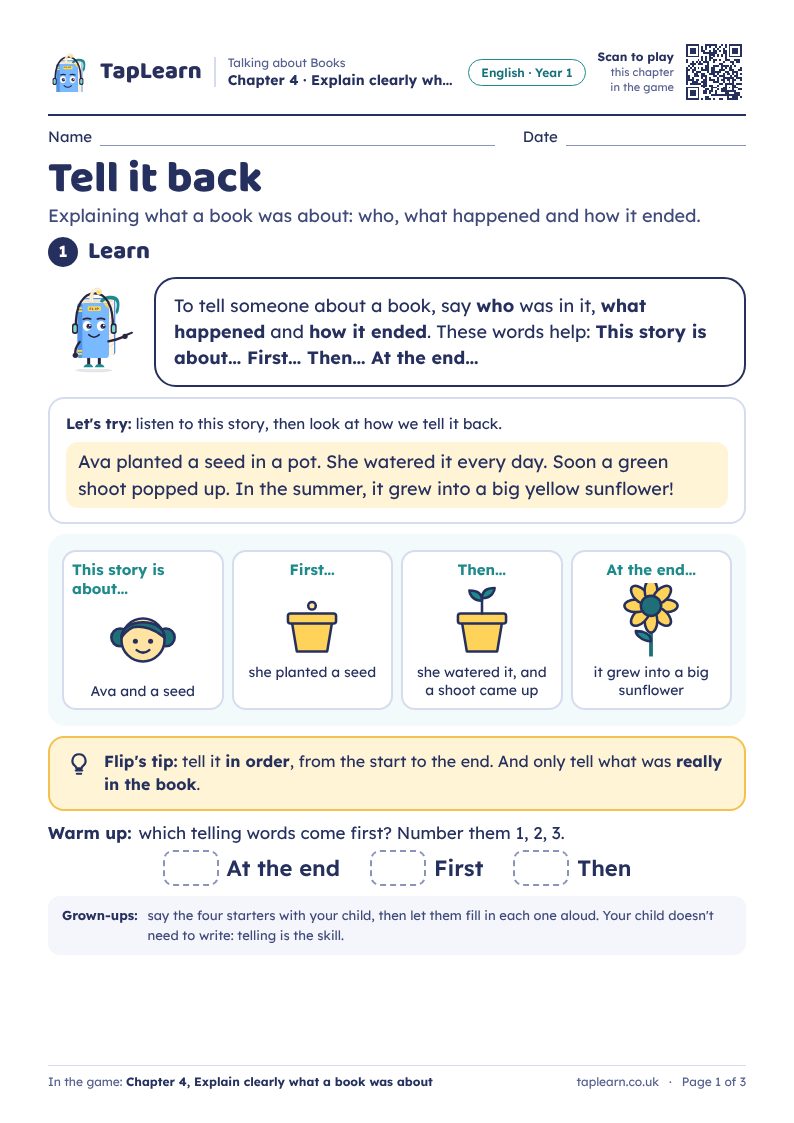
Tell It Back is a printable retelling a story worksheet for Year 1 (ages 5 to 6) that teaches children to explain a book using "This story is about…", "First…", "Then…" and "At the end…". It covers the Year 1 statement on explaining clearly their understanding of what is read to them.
What it practises: Explain your understanding of a story by saying who was in it, what happened and how it ended in order, explain why something happened, and sum up facts with "I found out that" (retelling).
This worksheet is for members
Membership opens every chapter of every game and every worksheet, for all your children.
See the plansAlready a member? Log in to print it.
Start with the free one: Listen and remember (chapter 1).
Print it on A4, in colour or black and white. Do it after the chapter, or before it to see what your child already knows.
What's on the worksheet
Your child explains what a book was about: who was in it, what happened in order and how it ended, using first, then and at the end. Includes a tell-someone-new activity and an answers sheet.
- Page 1 · Learn
- The four telling starters, a short sunflower story told back in four boxes, Flip's tip to tell it in order and only what was in the book, and a number-the-starters warm-up.
- Page 2 · Try it together
- Tell someone new: tell a book you've read together to someone who wasn't there, or a teddy, using the four starters, while the grown-up ticks each part you told.
- Page 3 · Practise
- Listen to The Paper Boat, number pictures in order, tick the telling that covers the whole story, tell back a book you know in four boxes, and a challenge about a muddled order.
- Answers sheet
- Every answer, mix-ups like telling only one bit, and phone-a-friend and five-finger-telling ideas.
3 A4 pages and an answers sheet · about 20 minutes
Using it at home
- Say the four starters with your child, then let them fill in each one aloud. Your child doesn't need to write: telling is the skill.
- In tell someone new, if your child tells only one bit, ask "What happened before that?" and "How did it end?"
- Let your child "phone" a toy and tell it about today's story.
Watch out for
- Telling only one bit, often the most exciting part.
- Ask, "How did it start?" and "How did it end?"
- Telling it in a muddled order.
- Use the starters First, Then, At the end, and flick back through the pictures.
- Adding made-up bits.
- Ask, "Was that in the book? Let's check."
Questions from the worksheet
- Which telling words come first? Number them 1, 2, 3: At the end, First, Then.
- Which telling of The Paper Boat tells the whole story? "The boat sank." or "Leo and Gran made a paper boat. They put it in a puddle, and the wind pushed it. At the end, it got soggy and sank."
- Tell back a book you know. Draw or write in each box: This story is about… First… Then… At the end…
- Sam told it like this: "The boat sank. Then they made a boat. Then the wind pushed it." What's wrong? How should it go?
The answers are on the answers sheet, for grown-ups.
National curriculum in England
This worksheet practises this statement from the Year 1 english programme of study:
- Explain clearly their understanding of what is read to them
In the classroom
- Display the four starters and use them to retell the class story together.
- Try five-finger telling in pairs: one finger each for who, where, first, then, at the end.
Questions and answers
How can children retell a story in order?
Use the starters "This story is about…", "First…", "Then…" and "At the end…", and look back through the pictures.
What should a good retelling include?
Who was in the story, what happened in order and how it ended, with only things that were really in the book.
Does my child need to write the retelling?
No. In Year 1, telling it aloud clearly is the skill; drawing or a grown-up scribing is fine.
 TapLearn