Roman numerals and zero worksheet for Year 4: Why zero matters
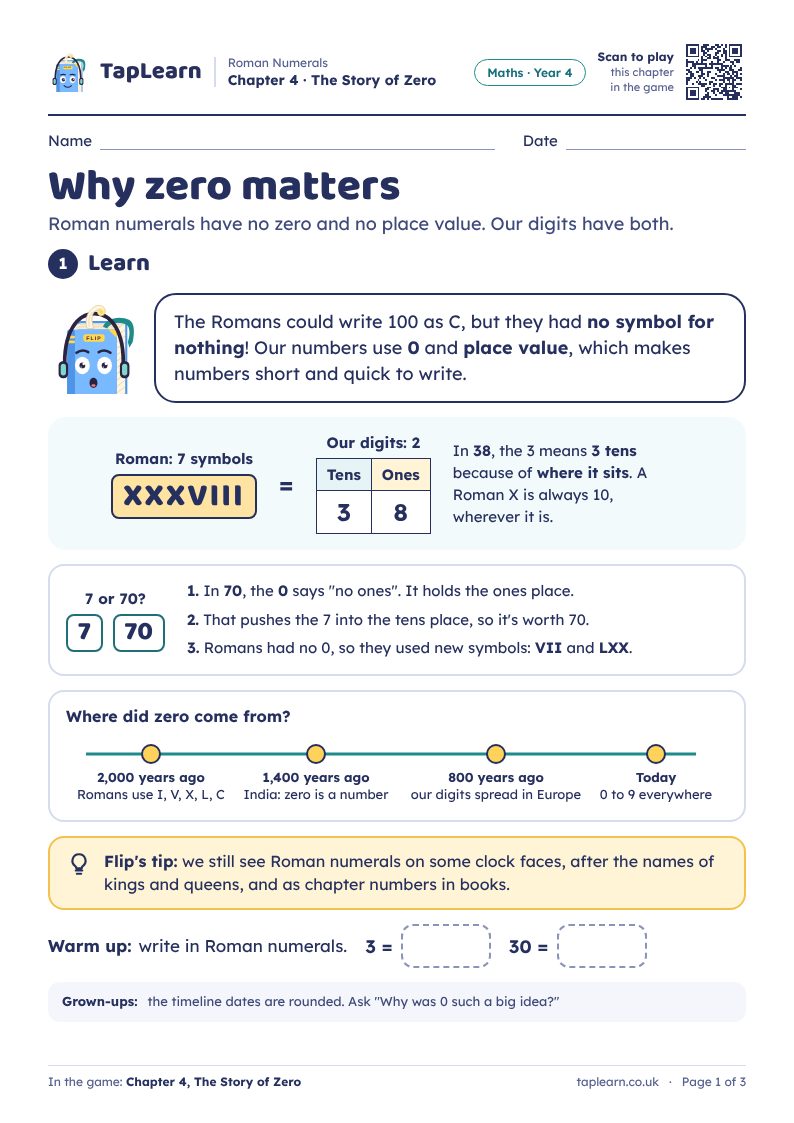
Why Zero Matters is a printable Roman numerals and zero worksheet for Year 4 (ages 8 to 9) that teaches children that Roman numerals have no zero and no place value, unlike our digits. It covers the Year 4 maths statement to know that over time, the numeral system changed to include the concept of 0 and place value.
Free to print, no account needed.
Print it on A4, in colour or black and white. Do it after the chapter, or before it to see what your child already knows.
What's on the worksheet
Your child finds out why Roman numerals have no zero and no place value, and how our digits use 0 to keep numbers short and clear. Includes a digits-against-symbols activity and an answers sheet.
- Page 1 · Learn
- 38 compared as two digits and seven Roman symbols, how the 0 in 70 holds the ones place, a short timeline of zero, Flip's tip on where Roman numerals are still seen, and a warm-up.
- Page 2 · Try it together
- Digits against symbols: write numbers that matter to you in digits and Roman numerals, count the marks each way needs, then hunt for the number to 100 with the most Roman symbols.
- Page 3 · Practise
- True or false statements about zero and place value, write tens in Roman numerals, match numbers like 14 and 41, give a reason digits are easier, and a challenge.
- Answers sheet
- Every answer, mix-ups like thinking O is a Roman zero, and zero hunt and Roman-or-not ideas.
3 A4 pages and an answers sheet · about 25 minutes
In the classroom
- Run digits against symbols as a class challenge to find the number to 100 needing the most Roman symbols.
- Discuss the timeline as a class: why might zero have been such a big idea?
Questions from the worksheet
- True or false? The Romans had a symbol for zero.
- Write each in Roman numerals. Is there a symbol for the 0? 10, 20, 50, 60, 70, 100
- Why are our digits easier than Roman numerals for big numbers? Write one reason.
- Sam says, "The Romans wrote zero as O." Is he right? How might a Roman show that there were no apples left?
The answers are on the answers sheet, for grown-ups.
National curriculum in England
This worksheet practises this statement from the Year 4 maths programme of study:
- Read Roman numerals to 100 (I to C) and know that over time, the numeral system changed to include the concept of 0 and place value
Source: National curriculum in England: mathematics programmes of study (DfE)
Using it at home
- The timeline dates on page 1 are rounded. Ask "Why was 0 such a big idea?"
- After the digits activity, try adding XXVII and XIV without turning them into digits, and talk about whether it's harder.
- Spot zeros around the house, on a clock or a phone, and say what each 0 is doing.
Watch out for
- Thinking O is a Roman zero.
- There isn't one: the Roman symbols up to 100 are only I, V, X, L and C.
- Thinking a digit always has the same value.
- The 4 in 40 and in 4 are worth different amounts. Point to the tens and ones places.
Questions and answers
Did the Romans have a zero?
No. Roman numerals have no symbol for zero. To show none, a Roman would use a word meaning nothing, or write nothing at all.
What is place value?
Place value means a digit's value depends on where it sits. In 38, the 3 means 3 tens. A Roman X is always 10, wherever it is.
Why does zero matter in our number system?
Zero holds an empty place, as in 70, so the other digits stay in the right places and numbers stay short.
 TapLearn