Roman numerals subtraction rule worksheet for Year 4: The take-away rule
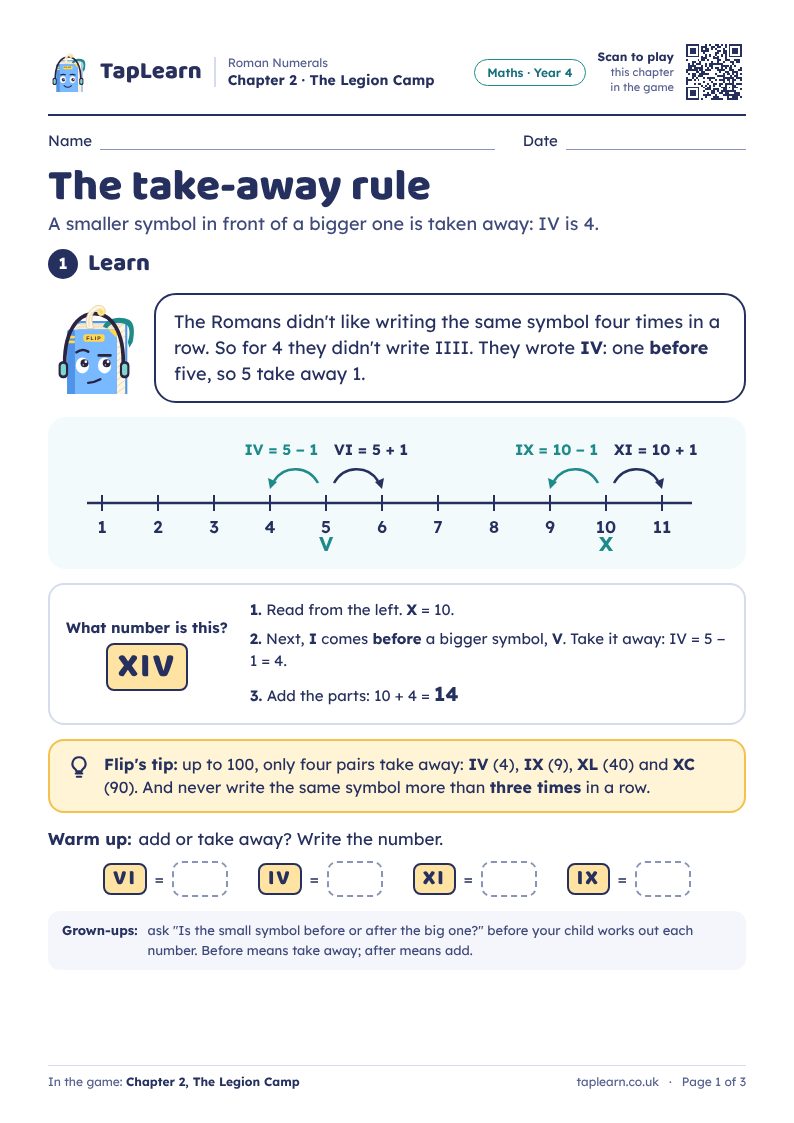
The Take-Away Rule is a printable Roman numerals subtraction rule worksheet for Year 4 (ages 8 to 9) that teaches children that a smaller symbol before a bigger one is taken away, as in IV and IX. It covers the Year 4 maths statement to read Roman numerals to 100 (I to C).
Free to print, no account needed.
Print it on A4, in colour or black and white. Do it after the chapter, or before it to see what your child already knows.
What's on the worksheet
Your child learns why IV is 4 and IX is 9: a smaller symbol before a bigger one is taken away. They read IV, IX, XL and XC and fix numerals like IIII. Includes a swap-the-soldiers card activity and an answers sheet.
- Page 1 · Learn
- Why the Romans wrote IV not IIII, IV, VI, IX and XI compared on a number line, a worked example reading XIV, Flip's tip on the four take-away pairs, and a warm-up.
- Page 2 · Try it together
- Swap the soldiers: put two symbol cards side by side, decide add or take away, then swap them round and compare, before a puzzle using X, I and V once each.
- Page 3 · Practise
- Read numerals like XL and XC, split numerals like XCIX into parts, rewrite signs that break the rule of three, true or false statements, and a challenge about IV.
- Answers sheet
- Every answer, the clock face IIII tradition, mix-ups like inventing pairs like IC, and before-or-after and countdown games.
3 A4 pages and an answers sheet · about 25 minutes
In the classroom
- Play before or after: say "X before C" and children write the number, then "X after C".
- Use the swap-the-soldiers cards in pairs to make and read pairs both ways round.
Questions from the worksheet
- Write the number: IX, XI, IV, XL, LX, XC
- Split each number into parts, then write it: XXIX, LXIV, XCIX
- These signs break the rule of three. Write them the Roman way: IIII (4), XXXX (40)
- Ava reads IV as 6. She says, "I is 1 and V is 5, and 1 + 5 = 6." What would you tell her?
The answers are on the answers sheet, for grown-ups.
National curriculum in England
This worksheet practises this statement from the Year 4 maths programme of study:
- Read Roman numerals to 100 (I to C) and know that over time, the numeral system changed to include the concept of 0 and place value
Source: National curriculum in England: mathematics programmes of study (DfE)
Using it at home
- Before each number, ask "Is the small symbol before or after the big one?" Before means take away; after means add.
- Only I and X are ever taken away, and only from the next two symbols up: I from V and X, X from L and C.
- Count down from 10 to 1 in Roman numerals together: X, IX, VIII, VII, VI, V, IV, III, II, I.
Watch out for
- Adding a symbol that comes first, like IV as 6 or XL as 60.
- Ask "Is the small one before or after the big one?"
- Copying IIII from a clock face.
- Some clocks show 4 as IIII as a clockmakers' tradition; the usual way, and the one used at school, is IV.
- Inventing new pairs like VX or IC.
- Only I and X are taken away, and only from the next two symbols up.
Questions and answers
Why is IV 4 in Roman numerals?
A smaller symbol before a bigger one is taken away, so IV is 5 − 1 = 4. VI, with the I after, is 5 + 1 = 6.
Which Roman numerals use the take-away rule to 100?
Up to 100, only four pairs take away: IV (4), IX (9), XL (40) and XC (90).
Why don't Romans write IIII for 4?
The rule is not to write the same symbol more than three times in a row, so 4 is IV.
 TapLearn