Roman numeral symbols worksheet for Year 4: Meet the Roman symbols
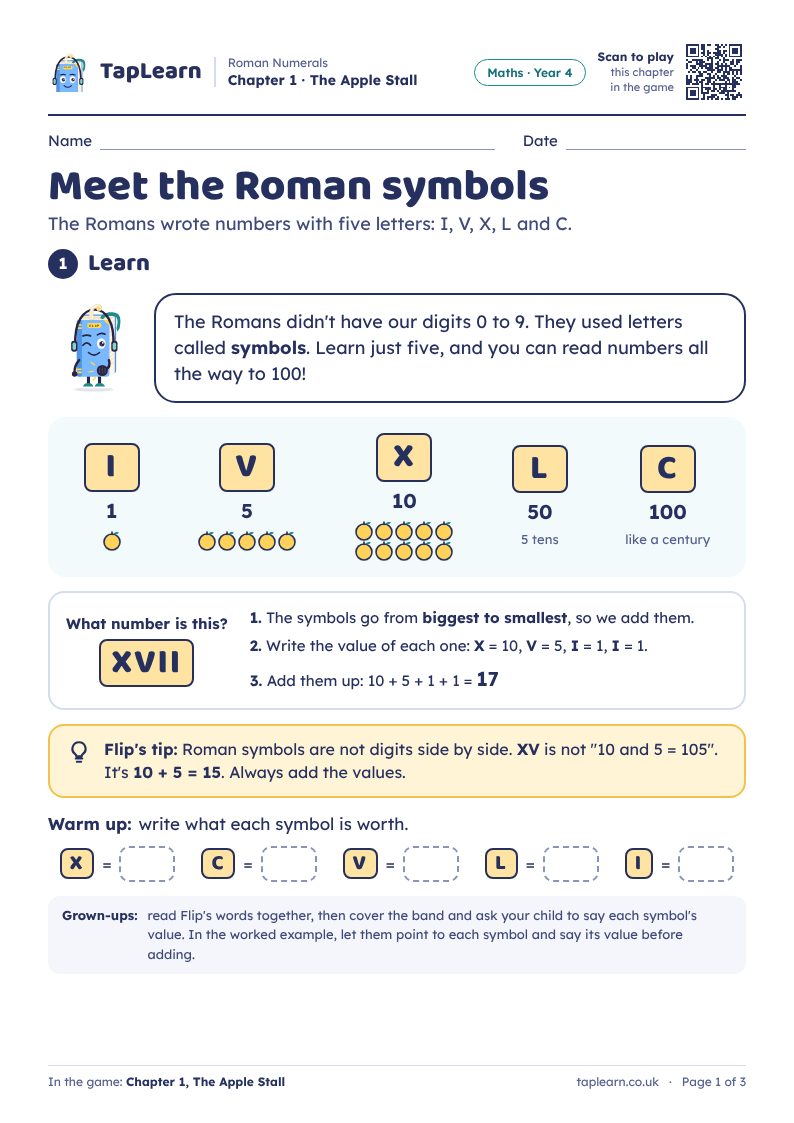
Meet the Roman Symbols is a printable Roman numeral symbols worksheet for Year 4 (ages 8 to 9) that teaches children the values of I, V, X, L and C and how to add symbols written biggest to smallest. It covers the Year 4 maths statement to read Roman numerals to 100 (I to C).
Free to print, no account needed.
Print it on A4, in colour or black and white. Do it after the chapter, or before it to see what your child already knows.
What's on the worksheet
Your child learns what I, V, X, L and C are worth and adds symbols written biggest to smallest, like XVII = 17. Includes a Roman market activity with paper symbol cards and pasta, and an answers sheet.
- Page 1 · Learn
- The five Roman symbols and their values, a worked example reading XVII as 17, Flip's tip that XV is not 105, and a symbol-values warm-up.
- Page 2 · Try it together
- The Roman market: make paper symbol cards, count out pasta and build the number with the cards biggest to smallest, then swap so the grown-up reads the child's numeral.
- Page 3 · Practise
- Match symbols to values, add up numerals like LXXVI, write 15, 20 and 52 in Roman numerals, ring the bigger of two numerals, and a challenge about XV and 105.
- Answers sheet
- Every answer, mix-ups like reading symbols as digits or mixing up L and C, and clock spotting and say-it-in-Roman games.
3 A4 pages and an answers sheet · about 25 minutes
In the classroom
- Play say it in Roman as a starter: call a number to 30 and children write its symbols on mini-whiteboards.
- Run the Roman market in small groups with counters and symbol cards.
Questions from the worksheet
- Add up the symbols. Write the number: LXXVI
- Write each number in Roman numerals: 15, 20, 52
- Draw a ring round the bigger number in each pair: C or LXXX
- Leo says XV means 105, because X is 10 and V is 5. Is he right? Explain how to read it.
The answers are on the answers sheet, for grown-ups.
National curriculum in England
This worksheet practises this statement from the Year 4 maths programme of study:
- Read Roman numerals to 100 (I to C) and know that over time, the numeral system changed to include the concept of 0 and place value
Source: National curriculum in England: mathematics programmes of study (DfE)
Using it at home
- Cover the symbol band and ask your child to say each symbol's value before starting the practice.
- In the Roman market, choose numbers without 4 or 9 in them for now; those use a rule that comes in the next sheet.
- Find a clock or watch face with Roman numerals and read the hours together.
Watch out for
- Reading symbols as digits, like XV as 105.
- Say "add the values" and write + signs between them: 10 + 5.
- Mixing up L and C.
- C is 100, like a century. L is half of that: 50.
- Thinking more symbols means a bigger number.
- LXXX has four symbols but is smaller than C, which has one. Compare values, not lengths.
Questions and answers
What are the Roman numeral symbols to 100?
I is 1, V is 5, X is 10, L is 50 and C is 100. With these five symbols you can write every number to 100.
How do you read Roman numerals written biggest to smallest?
Add the values of the symbols. XVII is 10 + 5 + 1 + 1 = 17.
Why isn't XV equal to 105?
Roman symbols aren't digits in places. You add their values, so XV is 10 + 5 = 15.
 TapLearn