Irregular past participles worksheet for Year 3: Gone, seen, eaten
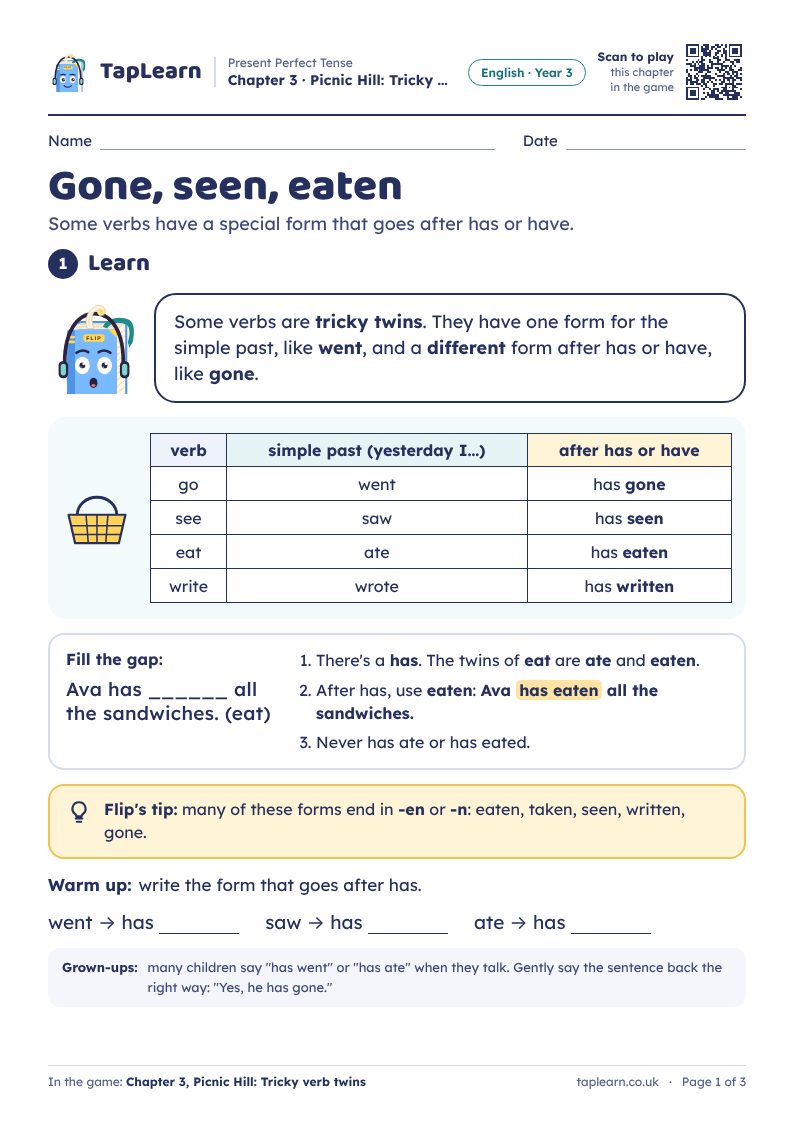
Gone, Seen, Eaten is a printable irregular past participles worksheet for Year 3 (ages 7 to 8) that teaches children that some verbs have one form for the simple past (went, saw, ate) and another after has or have (gone, seen, eaten). It covers the Year 3 statement on using the present perfect form of verbs instead of the simple past.
This worksheet is for members
Membership opens every chapter of every game and every worksheet, for all your children.
See the plansAlready a member? Log in to print it.
Start with the free one: Spot the present perfect (chapter 1).
Print it on A4, in colour or black and white. Do it after the chapter, or before it to see what your child already knows.
What's on the worksheet
Your child uses the special verb forms that go with has or have, like has gone, has seen and has eaten, never has went or has eated. Includes a teddy's picnic acting game and an answers sheet.
- Page 1 · Learn
- A table of verb twins like went and gone, a worked example filling the gap in "Ava has ___ all the sandwiches", Flip's tip on -en endings, and a warm-up.
- Page 2 · Try it together
- Teddy's picnic: set up a pretend picnic for a soft toy, pick verbs like drink, fall and give, act them out and say what has happened, like "Teddy has drunk his juice!"
- Page 3 · Practise
- Fill in missing verb twins, ring the right word, correct three mistakes, write the form after has for find and make, and a challenge about has eated.
- Answers sheet
- Every answer, mix-ups like has went, and twin ping-pong and have-you-ever ideas.
3 A4 pages and an answers sheet · about 20 minutes
Using it at home
- Many children say "has went" or "has ate" when they talk. Gently say the sentence back the right way: "Yes, he has gone."
- In teddy's picnic, drink, give and fall are good ones to try: drank and has drunk, gave and has given, fell and has fallen.
- Take turns asking "Have you ever…?" questions: "Have you ever seen a fox?"
Watch out for
- Using the simple past after has or have, like has went or have saw.
- Say, "After has or have, it's the other twin: gone, eaten, seen."
- Adding -ed to every verb, like has eated or has goed.
- Praise the thinking, then show the special form.
- Spoken habits like "I've went".
- It's common in some everyday speech, but in writing at school children use the standard form: I've gone.
Questions from the worksheet
- Draw a ring round the right word: Leo has went / gone to the shop. We have saw / seen a fox. Zoe has took / taken a photo.
- Each sentence has a mistake. Write it correctly: Mum has went to work. The dog has eated my sock. We have saw that film before.
- Some twins are identical: both forms are the same! Write the form after has: find → found → has ___; make → made → has ___.
- Sam wrote: I have eated my picnic. He says, "You just add -ed, like I have painted." Is he right? Explain.
The answers are on the answers sheet, for grown-ups.
National curriculum in England
This worksheet practises these statements from the Years 3–4 english programme of study:
- Develop their understanding of the concepts set out in English appendix 2 by: using the present perfect form of verbs in contrast to the past tense
- Text: use of the present perfect form of verbs instead of the simple past (Year 3 english)
In the classroom
- Play twin ping-pong: say a verb (swim) and pupils say both twins (swam, has swum).
- Use Practise A as a class verb-twin chart to add to.
Questions and answers
Is it has went or has gone?
It's has gone. Went is the simple past; after has or have, use gone: "Leo has gone to the shop."
What is a past participle?
A past participle is the verb form that goes after has or have, like gone, seen, eaten or painted.
Why is it has eaten, not has eated?
Eat is a tricky verb that doesn't take -ed. Its form after has or have is eaten.
 TapLearn