Simple past or present perfect worksheet for Year 3: Went or has gone?
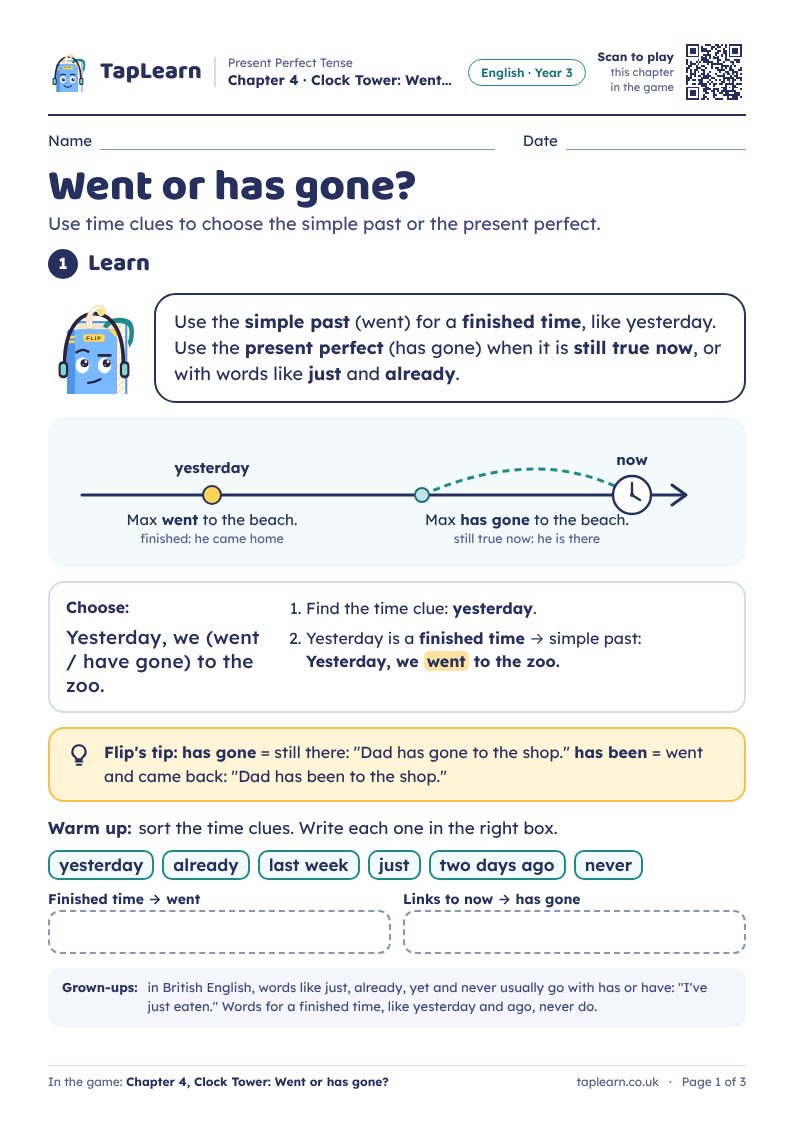
Went or Has Gone? is a printable simple past or present perfect worksheet for Year 3 (ages 7 to 8) that teaches children to use went with a finished time like yesterday, and has gone when something is still true now or with just and already. It covers the Year 3 statement on using the present perfect form of verbs instead of the simple past.
This worksheet is for members
Membership opens every chapter of every game and every worksheet, for all your children.
See the plansAlready a member? Log in to print it.
Start with the free one: Spot the present perfect (chapter 1).
Print it on A4, in colour or black and white. Do it after the chapter, or before it to see what your child already knows.
What's on the worksheet
Your child uses time clues to choose the simple past for a finished time like yesterday, and the present perfect when it is still true now, and tells has gone from has been. Includes a been-or-gone game and an answers sheet.
- Page 1 · Learn
- Max went and Max has gone on a timeline, a worked example choosing went after yesterday, Flip's tip on has gone and has been, and a sort-the-time-clues warm-up.
- Page 2 · Try it together
- Been or gone?: the grown-up leaves the room, the child says "Mum has gone to the kitchen", and when they return says "Mum has been to the kitchen", then you each say something from yesterday.
- Page 3 · Practise
- Ring the right verb using the time clue, write has gone or has been, correct three mistakes, write about yourself with yesterday and just or already, and a challenge.
- Answers sheet
- Every answer, mix-ups like "Yesterday we have gone", and time-detective and gone-or-been ideas.
3 A4 pages and an answers sheet · about 20 minutes
Using it at home
- In British English, words like just, already, yet and never usually go with has or have. Words for a finished time, like yesterday and ago, never do.
- In been or gone?, add a time detective question each round: "Is Mum still in the kitchen? So is it has gone or has been?"
- Say a sentence with the time clue missing ("…we went to the park") and your child adds a clue that fits, like "Last Saturday".
Watch out for
- Using has or have with a finished time, like "yesterday we have gone".
- Ask, "Is there a when word, like yesterday or ago? Then it's went."
- Using went for something still true now, like "Look, the bus went!"
- Ask, "Is it still true now? Then use has: the bus has gone."
Questions from the worksheet
- Look for the time clue. Draw a ring round the right verb: Yesterday, Leo went / has gone swimming. I just ate / have just eaten my lunch, so I'm full.
- Write has gone or has been: Max isn't here. He ___ to the park. Gran ___ to the shop. Look, she's back with the milk.
- Each sentence has a mistake. Write it correctly: Yesterday we have gone to the beach. Last week, Sam has broken his arm.
- Mia says, "Yesterday I have played football is right, because it happened in the past." Is she right? Explain.
The answers are on the answers sheet, for grown-ups.
National curriculum in England
This worksheet practises these statements from the Years 3–4 english programme of study:
- Develop their understanding of the concepts set out in English appendix 2 by: using the present perfect form of verbs in contrast to the past tense
- Text: use of the present perfect form of verbs instead of the simple past (Year 3 english)
In the classroom
- Use the warm-up time clues as a card sort on the board.
- Play been or gone? as a class game when someone leaves the room on an errand.
Questions and answers
When do you use went or has gone?
Use went for a finished time, like yesterday or last week. Use has gone when it is still true now, or with words like just and already.
What is the difference between has gone and has been?
Has gone means still there: "Dad has gone to the shop." Has been means went and came back: "Dad has been to the shop."
Can you say "Yesterday I have played"?
No. Yesterday is a finished time, so use the simple past: "Yesterday I played football."
 TapLearn