Has or have worksheet for Year 3: Has or have?
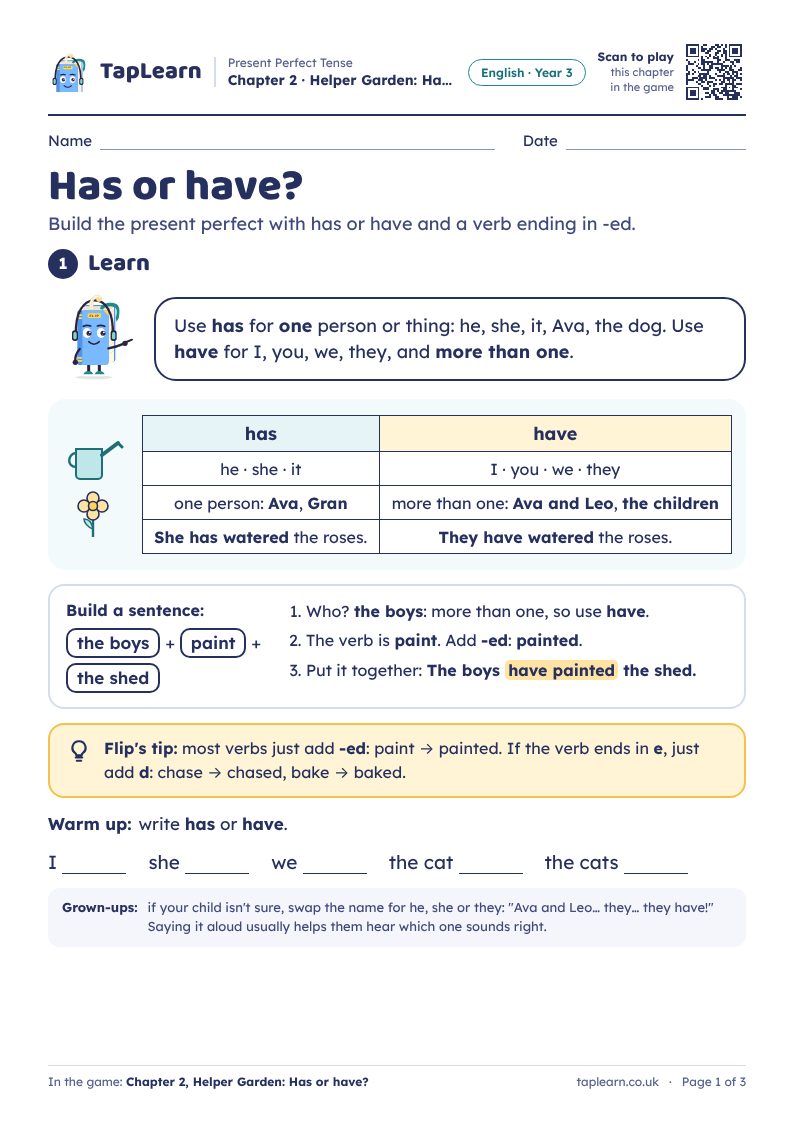
Has or Have? is a printable has or have worksheet for Year 3 (ages 7 to 8) that teaches children to use has for one person or thing and have for I, you, we, they and more than one, with an -ed verb. It covers the Years 3 to 4 statement on using the present perfect form of verbs in contrast to the past tense.
This worksheet is for members
Membership opens every chapter of every game and every worksheet, for all your children.
See the plansAlready a member? Log in to print it.
Start with the free one: Spot the present perfect (chapter 1).
Print it on A4, in colour or black and white. Do it after the chapter, or before it to see what your child already knows.
What's on the worksheet
Your child builds the present perfect with has (he, she, it) or have (I, you, we, they) and an -ed verb, like she has painted. Includes a little-helpers jobs activity and an answers sheet.
- Page 1 · Learn
- Which words go with has and have, a worked example building "The boys have painted the shed", Flip's tip on adding -ed or d, and a has-or-have warm-up.
- Page 2 · Try it together
- Little helpers: do four quick jobs like watering a plant or folding socks, then say what has been done with has or have, like "We have folded the socks", and write it.
- Page 3 · Practise
- Ring has or have, build present perfect sentences, correct three mistakes, write two sentences about jobs done today, and a challenge about Ava and Leo.
- Answers sheet
- Every answer, mix-ups like they has, and bedtime-round-up and silly-swaps ideas.
3 A4 pages and an answers sheet · about 20 minutes
Using it at home
- If your child isn't sure, swap the name for he, she or they: "Ava and Leo… they… they have!" Saying it aloud usually helps.
- In little helpers, tidy and wipe use Year 2 spelling rules: tidy becomes tidied (y to i), wipe becomes wiped (just add d).
- At bedtime, take turns to say what each person in the family has done today.
Watch out for
- Swapping has and have, like they has or I has.
- I always goes with have. Swap names for he, she or they to check.
- Using has with two names joined by and.
- Two names joined by and are more than one, so use have.
- Leaving off -ed, like has chase.
- Read it aloud: "has chase" sounds unfinished. The verb after has or have needs its ending.
Questions from the worksheet
- Draw a ring round has or have: Ava has / have planted seeds. We has / have cleaned the shed. They has / have picked apples.
- Build the present perfect. Choose has or have, and add -ed: she + paint the fence; they + water the plants; the cat + chase a leaf.
- Each sentence has a mistake. Write it correctly: They has watered the roses. The puppy has chase the ball.
- Mia wrote: Ava and Leo has helped in the garden. She says, "Ava has, and Leo has, so it's has." Is she right? Explain.
The answers are on the answers sheet, for grown-ups.
National curriculum in England
This worksheet practises these statements from the Years 3–4 english programme of study:
- Develop their understanding of the concepts set out in English appendix 2 by: using the present perfect form of verbs in contrast to the past tense
- Text: use of the present perfect form of verbs instead of the simple past (Year 3 english)
In the classroom
- Play silly swaps: say "The dogs has barked" and pupils fix it on mini whiteboards.
- Use Practise B as a sentence-building task in pairs.
Questions and answers
When do you use has or have?
Use has with he, she, it and one person or thing. Use have with I, you, we, they and more than one.
Is it they has or they have?
It's they have. They means more than one, so it takes have: "They have watered the roses."
How do you make the present perfect?
Use has or have, then a verb with its ending, like painted or chased: "She has painted the fence."
 TapLearn