Prepositions of time worksheet for Year 3: Before, during, after
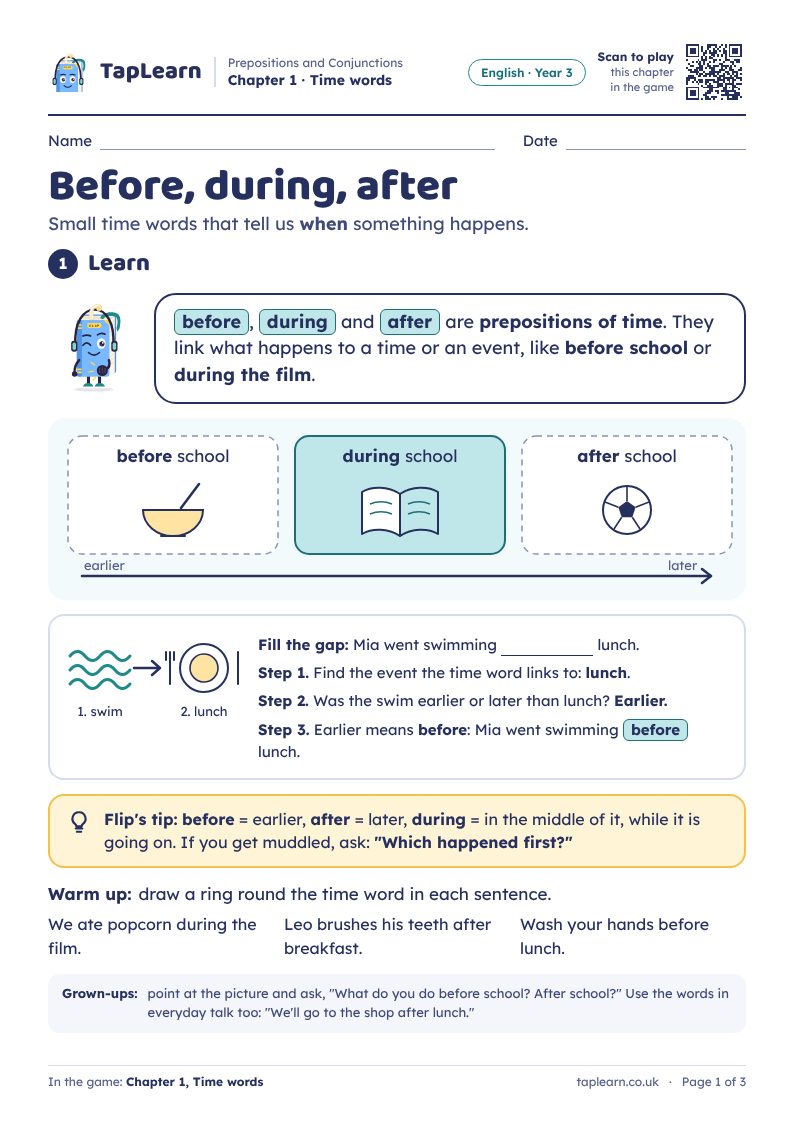
Before, During, After is a printable prepositions of time worksheet for Year 3 (ages 7 to 8) that teaches children to link what happens to a time or event, like before school or during the film. It covers the Year 3 grammar statement on expressing time using prepositions.
Free to print, no account needed.
Print it on A4, in colour or black and white. Do it after the chapter, or before it to see what your child already knows.
What's on the worksheet
Your child uses before, during and after as prepositions of time to say when things happen, and fixes before and after mix-ups. Includes a my-day-in-order activity and an answers sheet.
- Page 1 · Learn
- Before, during and after school on a timeline, a worked example choosing before for Mia's swim, Flip's tip to ask which happened first, and a ring-the-time-word warm-up.
- Page 2 · Try it together
- My day in order: write or draw 6 things from a school day on scraps of paper, lay them out from morning to night, and say sentences with before, after and during. Then catch the grown-up's mix-ups.
- Page 3 · Practise
- Fill gaps about Ava's Saturday, choose before, during or after, fix two time-word mix-ups, write sentences about your weekend, and a challenge about saying it two ways.
- Answers sheet
- Every answer, mix-ups like using during for something short, and bedtime-recap and silly-order ideas.
3 A4 pages and an answers sheet · about 25 minutes
Using it at home
- Use the words in everyday talk, like "We'll go to the shop after lunch", and ask what your child does before and after school.
- If your child mixes up before and after, put a finger on the first scrap and say "This one is earlier, so it comes before."
- At bedtime, recap the day together: "What did you do after lunch?"
Watch out for
- Mixing up before and after.
- Ask "Which happened first?" and point to the first thing: that one comes before. Acting it out helps: sock on, then shoe.
- Using during for something short.
- During needs something that lasts a while, like a film or a journey. "During the bell" sounds odd.
- Forgetting a preposition needs a thing after it.
- Prepositions come before a thing: "before lunch".
Questions from the worksheet
- Choose before, during or after to fill each gap: Put your socks on ___ your shoes. The baby slept ___ the whole car journey.
- Ava's Saturday is breakfast, swimming, lunch, park, bath. Write before or after: Ava went swimming ___ lunch.
- Fix the mix-up! Write it again correctly: I dry myself with a towel before my bath.
- Fix the mix-up! Leo put his helmet on after his bike ride.
- Mia says, "I had lunch after my swim. So my swim was before my lunch!" Is she right?
The answers are on the answers sheet, for grown-ups.
National curriculum in England
This worksheet practises these statements from the Years 3–4 english programme of study:
- Develop their understanding of the concepts set out in English appendix 2 by: extending the range of sentences with more than one clause by using a wider range of conjunctions, including when, if, because, although
- Develop their understanding of the concepts set out in English appendix 2 by: using conjunctions, adverbs and prepositions to express time and cause
- Develop their understanding of the concepts set out in English appendix 2 by: learning the grammar for years 3 and 4 in English appendix 2
- Sentence: expressing time, place and cause using conjunctions, adverbs, or prepositions (Year 3 english)
- Terminology: preposition, conjunction, word family, prefix, clause, subordinate clause, direct speech, consonant, consonant letter, vowel, vowel letter, inverted commas (or 'speech marks') (Year 3 english)
In the classroom
- Play silly order as a starter: say a sentence in the wrong order for pupils to fix.
- Use Practise B as a quick mini-whiteboard check, with pupils showing before, during or after.
Questions and answers
What are prepositions of time?
Prepositions of time are words like before, during and after that link what happens to a time or an event, such as before school or during the film.
How do you choose between before and after?
Ask which happened first. Before means earlier and after means later: "I put my socks on before my shoes."
When do you use during?
Use during for something that happens in the middle of something that lasts a while, like during the film or during the journey.
 TapLearn