Time conjunctions worksheet for Year 3: Joining ideas
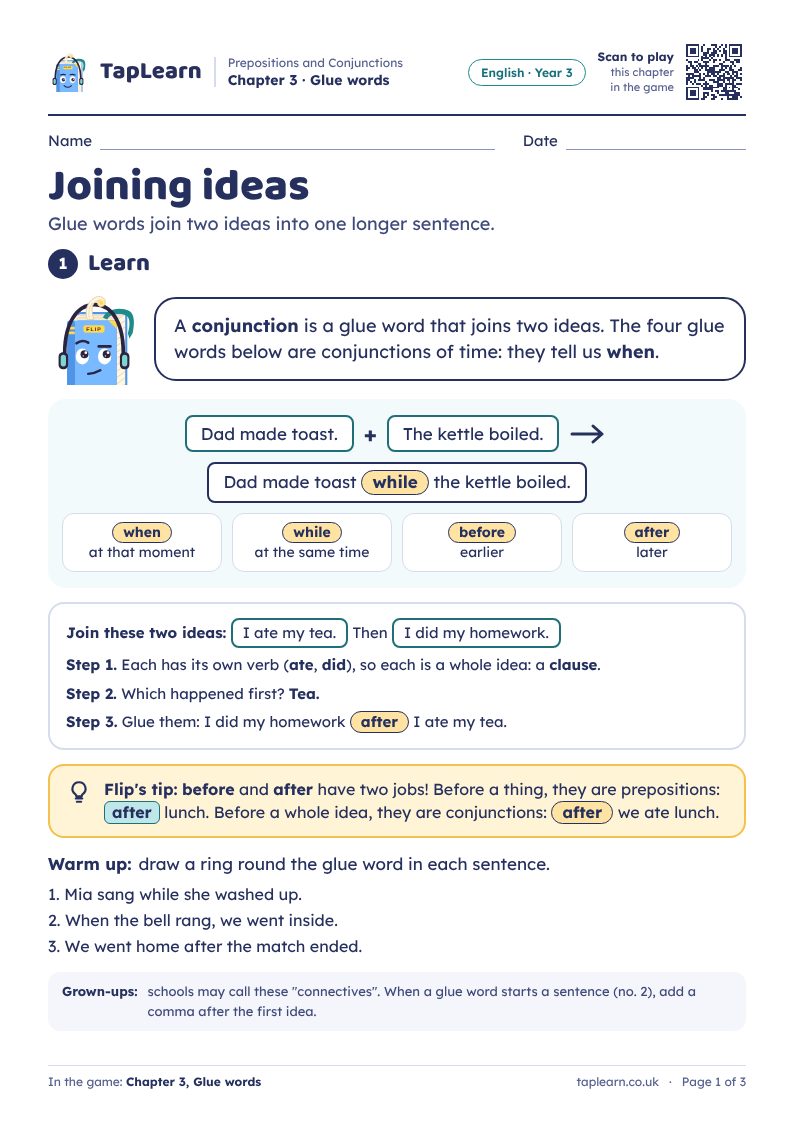
Joining Ideas is a printable time conjunctions worksheet for Year 3 (ages 7 to 8) that teaches children to glue two clauses together with when, while, before or after, and to tell a preposition from a conjunction. It covers the Years 3 to 4 statement on extending sentences with more than one clause using a wider range of conjunctions, including when.
This worksheet is for members
Membership opens every chapter of every game and every worksheet, for all your children.
See the plansAlready a member? Log in to print it.
Start with the free one: Before, during, after (chapter 1).
▶ Play chapter 3 in the game · How the conjunctions works
Print it on A4, in colour or black and white. Do it after the chapter, or before it to see what your child already knows.
What's on the worksheet
Your child joins two ideas into one sentence with the time conjunctions when, while, before and after, and spots when before and after are prepositions or conjunctions. Includes a sentence-glue activity and an answers sheet.
- Page 1 · Learn
- Two ideas glued with while, the four time conjunctions and what they mean, a worked example joining tea and homework, Flip's tip on before and after having two jobs, and a warm-up.
- Page 2 · Try it together
- Sentence glue: write 6 ideas and 4 glue words on scraps of paper, pick two ideas and one glue word, read the sentence aloud, then swap the glue word to see how the meaning changes.
- Page 3 · Practise
- Match starts to ends, join two ideas with a glue word, fill gaps using clues, tick preposition or conjunction, and a challenge about pyjamas and bed.
- Answers sheet
- Every answer, mix-ups like when or while, and story-chain and kitchen-talk ideas.
3 A4 pages and an answers sheet · about 25 minutes
Using it at home
- Schools may call these words connectives. When a glue word starts a sentence, add a comma after the first idea.
- In sentence glue, try "I brushed my teeth before we went to bed", then swap in after and ask "What happened first now?"
- Talk while you cook: "We stir the soup while it heats up."
Watch out for
- Mixing up before and after.
- Ask "Which happened first?" The idea after before happens later; the idea after after happens earlier.
- Mixing up when and while.
- While is for two things going on at the same time. When is for the moment something happens.
- Calling before or after a conjunction when only a thing follows.
- A conjunction needs a whole idea with a verb ("after we ate lunch"). Before just a thing ("after lunch"), it's a preposition.
Questions from the worksheet
- Join the two ideas with a glue word. Write one sentence: The film started. We sat down quietly.
- Join the two ideas: Sam was swimming. It began to rain.
- Clue: Leo whistled. At the same time, he painted the fence. Fill the gap: Leo whistled ___ he painted the fence.
- Is the word after a thing or a whole idea? We went to the park after lunch. We went to the park after we ate lunch.
- Leo wrote, "I got into bed before I put my pyjamas on." What is the mix-up? Write it the right way. Can you do it two ways?
The answers are on the answers sheet, for grown-ups.
National curriculum in England
This worksheet practises these statements from the Years 3–4 english programme of study:
- Develop their understanding of the concepts set out in English appendix 2 by: extending the range of sentences with more than one clause by using a wider range of conjunctions, including when, if, because, although
- Develop their understanding of the concepts set out in English appendix 2 by: using conjunctions, adverbs and prepositions to express time and cause
- Develop their understanding of the concepts set out in English appendix 2 by: learning the grammar for years 3 and 4 in English appendix 2
- Sentence: expressing time, place and cause using conjunctions, adverbs, or prepositions (Year 3 english)
- Terminology: preposition, conjunction, word family, prefix, clause, subordinate clause, direct speech, consonant, consonant letter, vowel, vowel letter, inverted commas (or 'speech marks') (Year 3 english)
In the classroom
- Play story chain round the class, each pupil adding an idea with a glue word.
- Use Practise D as a sorting task on the board: preposition or conjunction?
Questions and answers
What is a time conjunction?
A time conjunction is a joining word that links two ideas and says when, such as when, while, before and after.
Is before a preposition or a conjunction?
It can be both. Before a thing it is a preposition (before lunch). Before a whole idea with a verb it is a conjunction (before we ate lunch).
What is the difference between when and while?
While is for two things happening at the same time. When is for the moment something happens.
 TapLearn