Rhyming words worksheet for Reception: Rhyme time
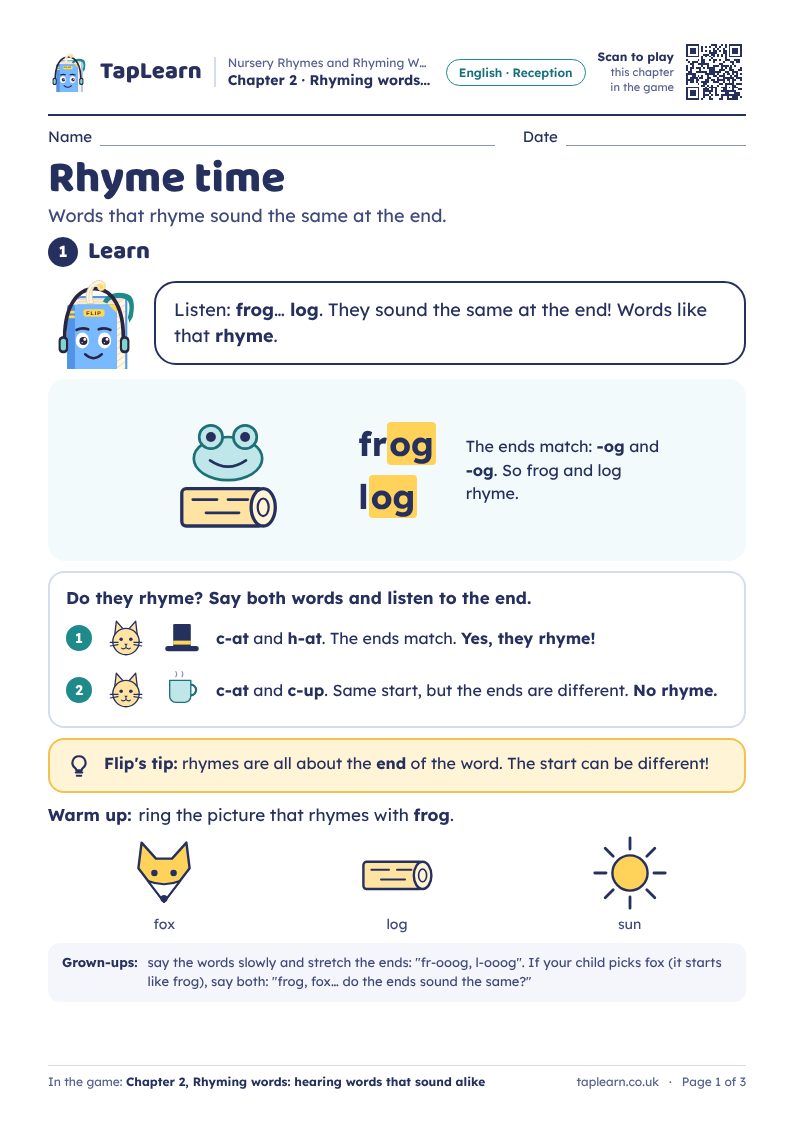
Rhyme Time is a printable rhyming words worksheet for Reception (ages 4 to 5) that teaches children that words rhyme when they sound the same at the end, like frog and log, not at the start, like cat and cup. It covers the Reception (EYFS) statement on listening carefully to rhymes and songs, paying attention to how they sound.
This worksheet is for members
Membership opens every chapter of every game and every worksheet, for all your children.
See the plansAlready a member? Log in to print it.
Start with the free one: Listening ears (chapter 1).
Print it on A4, in colour or black and white. Do it after the chapter, or before it to see what your child already knows.
What's on the worksheet
Your child hears when two words rhyme by listening to the end, like frog and log, and learns that cat and cup start the same but don't rhyme. Includes a rhyming sock puppet and an answers sheet.
- Page 1 · Learn
- Frog and log explained as matching ends, two worked examples (cat and hat rhyme, cat and cup don't), Flip's listen-to-the-end tip, and a ring-what-rhymes-with-frog warm-up.
- Page 2 · Try it together
- The rhyming sock: put a sock on your hand as a puppet, take turns saying words that rhyme with sock, then with cat, and write or draw them in the table. Made-up words count!
- Page 3 · Practise
- Join pictures that rhyme, ring the odd one out, tick or cross pairs that rhyme, draw something that rhymes with cake, and a challenge about cat and cup.
- Answers sheet
- Every answer, mix-ups like picking words that start the same, and rhyme-or-not ideas.
3 A4 pages and an answers sheet · about 15 minutes
Using it at home
- Say the two words slowly and stretch the ends: "fr-ooog, l-ooog".
- Made-up rhyming words like "zock" are fine: they show your child is hearing the end sound.
- Little and often works: lots of rhymes and songs every day help more than lots of worksheets.
Watch out for
- Choosing words that start the same, like cat and cup or sock and sun.
- Say both words slowly, stretch the ends, and ask "Do the ends match?"
- Choosing a word that means the same, like sock and shoe.
- Remind them we're listening to sounds, not meanings.
Questions from the worksheet
- Draw a line to join each picture to the one it rhymes with: cat, star, bee, mouse and tree, hat, house, car.
- Odd one out! Ring the one that does not rhyme: cat, hat, cup. Then: sock, sun, clock.
- Do they rhyme? Tick for yes, cross for no: star and car, frog and log, fish and frog, bee and ball.
- Mia says, "cat and cup rhyme, because they both start with c." Is she right? How do you know?
The answers are on the answers sheet, for grown-ups.
National curriculum in England
This worksheet practises this statement from the Reception english programme of study:
- Listen carefully to rhymes and songs, paying attention to how they sound
In the classroom
- Play rhyme or not: say two words, thumbs up if they rhyme, thumbs down if not.
- Use a sock puppet at carpet time to collect rhymes for sock and cat.
Questions and answers
What are rhyming words?
Rhyming words sound the same at the end, like frog and log or cat and hat. The start can be different.
Why does my child think cat and cup rhyme?
Words that start the same are the most common mix-up. Say both slowly, stretch the ends, and ask whether the ends match.
Do made-up words count as rhymes?
Yes. Silly words like zock for sock show your child is hearing the end sound, which is the skill that matters.
 TapLearn