Learning rhymes by heart worksheet for Reception: Sing it by heart
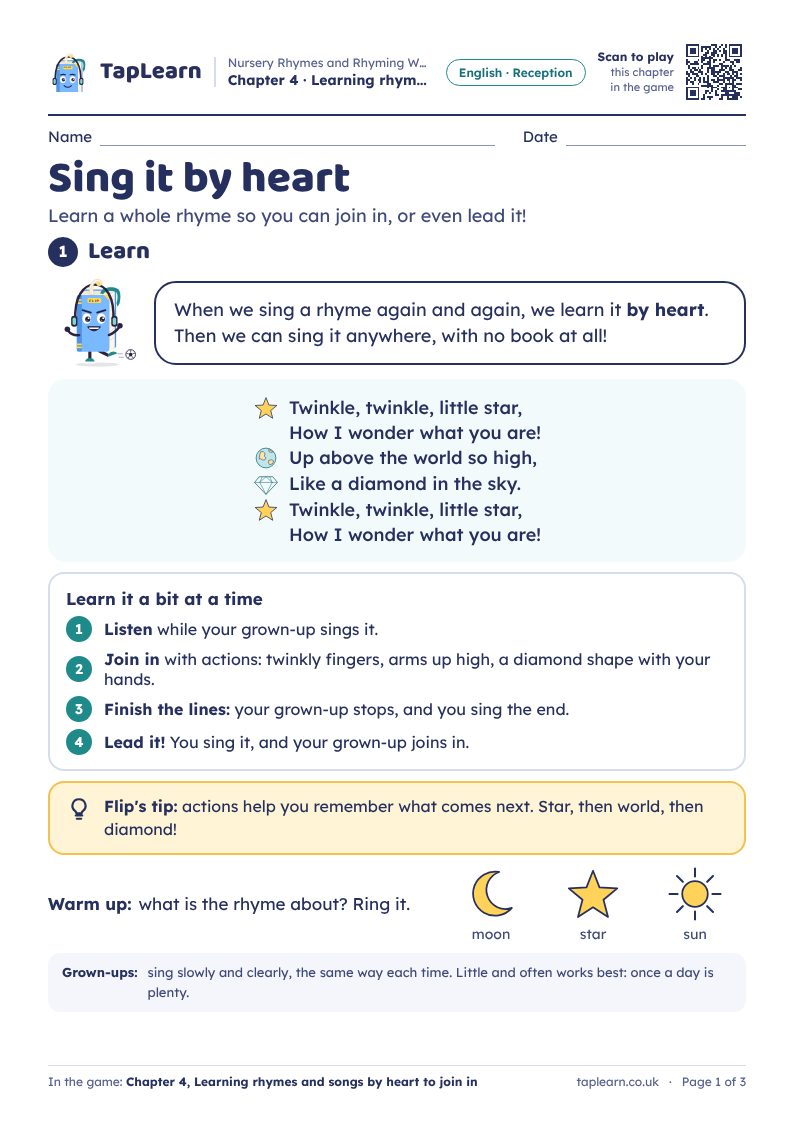
Sing It by Heart is a printable learning rhymes by heart worksheet for Reception (ages 4 to 5) that teaches children to learn Twinkle, Twinkle a bit at a time, with actions, until they can join in or lead it. It covers the Reception (EYFS) statements on learning rhymes, poems and songs, and on developing a love of reading.
This worksheet is for members
Membership opens every chapter of every game and every worksheet, for all your children.
See the plansAlready a member? Log in to print it.
Start with the free one: Listening ears (chapter 1).
Print it on A4, in colour or black and white. Do it after the chapter, or before it to see what your child already knows.
What's on the worksheet
Your child learns Twinkle, Twinkle and Humpty Dumpty by heart a bit at a time, using actions, and puts the lines in order. Includes a star singer chart for the week and an answers sheet.
- Page 1 · Learn
- Twinkle, Twinkle with four steps to learn it (listen, add actions, finish the lines, lead it), Flip's actions-help-you-remember tip, and a what-is-it-about warm-up.
- Page 2 · Try it together
- Star singer week: line up cuddly toys as an audience, sing Twinkle, Twinkle or Humpty Dumpty with actions, and colour a star on the chart for each rhyme sung, and for leading it.
- Page 3 · Practise
- Number the Humpty Dumpty events in order, number the Twinkle, Twinkle lines in order, draw your favourite rhyme and sing it to someone, and a challenge about Humpty.
- Answers sheet
- Every answer, mix-ups like lines in the wrong order, and car-and-bath song ideas.
3 A4 pages and an answers sheet · about 15 minutes
Using it at home
- Sing slowly and clearly, the same way each time. Once a day is plenty.
- If your child forgets a line, sing it together and carry on: no need to stop and correct.
- Sing the rhyme in everyday moments: on a walk, in the bath, at bedtime.
Watch out for
- Mixing up the order of the lines.
- Act it out: sit on a cushion "wall", then tumble off. The story shows what comes next.
- Getting stuck on a line.
- Sing the first word of the line as a clue, then let your child carry on.
Questions from the worksheet
- Sing Humpty Dumpty. What happened first? Write 1, 2, 3: had a great fall, couldn't be put together, sat on a wall.
- Sing Twinkle, Twinkle. Which line comes first? Write 1, 2, 3: Like a diamond in the sky. Twinkle, twinkle, little star. Up above the world so high.
- Leo sings: "Humpty Dumpty had a great fall, Humpty Dumpty sat on a wall." Is that the right order? How can you tell?
The answers are on the answers sheet, for grown-ups.
National curriculum in England
This worksheet practises these statements from the Reception english programme of study:
- It is crucial for children to develop a life-long love of reading. Reading consists of two dimensions: language comprehension and word reading. Language comprehension (necessary for both reading and writing) starts from birth. It only develops when adults talk with children about the world around them and the books (stories and non-fiction) they read with them, and enjoy rhymes, poems and songs together
- Learn rhymes, poems and songs
In the classroom
- Sing Twinkle, Twinkle with actions each day this week, then let a child lead it.
- Act out Humpty Dumpty to help children put the lines in order.
Questions and answers
How can I help my child learn a rhyme by heart?
Sing it a little and often, add actions, then stop before the end of a line for your child to finish. Soon they can lead it.
What if my child sings the words wrongly?
That's normal at this age. Sing it back the right way, without correcting.
Which rhyme should we learn next?
Once one rhyme is learned, add another, such as Hickory, Dickory, Dock or Jack and Jill.
 TapLearn