Listening to rhymes worksheet for Reception: Listening ears
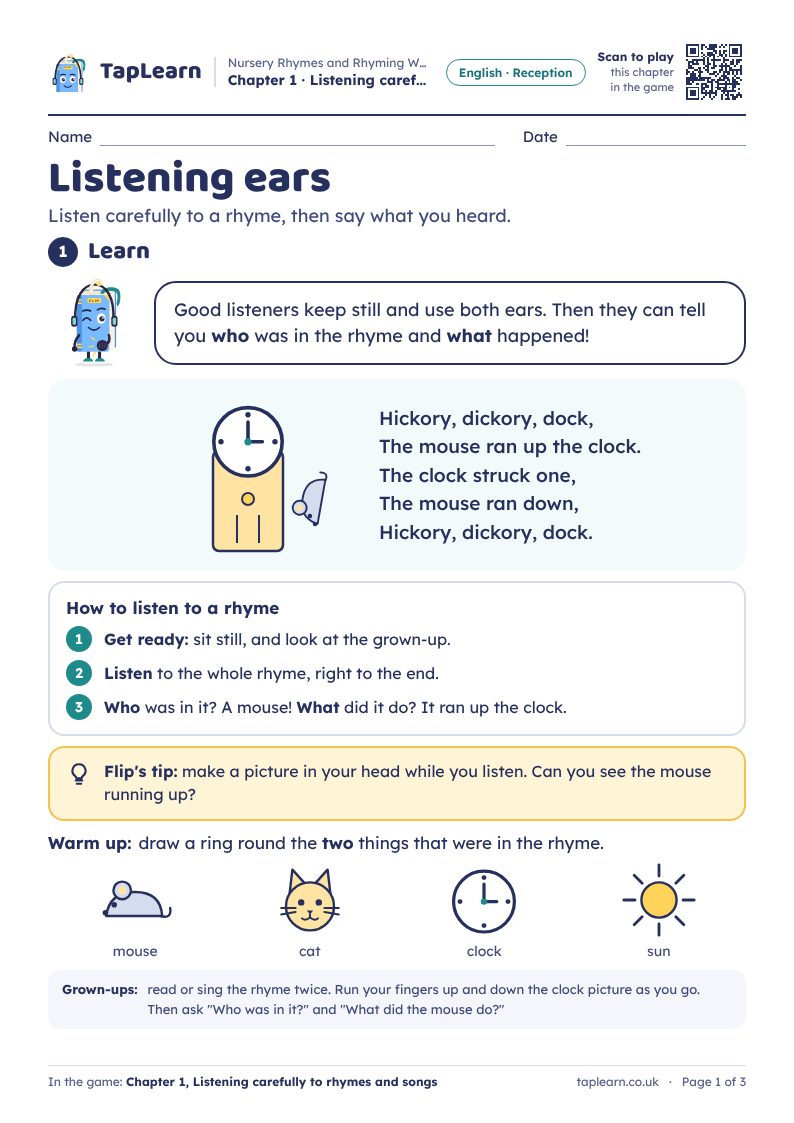
Listening Ears is a printable listening to rhymes worksheet for Reception (ages 4 to 5) that teaches children to sit still, listen to a whole rhyme like Hickory, Dickory, Dock, then say who was in it and what happened. It covers the Reception (EYFS) statement on listening carefully to rhymes and songs, paying attention to how they sound.
Free to print, no account needed.
Print it on A4, in colour or black and white. Do it after the chapter, or before it to see what your child already knows.
What's on the worksheet
Your child listens to a whole nursery rhyme, then says who was in it and what happened, and hears loud and quiet sounds. Includes a listening walk and an answers sheet.
- Page 1 · Learn
- How to listen to a rhyme, shown with Hickory, Dickory, Dock in three steps, Flip's make-a-picture-in-your-head tip, and a ring-who-was-in-it warm-up.
- Page 2 · Try it together
- A listening walk: stand still outside or by an open window, talk about each sound you hear, tick whether it is loud or quiet, and draw something else you heard.
- Page 3 · Practise
- Ring who was in Baa, Baa, Black Sheep, colour the loud things, ring the fast things, draw who was in Incy Wincy Spider, and a challenge about the mouse.
- Answers sheet
- Every answer, mix-ups like guessing from the pictures, and mouse-voice, giant-voice ideas.
3 A4 pages and an answers sheet · about 15 minutes
Using it at home
- Say or sing the rhyme twice, then ask one "who" question and one "what" question.
- Keep it short: one rhyme said twice is better than lots of rhymes said once.
- On the listening walk, add a describing word to each sound, like "a loud, rumbly lorry".
Watch out for
- Guessing from the pictures instead of listening.
- Cover the pictures, say the rhyme, then uncover them.
- Finding loud and quiet hard to name.
- Say the rhyme in a tiny mouse voice, then a big giant voice.
Questions from the worksheet
- Listen to your grown-up say Baa, Baa, Black Sheep. Ring who was in it: frog, sheep, cat or fish. How many bags full?
- Loud or quiet? Colour the loud things: drum, feather, thunder, mouse.
- Fast or slow? Ring the fast things: snail, car, tortoise, plane.
- Leo says, "In Hickory, Dickory, Dock, the mouse ran up a tree." Is he right? What did the mouse run up?
The answers are on the answers sheet, for grown-ups.
National curriculum in England
This worksheet practises these statements from the Reception english programme of study:
- Listen carefully to rhymes and songs, paying attention to how they sound
- It is crucial for children to develop a life-long love of reading. Reading consists of two dimensions: language comprehension and word reading. Language comprehension (necessary for both reading and writing) starts from birth. It only develops when adults talk with children about the world around them and the books (stories and non-fiction) they read with them, and enjoy rhymes, poems and songs together
In the classroom
- Say a rhyme twice at carpet time, then ask who was in it.
- Try the listening walk round the school grounds.
Questions and answers
How can I help my child listen to a rhyme?
Sit still together, say or sing the rhyme twice, and ask who was in it and what happened. Making a picture in your head helps too.
What if my child guesses from the pictures?
Cover the pictures, say the rhyme, then uncover them so your child has to listen first.
Why are nursery rhymes good for Reception children?
Nursery rhymes help children listen closely to sounds, hear rhyme and learn new words, which all help with early reading.
 TapLearn