Multiplication and division signs worksheet for Year 2: Using × and ÷
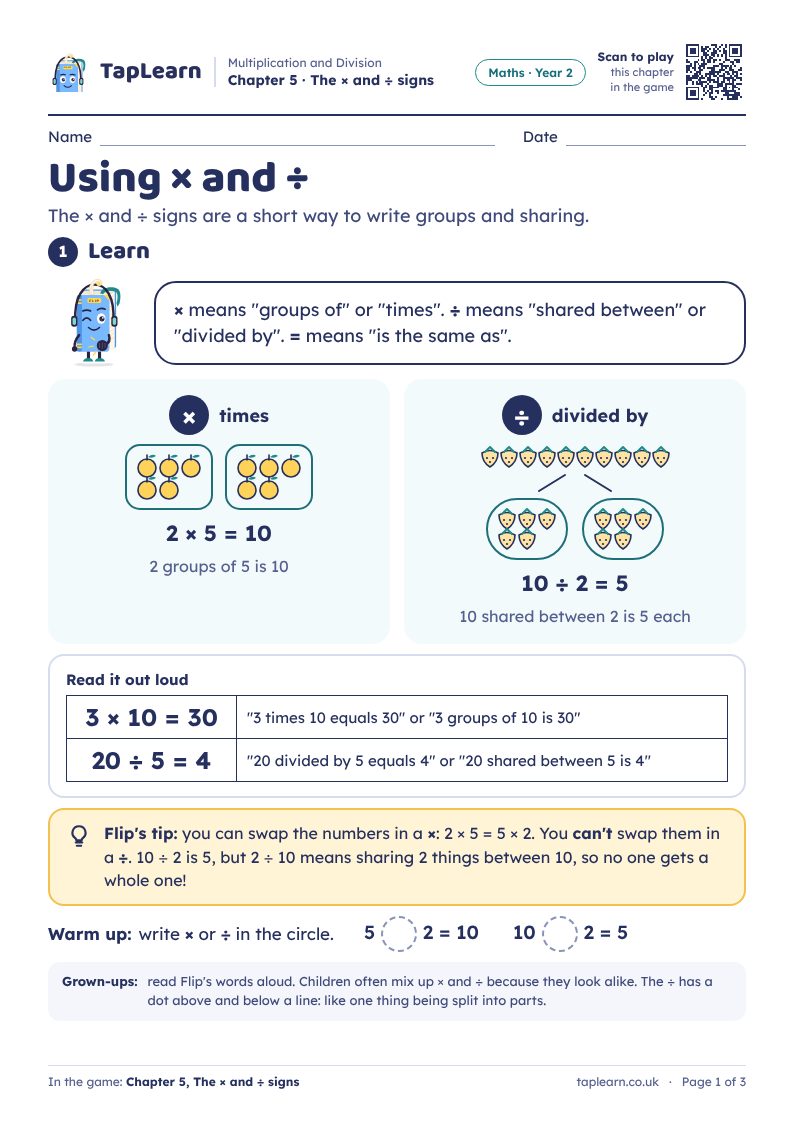
Using × and ÷ is a printable worksheet for Year 2 (ages 6 to 7) on multiplication and division signs, teaching children to read, write and complete number sentences with ×, ÷ and =. It links to the Year 2 maths national curriculum statement: calculate multiplication and division statements within the multiplication tables and write them using the ×, ÷ and = signs.
Free to print, no account needed.
Print it on A4, in colour or black and white. Do it after the chapter, or before it to see what your child already knows.
What's on the worksheet
Read and write number sentences with the ×, ÷ and = signs, and see why 10 ÷ 2 is not the same as 2 ÷ 10. With sign cards to make and match at home, and answers.
- Page 1 · Learn
- What ×, ÷ and = mean, how to read 3 × 10 = 30 and 20 ÷ 5 = 4 aloud, and why you can swap numbers in a × but not a ÷. Warm-up: write × or ÷.
- Page 2 · Try it together
- Sign cards: make ×, ÷ and = cards, then build a number sentence to match groups or shares the grown-up makes, and swap jobs.
- Page 3 · Practise
- Write number sentences for groups and shares, choose × or ÷, fill missing numbers like ? × 2 = 16, solve bunny and seed stories, and Leo's swapping challenge.
- Answers sheet
- All answers, three mix-ups to watch for, and sign-spotting and fact family ideas.
3 A4 pages and an answers sheet · about 20 minutes
Using it at home
- When it's your turn to make the cards, put the wrong sign in once and see if your child spots it.
- Ask "Is that groups of, or shared between?" whenever your child is unsure which sign to use.
Watch out for
- Mixing up the × and ÷ signs.
- Ask "Are we making groups, or sharing out?" The ÷ sign has two dots and a line; the × sign is a cross.
- Swapping the numbers in a division.
- The whole amount always comes first: 10 shared between 2 is 10 ÷ 2.
- Getting stuck on missing numbers like ? × 2 = 16.
- Count in 2s to 16 and count the steps: 8.
Questions from the worksheet
- Write the number sentence for 10 shared between 2. Put × or ÷ in the circle.
- 4 bunnies each have 2 carrots. How many carrots altogether?
- 15 seeds are shared between 5 pots. How many in each pot?
- Leo says, "10 ÷ 2 is the same as 2 ÷ 10, because you can swap the numbers round." Is he right? Why?
The answers are on the answers sheet, for grown-ups.
National curriculum in England
This worksheet practises these statements from the Year 2 maths programme of study:
- Calculate mathematical statements for multiplication and division within the multiplication tables and write them using the multiplication (×), division (÷) and equals (=) signs
- Show that multiplication of 2 numbers can be done in any order (commutative) and division of 1 number by another cannot
- Solve problems involving multiplication and division, using materials, arrays, repeated addition, mental methods, and multiplication and division facts, including problems in contexts
Source: National curriculum in England: mathematics programmes of study (DfE)
In the classroom
- Sign spotting starter: read out a story like "3 plates with 5 grapes each" and pupils hold up × or ÷.
- Fact families: from 2 × 5 = 10, pairs write the other three facts on mini-whiteboards.
Questions and answers
What does the ÷ sign mean in Year 2?
The ÷ sign means "divided by" or "shared between". 10 ÷ 2 = 5 means 10 shared between 2 is 5 each.
Why can you swap numbers in multiplication but not division?
2 × 5 and 5 × 2 both make 10, so multiplication works in any order. 10 ÷ 2 is 5, but 2 ÷ 10 means sharing 2 things between 10, which is very different.
 TapLearn