Arrays worksheet for Year 2: Rows and columns
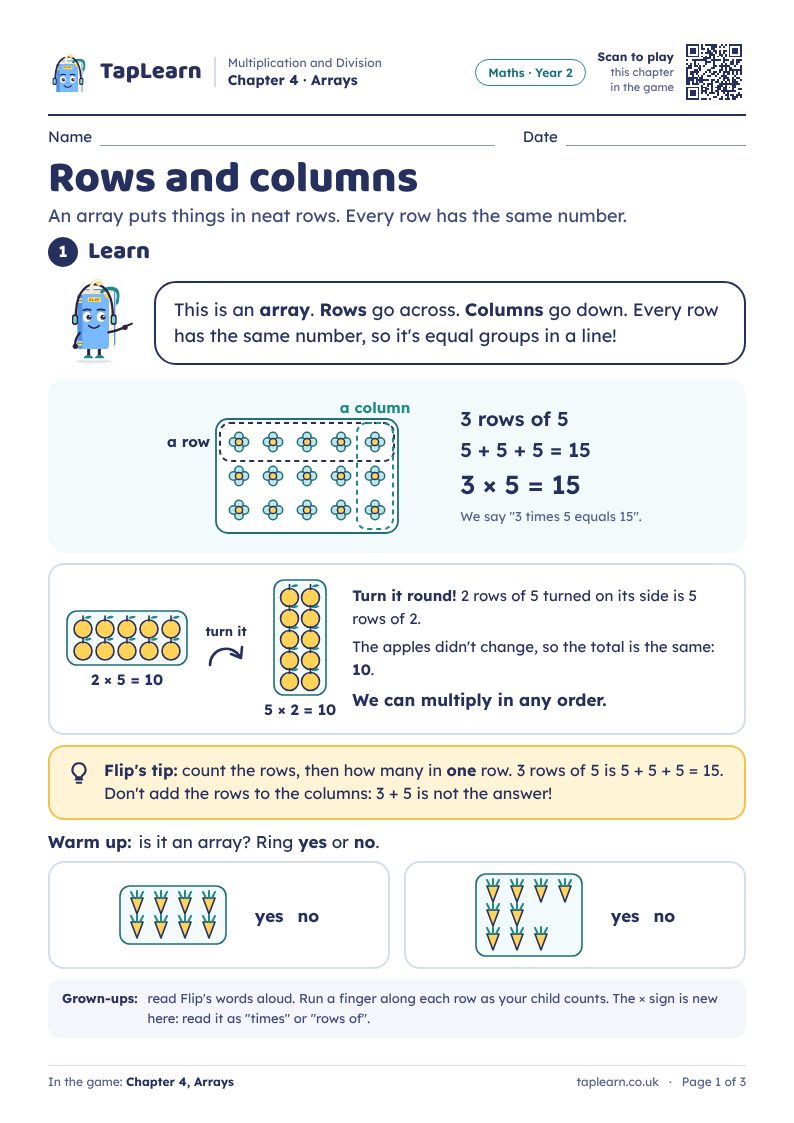
Rows and Columns is a printable arrays worksheet for Year 2 (ages 6 to 7) that teaches children to work out multiplications from rows and columns and see that 2 × 5 and 5 × 2 give the same total. It links to the Year 2 maths national curriculum statements: show that multiplication of 2 numbers can be done in any order, and solve problems using arrays and repeated addition.
Free to print, no account needed.
Print it on A4, in colour or black and white. Do it after the chapter, or before it to see what your child already knows.
What's on the worksheet
Use arrays (rows and columns) to work out multiplications, and turn them round to see that 2 × 5 and 5 × 2 make the same total. With an array hunt at home, and answers.
- Page 1 · Learn
- What rows and columns are, 3 rows of 5 written as 5 + 5 + 5 and 3 × 5, and turning an array to show 2 × 5 = 5 × 2. Warm-up: is it an array?
- Page 2 · Try it together
- Array hunt: lay out 2 rows of 5 and 4 rows of 5, turn the paper a quarter turn to check the total stays the same, then find an array at home like an egg box.
- Page 3 · Practise
- Write rows of and multiplication for arrays, draw 4 rows of 5, write two multiplications for an array, fill gaps like 5 × 2 = 2 × ?, and Ava's "4 + 5 = 9" challenge.
- Answers sheet
- All answers, three mix-ups to watch for, and array-spotting and turn-and-say ideas.
3 A4 pages and an answers sheet · about 20 minutes
Using it at home
- Run a finger along each row as your child counts, and read × as "times" or "rows of".
- When you turn the array, ask "Did we add or take any away?" so your child sees why the total stays the same.
Watch out for
- Adding instead of multiplying, like 4 rows of 5 as 9.
- Point to each row and add one 5 for each: 5 + 5 + 5 + 5.
- Drawing rows that aren't equal.
- Use squared paper, or line up dots under each other.
- Thinking the answer changes when the array turns.
- Turn a real array and count again: same things, same total.
Questions from the worksheet
- Draw the array: 4 rows of 5. Write the total.
- Write two multiplications for an array of 5 rows of 2.
- Fill the gaps: 10 × 4 = ? × 10
- Ava looks at an array with 4 rows of 5. She says, "That's 9, because 4 + 5 = 9." Is she right? How many are there really?
The answers are on the answers sheet, for grown-ups.
National curriculum in England
This worksheet practises these statements from the Year 2 maths programme of study:
- Calculate mathematical statements for multiplication and division within the multiplication tables and write them using the multiplication (×), division (÷) and equals (=) signs
- Show that multiplication of 2 numbers can be done in any order (commutative) and division of 1 number by another cannot
- Solve problems involving multiplication and division, using materials, arrays, repeated addition, mental methods, and multiplication and division facts, including problems in contexts
Source: National curriculum in England: mathematics programmes of study (DfE)
In the classroom
- Pairs build arrays with counters on mini-whiteboards, write both multiplications, then swap.
- Photograph arrays around the school (windows, bricks, tiles) and write a multiplication for each.
Questions and answers
What is an array in Year 2 maths?
An array is a set of things arranged in equal rows and columns. 3 rows of 5 shows 5 + 5 + 5 = 15, written as 3 × 5 = 15.
Why is 2 × 5 the same as 5 × 2?
Turning an array of 2 rows of 5 on its side makes 5 rows of 2, with nothing added or taken away. The total stays 10, so multiplication can be done in any order.
 TapLearn