Division by grouping worksheet for Year 2: Making equal groups
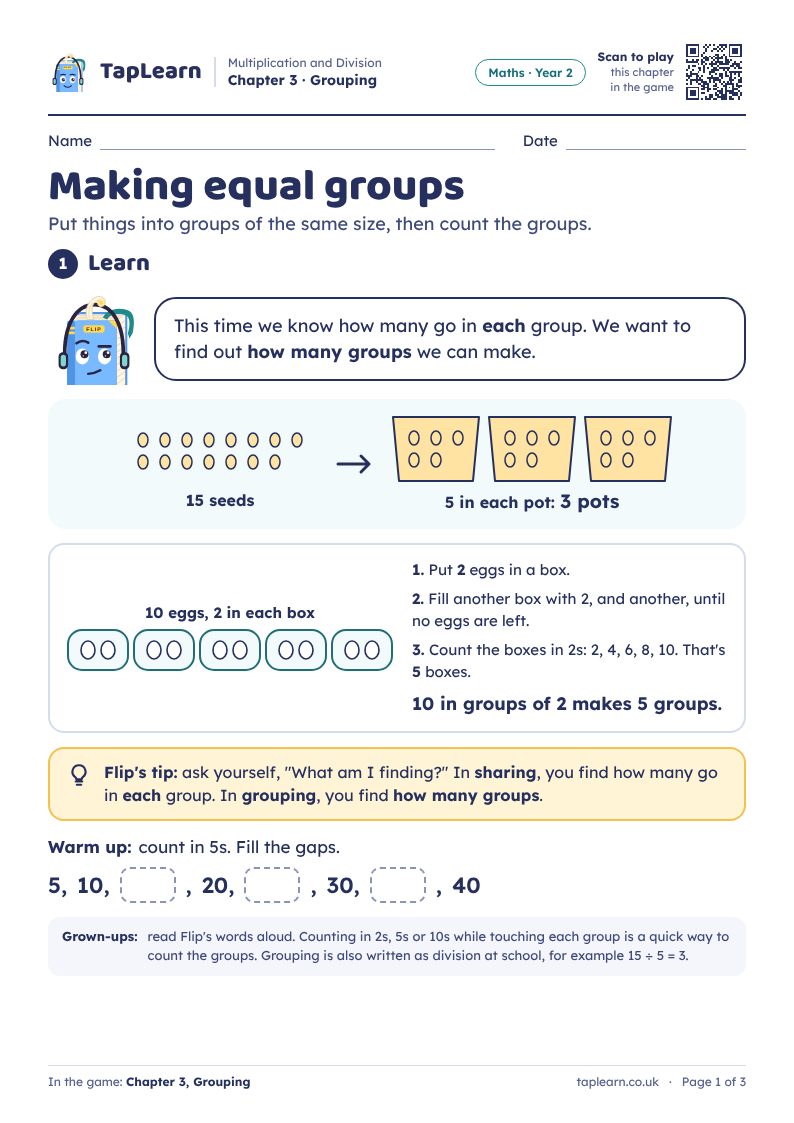
Making Equal Groups is a printable division by grouping worksheet for Year 2 (ages 6 to 7) that teaches children to put things into groups of 2, 5 or 10 and count how many groups they make. It links to the Year 2 maths national curriculum statement: solve problems involving multiplication and division, using materials, arrays, repeated addition, mental methods and multiplication and division facts.
Free to print, no account needed.
Print it on A4, in colour or black and white. Do it after the chapter, or before it to see what your child already knows.
What's on the worksheet
Put things into groups of 2, 5 or 10 and count how many groups there are, with pictures, number lines and stories. With a pack-it-up activity using cups or bags, and answers.
- Page 1 · Learn
- Grouping 10 eggs into boxes of 2 step by step, and Flip's tip on telling grouping from sharing. Warm-up: count in 5s to 40.
- Page 2 · Try it together
- Pack it up: pack 20 things into cups in groups of 2, then 5, then 10, count the groups each time, and talk about which made the most.
- Page 3 · Practise
- Ring groups of 2, 5 and 10, draw jumps on number lines to 12 and 20, solve sock, seed and flower stories, and Sam's "5 bags" challenge.
- Answers sheet
- All answers, three mix-ups to watch for, and sock-pair and hopping ideas.
3 A4 pages and an answers sheet · about 20 minutes
Using it at home
- If you run out of cups, put each group in its own pile, and touch each group as you count in 2s, 5s or 10s.
- Talk about why 20 makes 10 groups of 2 but only 2 groups of 10: smaller groups make more groups.
Watch out for
- Mixing up the number of groups and how many are in each.
- In grouping, the group size is given; the answer is how many groups. Ask "How many bags did you fill?"
- Uneven rings round the pictures.
- Check each ring has the right number before counting the rings.
- Counting the numbers on a number line instead of the jumps.
- Count the arcs, not the marks.
Questions from the worksheet
- Jump in 5s from 0 to 20 on the number line. How many jumps?
- There are 14 socks. 2 socks make a pair. How many pairs?
- 30 seeds go into packets of 10. How many packets?
- Sam puts 10 carrots into bags, with 5 in each bag. He says, "That makes 5 bags." Is he right? How many bags are there really?
The answers are on the answers sheet, for grown-ups.
National curriculum in England
This worksheet practises these statements from the Year 2 maths programme of study:
- Calculate mathematical statements for multiplication and division within the multiplication tables and write them using the multiplication (×), division (÷) and equals (=) signs
- Show that multiplication of 2 numbers can be done in any order (commutative) and division of 1 number by another cannot
- Solve problems involving multiplication and division, using materials, arrays, repeated addition, mental methods, and multiplication and division facts, including problems in contexts
Source: National curriculum in England: mathematics programmes of study (DfE)
In the classroom
- Pupils stand in a line and get into groups of 2, 5 or 10 as called, then count the groups.
- Model the number line jumps on a large floor number line with a volunteer hopping.
Questions and answers
What is grouping in Year 2 division?
Grouping means putting things into groups of the same size and counting how many groups you make. 10 in groups of 2 makes 5 groups, written at school as 10 ÷ 2 = 5.
What is the difference between sharing and grouping?
In sharing you know how many groups and find how many go in each. In grouping you know how many go in each group and find how many groups.
 TapLearn