Expanded noun phrases worksheet for Year 2: Sentences that paint
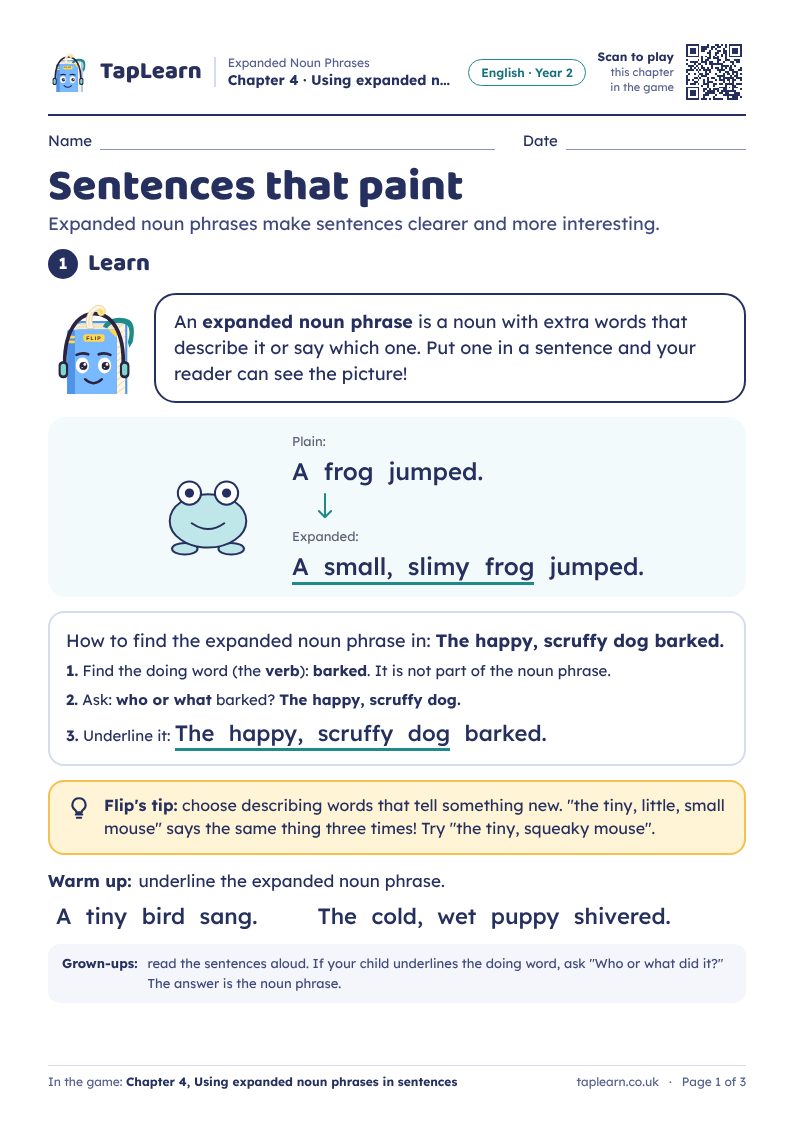
Sentences That Paint is a printable expanded noun phrases worksheet for Year 2 (ages 6 to 7) that teaches children to find the expanded noun phrase by asking who or what did it, and to choose describing words that say something new. It covers the Year 2 English grammar statement on learning how to use expanded noun phrases to describe and specify.
This worksheet is for members
Membership opens every chapter of every game and every worksheet, for all your children.
See the plansAlready a member? Log in to print it.
Start with the free one: Find the noun (chapter 1).
Print it on A4, in colour or black and white. Do it after the chapter, or before it to see what your child already knows.
What's on the worksheet
Your child spots expanded noun phrases in sentences and uses them to make writing clearer and more interesting. Includes a window pictures activity and an answers sheet.
- Page 1 · Learn
- A plain and an expanded frog sentence, a worked example finding the noun phrase in "The happy, scruffy dog barked", Flip's tip on not repeating meanings, and an underlining warm-up.
- Page 2 · Try it together
- Window pictures: look out of a window, choose 3 things, say a plain sentence, then answer "What is it like? Which one?" and say it again with an expanded noun phrase.
- Page 3 · Practise
- Underline expanded noun phrases in sentences, add words to paint a picture, tick the better of two phrases, write a sentence about a picture, and a challenge about the verb.
- Answers sheet
- Every answer, mix-ups like piling up words that mean the same, and shopping-list makeover and story-starter ideas.
3 A4 pages and an answers sheet · about 20 minutes
Using it at home
- Read the sentences aloud. If your child underlines the doing word, ask "Who or what did it?"
- In window pictures, take turns: you say a plain sentence and your child makes it better, then swap.
- When writing a card or list together, swap a plain noun for an expanded one, like "some crunchy green apples".
Watch out for
- Picking the doing word, like ran or sang.
- Ask "Who or what did it?" The answer is the noun phrase.
- Piling up words that mean the same, like big, huge, giant.
- Ask "Does this word tell us anything new?"
- Leaving out the or a.
- The little pointing word belongs to the noun phrase too: the little boat.
Questions from the worksheet
- Underline the expanded noun phrase in each sentence: A muddy dog ran home. A bird with a yellow beak sang.
- Make it better. Add words to paint a picture: The ___ cat sat on the mat.
- Which is better? Tick it: a wet, damp, soggy sock or a wet, smelly sock.
- Ava read: The little bird sang a happy song. She says the noun phrase is sang. Is she right? Can you find two noun phrases?
The answers are on the answers sheet, for grown-ups.
National curriculum in England
This worksheet practises these statements from the Year 2 english programme of study:
- Develop their understanding of the concepts set out in English appendix 2 by: learning how to use expanded noun phrases to describe and specify
- Sentence: expanded noun phrases for description and specification
In the classroom
- Do window pictures as a class, improving plain sentences together on the board.
- Use Practise C to discuss which describing words add something new.
Questions and answers
What is an expanded noun phrase?
An expanded noun phrase is a noun with extra words that describe it or say which one, like "a small, slimy frog".
How do you find an expanded noun phrase in a sentence?
Find the doing word, then ask who or what did it. In "The happy, scruffy dog barked", the noun phrase is the happy, scruffy dog.
Why use expanded noun phrases in writing?
They make sentences clearer and help the reader picture what you mean.
 TapLearn