Noun phrases to specify worksheet for Year 2: Which one?
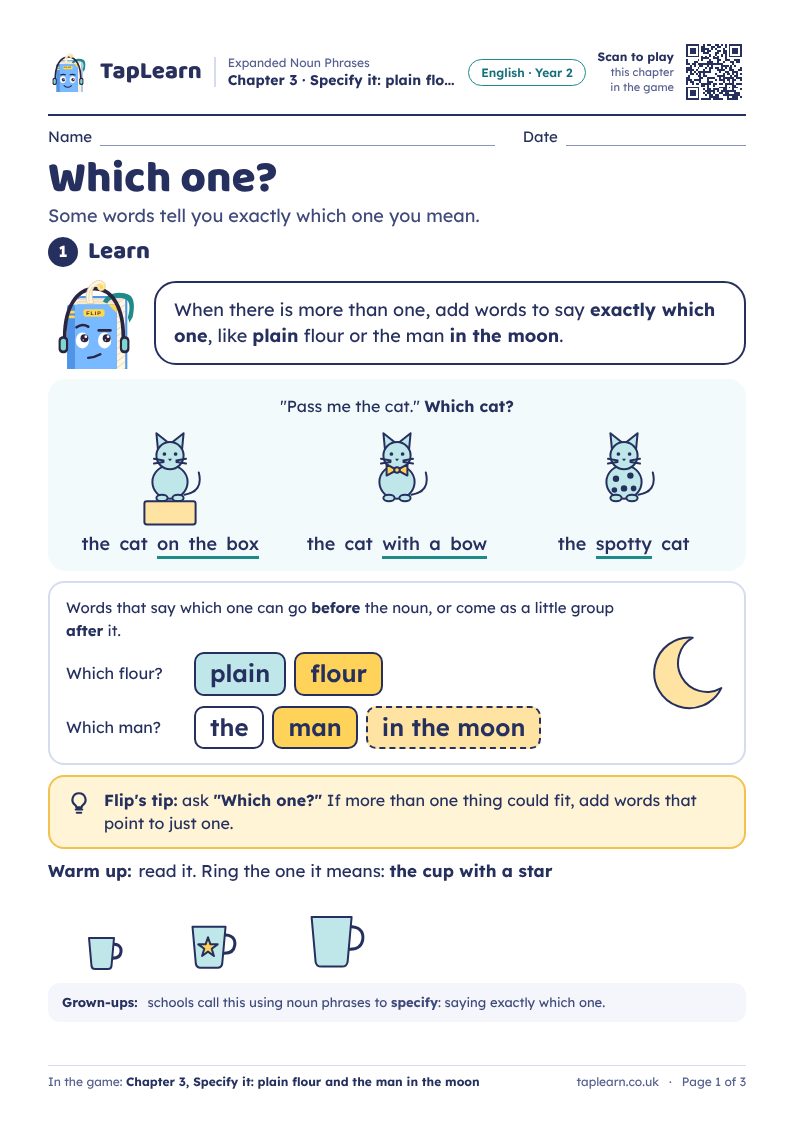
Which One? is a printable noun phrases to specify worksheet for Year 2 (ages 6 to 7) that teaches children to add words before or after a noun that point to just one, like the cat with a bow. It covers the Year 2 English grammar statement on learning how to use expanded noun phrases to describe and specify.
This worksheet is for members
Membership opens every chapter of every game and every worksheet, for all your children.
See the plansAlready a member? Log in to print it.
Start with the free one: Find the noun (chapter 1).
Print it on A4, in colour or black and white. Do it after the chapter, or before it to see what your child already knows.
What's on the worksheet
Your child uses words that say exactly which one, like plain flour or the man in the moon. Includes a pass-me-that-one game and an answers sheet.
- Page 1 · Learn
- Three cats and noun phrases that point to each one, plain flour and the man in the moon as examples, Flip's tip to ask "Which one?", and a ring-the-one-it-means warm-up.
- Page 2 · Try it together
- Pass me that one!: line up 3 similar spoons or socks, the grown-up asks for "the spoon", the child asks "Which one?", then the child says exactly which one for the grown-up to pick.
- Page 3 · Practise
- Ring the house, tree and fish a phrase describes, write noun phrases that say which one an arrow points to, choose a cake, and a challenge about "the sock".
- Answers sheet
- Every answer, mix-ups like words that fit more than one thing, and kitchen-words and guess-my-toy ideas.
3 A4 pages and an answers sheet · about 20 minutes
Using it at home
- Schools call this using noun phrases to specify: saying exactly which one.
- In pass me that one!, if the words could fit two things, pick the wrong one on purpose and ask "What could you add so I know which one?"
- In the kitchen, look for food words that say which kind, like plain flour, brown bread or apple juice.
Watch out for
- Using words that could mean more than one thing.
- Ask "Which one?" and pretend to pick the wrong one until the words point to just one.
- Picking the wrong one when told exactly which.
- Read the phrase slowly, pointing at each word, then check each picture.
- Not counting words after the noun as part of the phrase.
- Words like "in the moon" or "with a star" are part of the noun phrase too.
Questions from the worksheet
- Read it. Ring the one it means: the house with a chimney, the tree with a bird in it, the fish with spots.
- Which cake would you like? Write exactly which one: I would like the ___.
- Leo says, "Pass me the sock." Why is that hard to do? Write a noun phrase that tells you exactly which sock.
The answers are on the answers sheet, for grown-ups.
National curriculum in England
This worksheet practises these statements from the Year 2 english programme of study:
- Develop their understanding of the concepts set out in English appendix 2 by: learning how to use expanded noun phrases to describe and specify
- Sentence: expanded noun phrases for description and specification
In the classroom
- Play pass me that one! with sets of similar classroom objects in pairs.
- Line up 5 toys and have children describe one in a single noun phrase for the class to find.
Questions and answers
What does it mean to specify with a noun phrase?
It means adding words that say exactly which one you mean, like plain flour or the man in the moon.
Can noun phrase words come after the noun?
Yes. Words like "with a star" or "in the moon" can come after the noun and still be part of the noun phrase.
How do you know if a noun phrase is specific enough?
Ask "Which one?" If more than one thing could fit, add words that point to just one.
 TapLearn