Adjectives worksheet for Year 2: Describing words
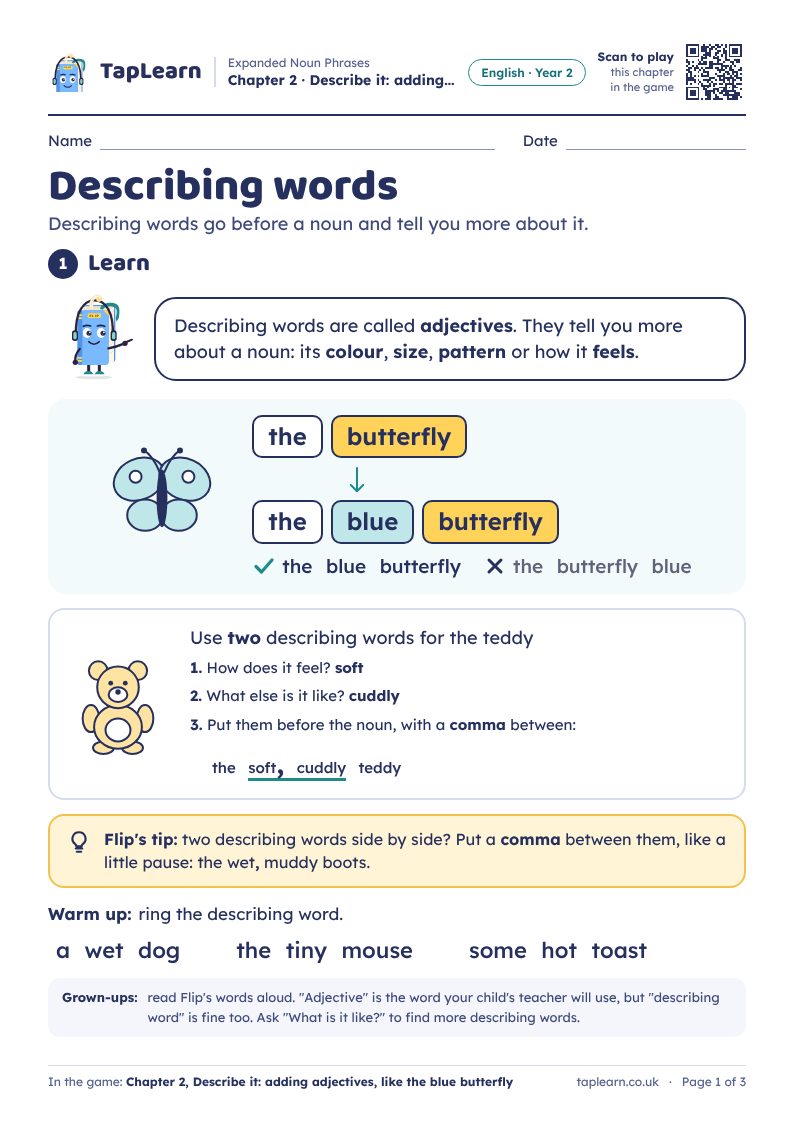
Describing Words is a printable adjectives worksheet for Year 2 (ages 6 to 7) that teaches children to put describing words before the noun and a comma between two of them, as in the soft, cuddly teddy. It covers the Year 2 English grammar statement on learning how to use expanded noun phrases to describe and specify.
This worksheet is for members
Membership opens every chapter of every game and every worksheet, for all your children.
See the plansAlready a member? Log in to print it.
Start with the free one: Find the noun (chapter 1).
Print it on A4, in colour or black and white. Do it after the chapter, or before it to see what your child already knows.
What's on the worksheet
Your child adds describing words (adjectives) before a noun, like the blue butterfly, and puts a comma between two of them. Includes a feely bag activity and an answers sheet.
- Page 1 · Learn
- The butterfly becoming the blue butterfly, why "the butterfly blue" is wrong, a worked example choosing two words for a teddy, Flip's tip on commas, and a ring-the-describing-word warm-up.
- Page 2 · Try it together
- Feely bag: feel a hidden object and say how it feels, pull it out and add a word for its size, colour or pattern, then say and write both words before the noun with a comma.
- Page 3 · Practise
- Ring the describing words, colour pictures to match noun phrases, write back-to-front phrases the right way round, add two describing words with a comma, and a challenge.
- Answers sheet
- Every answer, mix-ups like words that don't match the picture, and guess-my-thing and opposites ideas.
3 A4 pages and an answers sheet · about 20 minutes
Using it at home
- "Adjective" is the word your child's teacher will use, but "describing word" is fine too. Ask "What is it like?"
- In the feely bag, if your child says "the spoon shiny", say it both ways and ask which sounds right.
- Say "the big, noisy dog" and let your child swap each describing word for its opposite.
Watch out for
- Putting the describing word after the noun, like "the butterfly blue".
- Say both versions aloud and ask which sounds right.
- Choosing words that don't match the picture.
- Ask "Look again: is it really spiky?" Good describing words tell the truth.
- Putting the comma in the wrong place.
- With two describing words, the comma goes between them, not before the noun.
Questions from the worksheet
- Ring the describing words: the tiny mouse, a tall, thin tree, a fluffy cat, the wet, slimy frog.
- Oops! These are back to front. Write each one the right way round: the butterfly blue, a cat fluffy, the hat big.
- Add two describing words. Remember the comma! the ___, ___ kite.
- Mia looked at a small, smooth mouse and wrote "the huge, spiky mouse". Is that a good noun phrase for this mouse? What would you write?
The answers are on the answers sheet, for grown-ups.
National curriculum in England
This worksheet practises these statements from the Year 2 english programme of study:
- Develop their understanding of the concepts set out in English appendix 2 by: learning how to use expanded noun phrases to describe and specify
- Sentence: expanded noun phrases for description and specification
In the classroom
- Run the feely bag with a group, building a class list of feel words.
- Play guess my thing as a starter, describing a classroom object with two adjectives.
Questions and answers
What is an adjective?
An adjective is a describing word. It tells you more about a noun, like its colour, size, pattern or how it feels.
Where do adjectives go in a noun phrase?
Before the noun: the blue butterfly, not the butterfly blue.
When do you use a comma between adjectives?
When two describing words sit side by side, put a comma between them: the wet, muddy boots.
 TapLearn